
Albany, New York’s Broadway corridor near the Hudson River is a recognized high risk urban forestry zone where wind exposure, soil instability, and aging tree infrastructure significantly increase the likelihood of hazardous tree failure.
This guide explains how hazardous tree situations are identified, who is responsible, and how emergency tree removal is handled in real-world municipal and arborist systems across the Capital District.
1. 🌪️ Why the Albany Broadway Corridor Has Higher Hazardous Tree Risk
The Broadway waterfront sector stretching from the downtown business hub near the SUNY System Administration building, past the local shipping terminals, up toward the North Albany industrial zones experiences elevated structural tree stress due to unique environmental and urban factors:
– Strong Wind Channeling: Accelerated gales cutting directly along the open Hudson River basin.
– Saturated Substrata: Seasonal flooding and fluctuating water tables that weaken soil stability and root anchoring.
– Severe Freeze Thaw Cycles: Upstate winter weather patterns causing internal trunk fractures and deep frost heaving.
– Aging Urban Canopy: Mature, dense trees with limited structural reinforcement in a highly developed grid.
– Root Compression: Extreme soil compaction beneath concrete sidewalks, heavy commercial roads, and municipal utility lines.
– Severe Storm Exposure: Direct vulnerability to high-impact Northeast weather systems and coastal remnants.
👉 These combined conditions significantly increase the probability of sudden, catastrophic tree failure in our local commercial zones.
2. ⚠️ Early Warning Signs of Dangerous Trees in Albany Broadway
Property managers, business owners, and residents should treat the following structural warning signs as immediate indicators of potential failure:
– Sudden Leaning: New, noticeable angles developing after severe windstorms or heavy rain events.
– Deep Structural Fractures: Vertical cracks penetrating the main trunk or severe bark separation.
– Compromised Canopy: Large deadwood, decaying leaders, or hanging branches directly over public sidewalks or busy thoroughfares.
– Soil Uplift: Visible root plate shifting or ground heaving at the base of the tree.
– Hollow Structural Sounds: Flat or hollow resonance when the trunk is tapped, signaling advanced internal decay.
– Infrastructure Interference: Large limbs encroaching on high-voltage power lines, commercial roofing, or historic brick masonry.
👉 If multiple signs are present on your property, an immediate professional hazard evaluation is required to protect your structural assets.
3. 🏛️ Who Is Responsible for Hazardous Trees in Albany?
Liability and maintenance responsibility are strictly dictated by property boundaries and public right-of-way jurisdictions.
3.1 🌿 Public Trees (City Jurisdiction)
This encompasses trees rooted within:
Broadway sidewalks, public medians, and municipal street corridors.
Local public parks and municipal green spaces throughout downtown.
Designated municipal right-of-way zones within Albany city limits.
When evaluating these public assets, urban forestry officials analyze:
The immediate public safety risk level to pedestrians and traffic.
Structural stability ratings and immediate failure probability.
Obstruction of emergency vehicles, public transit, or line-of-sight visibility.
Interference with overhead utility lines or subterranean city infrastructure.
Emergency priority classification under municipal guidelines.
👉 These high-risk cases are dispatched through municipal forestry crews or the Albany Department of Public Works.
3.2 🏠 Private Property Trees (Owner Responsibility)
This encompasses trees located on:
Commercial buildings, retail storefronts, and private parking fields.
Residential properties and multi-family complexes.
Private waterfront parcels along the Hudson River industrial banks.
👉 Property owners carry full legal and financial responsibility for ongoing maintenance and hazard mitigation. In urgent or high-liability scenarios, private entities must immediately engage a certified local emergency tree service.
4. 🚨 When Does a Tree Become an Immediate Emergency?
A tree transitions from a routine maintenance issue to a critical emergency hazard when any of the following immediate life-safety threats occur:
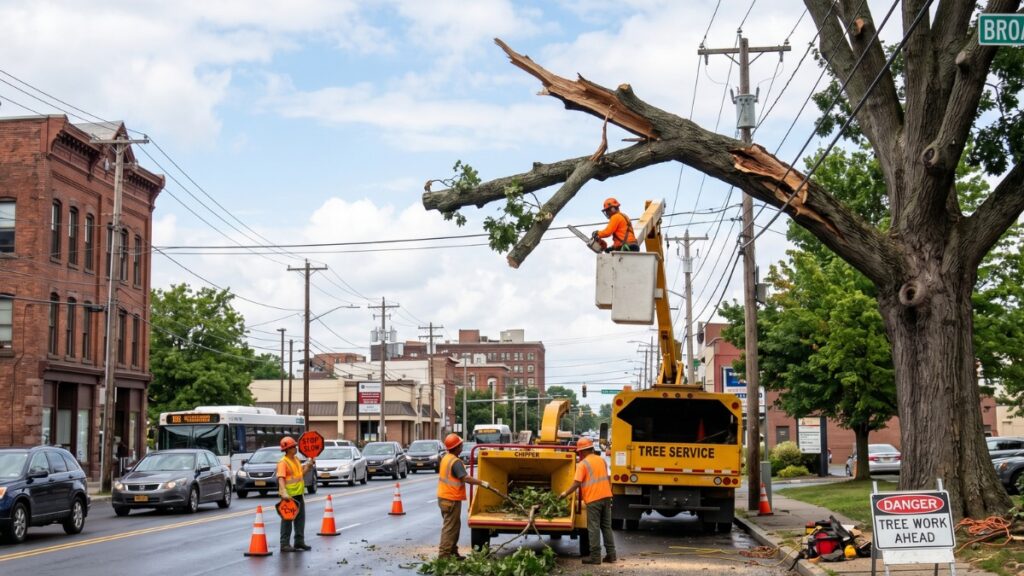
Active Overhanging Threat: A compromised tree visibly shifting or leaning toward commercial buildings, high-traffic pedestrian paths, or busy public roads.
Severe Trunk Splitting: Major structural failure where the main trunk is actively cracking apart or splitting at a critical co-dominant stem.
Post-Storm Hangars: A massive, broken canopy hanging precariously by a thread over utility assets or pathways.
Root Plate Failure: The root system actively pulling out of the ground, exposing raw earth and destabilizing the entire tree weight.
High-Voltage Encroachment: Direct contact or imminent arcing risk with primary power distribution lines.
Complete Route Blockage: Large fallen limbs or entire trunks obstructing emergency access routes, driveways, or major roadways.
5. 📍 Hazardous Tree Reporting & Response Process on Broadway
Step 1: Verify Ownership & Boundaries: Determine if the tree is located within a public right-of-way (City responsibility) or on your deeded commercial/residential boundary (Private responsibility).
Step 2: Meticulously Document the Hazard: Take clear, high-resolution photos from multiple angles safely away from the drop zone. Document the direction of any lean, trunk fissures, and proximity to adjacent buildings or power lines.
Step 3: Route the Emergency Call: For public hazards, alert the City of Albany emergency reporting desk. For urgent private property hazards, contact our specialized emergency dispatch team directly.
Step 4: Professional On-Site Inspection: Our ISA certified Arborists evaluate structural load-bearing stability, root anchoring capacity, and systemic failure probability to determine whether localized technical pruning can save the asset or if immediate, controlled crane extraction is required.
6. 🌊 Why Waterfront Trees Near the Hudson River Are Inherently Dangerous
Trees lining the immediate Hudson River basin face distinct micro-climate stresses that make them structurally less stable than inland urban trees:
Wind Micro-Climates: Unobstructed wind acceleration directly off the open water channels high-velocity forces straight into the edge of the urban canopy.
Saturated Root Ecosystems: Periodic river surges saturate the surrounding root zones, causing anaerobic soil conditions that rot anchoring roots and compromise ground stability.
Accelerated Frost Shifting: High moisture levels near the riverbanks mean harsher freeze-thaw cycles, which rapidly expand internal cracks in compromised hardwoods like maples and oaks.
7. 🪓 Emergency Tree Removal Process (The Professional Standard)
When an urban tree is deemed too hazardous to stand, our specialized crews execute a highly controlled, safety-first removal workflow designed for high-density downtown environments:
7.1 Rapid Technical Risk Assessment
Before a single cut is made, we evaluate the tree’s center of gravity, map out immediate drop-and-impact zones, identify overhead line hazards, and prioritize the absolute safety of surrounding structures and human life.
7.2 Strict Site Stabilization
We establish clear perimeter exclusion zones, deploy safety rigging, reroute local pedestrian or vehicular traffic if necessary, and coordinate immediate safety clearance checks with local utility providers.
7.3 High Risk Controlled Disassembly
In tight downtown quarters especially near historic brick facades or narrow alleyways our expert teams avoid traditional felling. Instead, we utilize advanced rigging systems for controlled lowering and crane-assisted technical removal to lift massive, compromised trunk sections vertically out of tight spots without touching surrounding infrastructure.
[Secure Site Perimeter] ➔ [Rig High-Hazard Canopy] ➔ [Crane-Assisted Sectional Extraction] ➔ [Debris Clearance]
7.4 Comprehensive Site Reclamation
Once the structural threat is mitigated, we clear all lingering debris from public paths, process major wood sections, and execute final safety stabilization to ensure the surrounding property is secure, clean, and accessible.
8. ⏱️ Emergency Response Times Across the Capital District
To ensure public safety, emergency dispatch queues are prioritized based on the severity of the threat, rather than the order the request was received:
| Risk Classification | Threat Level Criteria | Operational Response Protocol |
| 🔴 Critical Risk | Active collapse threat, root plate failure, resting on structures or blocking vital traffic routes. | Immediate, Same-Day Emergency Dispatch |
| 🟠 High Risk | Heavily compromised or damaged trunk but currently standing; poses a significant threat if high winds return. | Priority Scheduled Response (Within 24 Hours) |
| 🟡 Moderate Risk | Deadwood in canopy or light lean without active structural splitting or root movement. | Inspection-First Evaluation & Scheduled Maintenanc |
9. 🛡️ Prevention: Reducing Hazardous Tree Emergencies
The most efficient way to manage a hazardous tree emergency is to prevent it before it happens. Proactive urban canopy management along high-exposure corridors like Broadway includes:
Scheduling annual, comprehensive tree inspections with certified arborists.
Executing immediate post-storm structural assessments to catch hidden fractures early.
Proactively removing dead, decaying, or over-extended structural limbs over hanging spaces.
Monitoring root health and structural soil health near sidewalk renovations and utility repairs.
Implementing seasonal, directional pruning strategies to reduce wind-sail resistance before heavy winter storms hit Upstate New York.
📌 10. Final Expert Summary
Navigating high-risk tree scenarios along the historic Albany Broadway grid requires strict adherence to safety protocols and local jurisdictional rules:
– Public Hazards: Owned and managed by the City of Albany municipal departments.
– Private Hazards: The direct legal responsibility of local property managers and commercial owners.
– Waterfront Vectors: Inherently volatile zones demanding specialized care due to Hudson River wind and moisture exposure.
– Emergency Interventions: Must always be executed by fully licensed, insured professionals utilizing proper crane and rigging equipment to avoid catastrophic structural liability.
📞 Contact Your Local Albany Emergency Tree Specialists Today
If you are managing a property along the Broadway corridor, downtown Albany, or throughout Ulster and Albany Counties, don’t let an unstable tree threaten your business continuity or customer safety.
Contact the local experts at KD Tree Service Albany NY right now at (518) 625-8733 to request a rapid-response emergency site walkthrough, or visit our verified Google Business Profile to view our 24/7 availability and client reviews. Our certified teams are standing by with advanced rigging and crane assets to handle your highest-risk trees safely and efficiently.