Roadside trees add immense aesthetic value, shade, and environmental benefits to neighborhoods throughout Latham, NY. However, when a roadside tree becomes dead, structurally compromised, or heavily decayed, it transforms into an immediate liability. A failing tree risks striking motorists, blocking pedestrian walkways, knocking out three-phase utility lines, and damaging nearby commercial or residential structures.
Unlike standard backyard tree care, executing a tree removal adjacent to an active thoroughfare requires complex permit navigation, strict traffic safety setups, multi-agency coordination, and absolute regulatory compliance. Whether you are a local homeowner, a commercial property manager, an HOA representative, or a business owner along a major corridor, this guide breaks down exactly how to manage roadside tree care safely, legally, and efficiently while understanding when professional tree removal services may be necessary to protect public safety and remain compliant with local regulations.
Quick Answer: Do You Need a Permit for Roadside Tree Removal in Latham, NY?
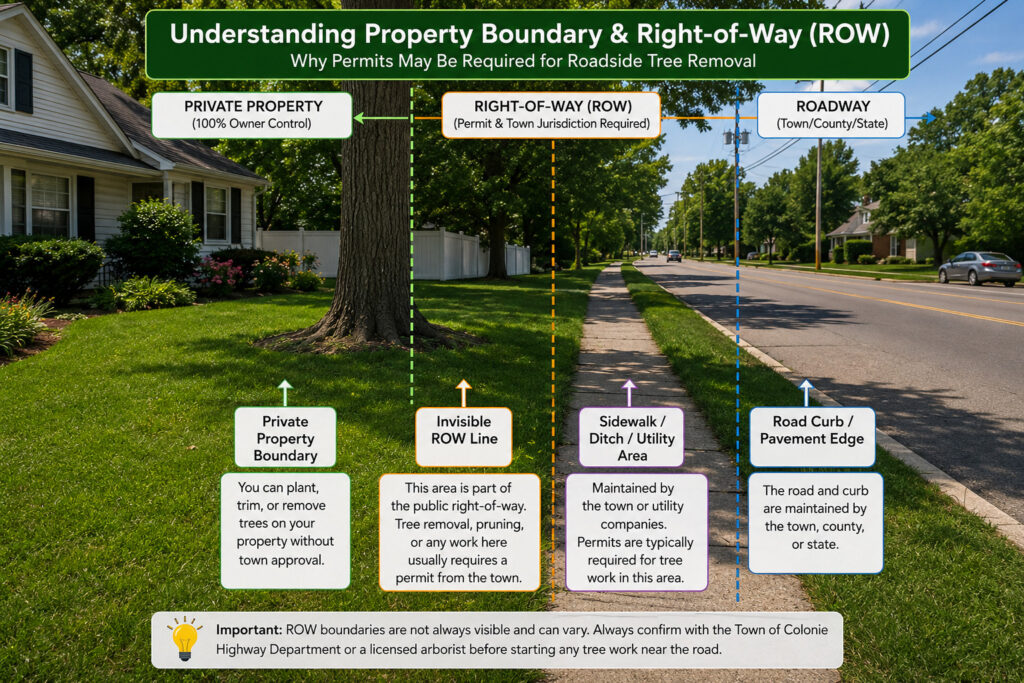
Yes, in the vast majority of cases. Because Latham is an unincorporated hamlet within the Town of Colonie, regulatory oversight depends entirely on the tree’s proximity to the public right-of-way (ROW).
A formal permit, municipal approval, or utility clearance is strictly required if:
- The tree’s trunk sits partially or fully within a public right-of-way or municipal easement.
- The physical removal operations require partial lane closures, shoulder obstructions, or sidewalk blocks.
- The canopy or root system interfaces directly with overhead primary power distribution lines.
- The tree borders municipal, Albany County, or New York State-controlled roadways.
Why Roadside Tree Care Requires Advanced 20 Year Industry Expertise
Dropping a tree in an open backyard is straightforward. Cutting down a massive canopy tree next to an active, moving roadway leaves zero margin for error. Professional tree crews must proactively mitigate dynamic variables that do not exist in standard residential jobs:
- Dynamic Vehicle Traffic & Driver Distraction: Managing real time traffic speeds while maintaining safe operating footprints.
- Pedestrian Interception: Securing busy walkways, bus stops, and school zones from overhead debris.
- High Voltage Utility Coexistence: Safely rigging massive limbs down around active National Grid primary lines.
- Restricted Critical Drop Zones: Working in narrow corridors sandwiched between asphalt highways, structural storefronts, and underground infrastructure.
- Emergency Routing: Maintaining absolute clarity for fire, EMS, and police vehicles passing through active work areas.
Common Indicators Demanding Roadside Tree Removal in Latham
Property managers and local authorities regularly monitor roadside lines for specific structural failure signs. If your roadside trees exhibit any of the following, prompt action is necessary:
1. Structural Deadwood & Brittle Limbs
Dead trees shed moisture and cell elasticity rapidly. Deprived of living sapwood, major leaders become highly brittle, making them prone to snapping under minimal wind loads and dropping directly onto travel lanes.
2. Capital Region Storm Damage
Severe weather across Albany County places immense stress on roadside canopies. Trees frequently suffer catastrophic structural breakdown from:
- Heavy Ice Accumulation: Weighting down lateral limbs until they shear off.
- Wet, Dense Snow Loading: Snapping central leader trunks.
- High Summer Wind Shear & Microbursts: Twisting asymmetric canopies and loosening root stability.
3. Progressive Truncal Lean
A tree that develops a sudden or progressive lean toward a road, commercial parking area, or sidewalk demands immediate, proactive extraction before a complete root-plate failure occurs.
4. Sight Triangle Obstructions (Visibility Hazards)
Overgrown roadside trees can block critical lines of sight. Municipalities require clear lines of vision, meaning trees must be removed or heavily pruned if they obscure:
- Regulatory traffic signs, signals, and flashing lights.
- Approaching vehicles at intersections and blind corners.
- Commercial curb cuts, driveways, and pedestrian crosswalks.
5. Advanced Heartwood Rot & Internal Fungal Decay
Fungal brackets (conks) at the base or deep cavities along the trunk signify advanced internal decay. When the structural integrity of the heartwood compromises, the tree risks completely shearing at the base during a storm.
Deciphering Roadway Right-of-Way (ROW) Jurisdictions in Latham
Determining who owns a roadside tree depends entirely on the specific road classification. In Latham, public roadways are segmented into three distinct management tiers:
| Roadway Type / Hierarchy | Primary Managing Agency | Key Local Examples in Latham, NY |
|---|---|---|
| Local Hamlet Roads | Town of Colonie Highway Department | Residential subdivisions, secondary connector streets |
| County Roads | Albany County Department of Public Works | Major routes feeding into neighboring towns |
| State Highways | New York State Department of Transportation (NYSDOT) | Route 9 (Loudon Rd), Route 7 (Troy-Schenectady Rd), Albany Shaker Rd |
If a hazardous tree is rooted entirely inside the official ROW of any of these entities, unauthorized cutting by a private property owner is highly illegal. However, if the trunk sits on your private property but its dead canopy hangs over a state or town road, you retain full liability for any damage or injury caused by falling limbs.
Who Holds Legal & Financial Responsibility for Roadside Trees?
Is the tree trunk inside the public property/ROW line?
 ├── YES ──► Municipal, County, or State DOT responsibility.
 └── NO  ──► 100% Private Property Owner responsibility (Even if limbs overhang the road).
- Private Property Owners: Responsible for trees rooted on their deeded land. If a known dead tree on your property falls onto a road, insurance companies can classify it as owner negligence rather than an “Act of God.”
- Town of Colonie Highway Division: Manages proactive trimming and emergency clearing within the ROW of over 330 miles of dedicated Town roads.
- Albany County Highway Authorities: Maintains clearance profiles along designated county highway properties.
- NYSDOT (New York State DOT): Maintains absolute authority over tree removal and canopy clearances on state infrastructure like Route 9.
- National Grid (Utility Provider): If a tree or limb poses an imminent threat to high-voltage lines, National Grid’s utility contractors may execute drastic line-clearance pruning to safeguard regional grid stability.
Advanced Traffic Safety Protocols During Roadside Removals
To insulate the public from danger, professional crews implement rigid Maintenance and Protection of Traffic (MPT) guidelines that conform strictly to state standards.
- Advanced Reflective Signage: High-visibility orange warning arrays (e.g., “Tree Work Ahead”) placed at calculated distances to alert oncoming drivers.
- Channelizing Safety Devices: Heavy-duty traffic cones, reflective drums, and physical barricades to clearly map a smooth vehicular transition zone around operations.
- Certified Traffic Flaggers: Stationed strategically at opposite ends of two-lane setups to coordinate safe, alternating single-lane traffic flow in real-time.
- Engineered Temporary Lane Closures: Coordinated ahead of time with local law enforcement to safely position high-reach bucket trucks and heavy cranes.
- Pedestrian Intercept Containment: Physically barricading walkways to prevent foot traffic from walking beneath active overhead rigging systems.
- Machinery Exclusion Footprints: Keeping an absolute safety buffer around commercial log loaders, heavy-duty wood chippers, and crane outriggers to protect bystanders from mechanical swing zones.
Executing Complex Removals Near Route 9, Loudon Road & Commercial Arteries
Operating along Latham’s high-traffic business sectors—such as Route 9 (Loudon Road), Route 7 (Troy-Schenectady Road), and surrounding school zones—presents distinct logistical hurdles. High daily traffic volumes, dense commercial entryways, and compressed utility lines eliminate the possibility of traditional felling methods.
To execute tree care seamlessly here, experienced commercial crews utilize heavy-duty, crane-assisted rigging. By securing the tree sections to a crane hook before making the cut, operators can lift massive timber pieces vertically into the air and swing them safely away from traffic into a controlled processing zone. These high-stress operations are frequently scheduled during off-peak windows to eliminate local traffic bottlenecks and protect commercial access points.
Dedicated Commercial Roadside Tree Services
For corporate stakeholders, retail center managers, real estate developers, and local HOAs, roadside tree hazards pose massive financial, operational, and liability challenges. Commercial roadside projects routinely support:
- Major retail strip centers and sprawling corporate office parks.
- Multi-family residential complexes and multi-acre townhome developments.
- Medical office campuses and institutional facilities.
Commercial properties demand meticulous risk mitigation. A professional tree service provides comprehensive structural asset management by delivering formal traffic control blueprints, absolute utility verification records, multi-million dollar commercial general liability policies, and synchronized scheduling designed to protect your day-to-day business operations.
How Much Does Roadside Tree Removal Cost in Latham, NY?
Because roadside tree removals incorporate significant safety logistics and specialized heavy machinery, costs are calculated across several operational variables:
- Tree Dimensions & Condition: Tall, heavy-canopy structures or unstable, hollow trees require more meticulous rigging steps and increased crew hours.
- Proximity to Live Travel Lanes: Jobs directly touching active curbs necessitate more extensive MPT setups, signs, and flagging personnel, which influences base operational overhead.
- Heavy Equipment Deployment: Incorporating specialized high-reach bucket trucks or large-tonnage cranes introduces mechanical operational costs but significantly accelerates project timelines and safety.
- Utility Line Complexity: Coordinating with utility line-clearance professionals to insulate lines adds specialized safety protocols.
- Administrative Permit Processing: Managing site plans, engineering traffic approvals, and coordinating with Town of Colonie or state offices involves administrative hours.
Emergency Roadside Tree Removal After Capital Region Storms
When unpredictable weather strikes Latham, compromised trees can fail instantly. Emergency roadside tree response is prioritized immediately when:
- Uprooted trunks or massive broken sections completely block active roadway lanes.
- Fractured, high-altitude limbs hang loosely over sidewalks or parking lots (“widowmakers”).
- Heavy structural timber collapses directly into primary power configurations, creating a live hazard.
- Essential paths for emergency vehicles are entirely cutoff.
Highly responsive emergency tree crews work in tandem with regional emergency services to efficiently cut, clear, and restore safe, normal traffic flow across Latham’s road network.
The Roadmap of a Professional Roadside Tree Removal Project
[1. Certified Arborist Site Assessment]
                   │
                   ▼
[2. Permitting & Jurisdictional Verification]
                   │
                   ▼
[3. MPT Traffic Control Deployment]
                   │
                   ▼
[4. Heavy Machinery & Crane Stabilization]
                   │
                   ▼
[5. Precision Sectional Rigging & Removal]
                   │
                   ▼
[6. Complete Debris Processing & Chipping]
                   │
                   ▼
[7. Final Roadway Sweeps & Reopening]
- Certified Arborist Site Assessment: The tree’s structural health, lean, internal hollows, and proximity to infrastructure are systematically analyzed to map out the safest extraction method.
- Permitting & Jurisdictional Verification: Crews identify whether the asset falls under private, Town, County, or State DOT jurisdiction, securing all necessary work-within-right-of-way permits before a single machine rolls out.
- MPT Traffic Control Deployment: Before starting any equipment, warning signage, safety cones, and flagging teams are deployed to insulate the workspace legally and physically.
- Heavy Machinery & Crane Stabilization: Bucket trucks, chip vans, and cranes enter the secured zone, setting down heavy-duty outrigger pads to distribute weight safely across the road shoulder or asphalt.
- Precision Sectional Rigging & Removal: Highly trained climbers or bucket operators piece out the canopy section-by-section, using heavy-duty rigging ropes or cranes to lower massive limbs with absolute spatial control.
- Complete Debris Processing & Chipping: Small branches are routed through high-horsepower wood chippers, massive trunk sections are loaded via grapple loaders onto log trucks, and sawdust is completely cleared.
- Final Roadway Sweeps & Reopening: The entire roadway, sidewalk, and curb footprint undergo meticulous manual sweeping to eliminate any organic hazards. Traffic control devices are packed, and full public transit safely resumes.
Frequently Asked Questions
Do you need a permit to remove a roadside tree in Latham, NY?
Voice Search Answer: Yes, if the tree stands inside the public right-of-way or if its removal process alters traffic flow, cuts off sidewalks, or requires specialized lane closures. For trees standing 100% on private property outside the right-of-way, a municipal permit is generally not required unless specified by Town of Colonie site-plan covenants.
How do I accurately confirm who owns a roadside tree near my property?
An experienced local tree care company can verify your exact property pins and cross-reference them with Town of Colonie or Albany County tax maps and right-of-way blueprints to pinpoint the exact managing authority.
Can a private property owner remove limbs near overhead utility lines?
No. Working within 10 feet of primary, high-voltage lines requires specialized OSHA line-clearance certifications. Untrained individuals attempting this face extreme risks of electrical arc-flashes or fatal electrocution. Always utilize an insured crew trained in utility safety protocols.
What should I do if a storm damaged tree completely blocks a road?
If a fallen tree introduces an immediate safety crisis or blocks public roads, contact local emergency services or the Town of Colonie Highway Department right away. For dangerous trees impacting your private driveway or commercial parking footprint, contact an emergency tree service for immediate mitigation.
Secure Your Professional Roadside Tree Consultation in Latham, NY
Safely managing a complex roadside tree project requires deep regulatory insight, advanced heavy machinery, and an absolute commitment to local traffic safety standards. Whether you are dealing with an unstable tree threatening a local sidewalk, managing an expansive commercial plaza on Route 9, or requiring urgent, fast storm cleanup, hiring an experienced team ensures the project is executed safely, legally, and cleanly.
From managing complex Town of Colonie right-of-way protocols to deploying advanced crane-assisted rigging and compliant traffic boundaries, professional crews keep Latham’s properties safe, valuable, and accessible throughout the entire year.
Are you dealing with an unstable or hazardous roadside tree along your property line? What specific roadways or overhead utilities border your trees?