
It’s 2:00 AM. A severe Capital District storm is howling outside, throwing heavy rain against your windows. Suddenly, a deafening, structural CRACK echoes through your house, followed by a violent thud that shakes your foundation. You grab a flashlight, look out into your yard, and see a massive, 70-foot mature Oak or White Pine sprawled across your driveway, blocking your cars, tearing down utility lines, and resting precariously on your roofline near Western Avenue.
In that exact moment, panic sets in. Your immediate instinct might be to put on boots, grab a consumer grade chainsaw from the garage, or start aggressively calling your insurance agent. Stop. Handling a multi ton fallen tree removal in Guilderland NY requires a calculated, safety first blueprint. Making the wrong move in the first 60 minutes can result in severe personal injury, thousands of dollars in uncovered property damage, or a flatly denied insurance claim. As seasoned tree care professionals who handle storm damage across Albany County week in and week out, here is your real world, step-by-step survival guide.
1. The Immediate 60 Minute Emergency Protocol
When thousands of pounds of unstable timber collapse onto a residential property, the environment changes instantly. Follow this operational triage sequence to secure your family and property.
Step 1: Establish a Safety Perimeter & Evacuate if Necessary
Before you look at the damage, account for every human and pet in the household. If the tree has physically breached your living space, punctured the roof, or cracked the structural framing of your home, evacuate the house immediately.
Secondary structural collapses can happen hours after the initial impact as the house settles under dynamic, deadweight loads. Move your family to a safe area or a neighbor’s home down the road.
Step 2: Survey for “Invisible” Utility Hazards
Look up before you look down. Capital District storms frequently tear down high-voltage distribution lines along major local arteries like Carman Road or Route 146. If the fallen tree or its outer canopy is touching, leaning on, or even within a few feet of overhead utility wires, do not touch anything in your yard.
The Ground Conduction Threat: Wet soil and foliage can conduct electricity across an entire wet lawn.
Action: Do not approach your vehicle or the tree. Immediately call National Grid at 1-800-867-5222 or dial 911 if you notice sparking, smoke, or active fire.
Step 3: Document for the Adjuster (Before Moving Anything)
Once the scene is stable and you are 100% safe, pull out your smartphone. You need high-resolution photographic evidence to satisfy local insurance adjusters who look for any reason to lower payouts.
Wide-Angle Context Shots: Capture the entire tree, showing exactly where it stood and where it landed.
Point of Failure: Take close-ups of the root ball or the trunk snap. This proves whether the tree failed due to sudden wind shear or pre-existing rot.
Property Damage Specifics: Photograph structural impact points on your roof, gutters, fencing, or vehicles from multiple angles.
Step 4: Secure Emergency Mitigation (The 24/7 Dispatch)
Do not wait for an insurance adjuster to visit your property before calling a professional crew. Homeowners insurance policies contain a mandatory “Duties After Loss” clause, which legally obligates you to take immediate action to prevent further damage to your property (such as rainwater pouring through a punctured roof).
Call an emergency crew that offers 24/7 Emergency Tree Service in Guilderland NY. Call (518) 625-8733 for immediate emergency crane dispatch and structural tarping to protect your home from subsequent rain damage.
2. Why Trees Topple in Guilderland: The Ground Reality
To understand why a tree suddenly fails, you have to look below the surface. Guilderland’s unique geography makes it highly susceptible to specific types of tree failures, especially during seasonal Capital District weather shifts.
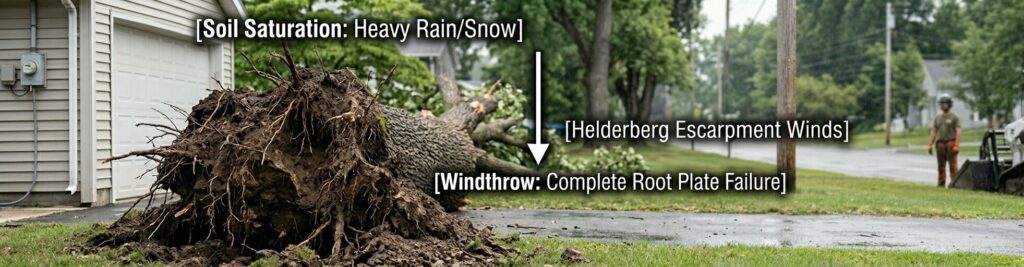
The Sandy Pine Bush vs. Heavy Clay Dynamic
Guilderland’s geology is diverse. Areas closer to the Albany Pine Bush Preserve feature highly sandy, loose soils, whereas other pockets of the town sit on dense, poorly draining clay layers.
When we experience heavy, consecutive days of rain or rapid spring snowmelts, the ground becomes completely oversaturated. The clay traps the water, turning the subsurface soil into a loose, liquid slurry.
The Helderberg Wind Factor
When high-velocity winds sweep down from the nearby Helderberg Escarpment, mature trees with large, full leaf canopies act like giant sails. If the roots are anchored in saturated, muddy soil, the lateral force causes a phenomenon known as windthrow. Instead of the trunk snapping, the entire root plate completely lifts out of the ground, shifting sidewalks, driveways, and lawns along with it.
3. Insurance Myths vs. Real World Liability
When a tree falls across a property line, neighborly relationships can fracture quickly. Let’s separate legal facts from common neighborhood myths regarding who pays for the cleanup.
The “Act of God” Principle
If a healthy tree on your neighbor’s property falls into your yard during a high-wind storm or an ice accumulation event, who is responsible? Your insurance policy covers your yard, and their insurance covers theirs. In the insurance world, sudden severe weather is classified as an “Act of God.” It does not matter that the trunk was rooted on your neighbor’s side of the property line; your homeowners insurance company will handle the structural removal and debris cleanup on your side, minus your deductible.
The Negligence Exception
The only time your neighbor is financially liable for a tree falling into your yard is if you can prove prior negligence.
The Legal Baseline: If the neighbor’s tree was visibly dead, completely rotted, hollowed out by wood-boring insects, or leaning dangerously for months, and they ignored the hazard, they are liable. If you previously sent them a polite, certified letter with photos from an ISA Certified Arborist warning them of the hazard, their insurance carrier will likely have to pay for your property damage due to failure to maintain the property.
4. The Extreme Danger of DIY Chainsaw Tree Removal
Every year, hospital emergency rooms across Albany County treat homeowners who attempted to clean up storm debris themselves. Cutting a fallen tree is fundamentally different from slicing firewood on a flat chopping block.
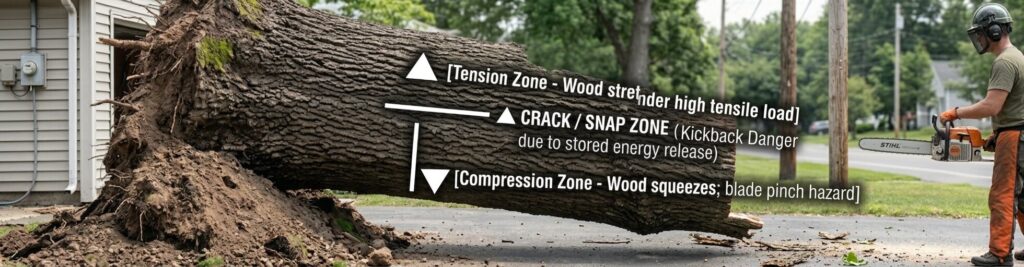
Compression, Tension, and Springpoles
When a tree falls, it traps immense kinetic energy within its branches.
Tension: Branches on the outer curve of a bend are stretched tightly like a recurve bow. Cutting into a tensioned branch causes it to snap violently outward (kickback), which can instantly shatter bones or throw a heavy chainsaw back into the operator’s face.
Compression: Branches underneath the tree are compressed by the weight of the trunk. Cutting them causes the guide bar of your chainsaw to become instantly pinched and trapped, leaving you vulnerable next to an unstable log.
The Root Ball Trap
When a fully uprooted tree is severed near its base without proper equipment securing it, the physics shift instantly. The massive root ball, balanced under heavy tension by hundreds of pounds of root-bound soil, can suddenly roll right back down into its original hole like a giant trapdoor, crushing anyone standing underneath it. Professional crews use heavy-duty Stihl MS 462 professional saws, specialized rigging, and skid steers to safely bleed off this mechanical energy step-by-step.
5. What Real Life Tree Removal Costs in Guilderland
Let’s talk transparent numbers. No professional can give an exact quote without seeing the specific situation, but emergency operations generally follow a strict risk-and-resource matrix.
Cost Breakdown Matrix
| Service Level | Estimated Price Range | What’s Included / Key Variables |
| Emergency Triage & Tarping | $600 – $2,500 | After-hours mobilization, stabilizing a tree resting on a roof, applying heavy-duty structural tarps over holes. |
| Standard Crane-Assisted Removal | $1,500 – $4,500+ | Bringing in a heavy crane to lift multi-ton log sections cleanly off a house without scratching siding or damaging roofs. |
| Basic Yard Debris Chipping | $400 – $1,200 | Dragging limbs to a high-capacity industrial chipper, processing brush into wood chips, and hauling it away. |
| Deep Stump Grinding | $300 – $950 | Grinding the main stump and primary root flares down 6 to 12 inches below grade so you can replant grass. |
Critical Factors That Change the Bill
– Target Involvement: A tree lying safely in an open lawn is straightforward. A tree leaning over high-voltage power lines or resting inside a second-story master bedroom requires slow, highly technical rigging, which increases labor time.
– Equipment Accessibility: Can a 24-ton crane or a specialized spider lift drive directly into your backyard, or must the crew cut, carry, and rig every log manually out of a tight property gap?
6. Proactive Storm Proofing: Stop the Next Fall
The easiest way to deal with an emergency tree removal cost is to avoid it entirely. Before the next major storm pattern moves through the Capital District, take a walk through your property and audit your tree canopy for these high-risk warning signs:
– Co-Dominant Stems (The “V” Crotch): Trees that split into two equal-sized main trunks forming a sharp “V” shape lack a continuous wood fiber connection at the base. Under the weight of heavy ice or twisting wind, these are the number one structural points to fail, splitting right down the center.
– Fungal Shelf Mushrooms: If you see large, woody mushrooms growing out of the base of your tree or directly from the root flares, it means internal wood-decay fungi are actively eating away the structural heartwood of your tree. It may look green on top, but it is hollow and structurally compromised inside.
– Proactive Canopy Thinning: Having an expert perform structural pruning reduces the “sail effect.” By selectively removing weak, crossing, or dead inner limbs, wind can blow cleanly through the canopy rather than catching it and ripping the roots out of the ground.
Guilderland Quick Reference Emergency Contacts
When a tree failure threatens your safety, utilities, or property structure, use this localized directory for an immediate response:
– Life Threatening Crushes / Fires / Injuries: Dial 911
– Town of Guilderland Police (Non-Emergency Line): (518) 356-1501
– National Grid (To Report Fallen Power Lines): 1-800-867-5222
– Town of Guilderland Highway Dept (Trees Blocking Public Roads): (518) 861-5108
– Expert Emergency Tree Service & Crane Support: Call (518) 625-8733 for immediate dispatch, storm damage stabilization, and insurance-compliant crane clearing throughout Guilderland, Albany County, and surrounding areas.