Tree risk management in Syracuse NY, helps property owners recognize potentially hazardous trees, understand storm damage, and decide when professional assessment, pruning, or removal may be appropriate. KD Tree Syracuse NY provides certified arborist consultations, tree removal, emergency tree services, trimming and pruning, stump grinding, and crane assisted removal.
A tree does not have to fall before it becomes a concern. A new crack in the trunk, a broken limb above a roof, disturbed soil around the roots, or sudden changes after a storm can all justify a closer look.
For Syracuse homeowners, landlords, and commercial property managers, the challenge is knowing which signs require urgent attention, which trees may be managed through maintenance, and when professional help is necessary.
This guide explains how to recognize potential tree hazards, what to expect from a tree risk assessment, how to respond to storm damage, and how to make informed decisions about tree care in Syracuse and nearby Central New York communities.
Need professional tree care? Visit KD Tree Syracuse NY or call (315) 902-1222 to discuss your tree concern.
What Is Tree Risk Management?
Tree risk management is a practical process for identifying tree related hazards, evaluating the likelihood and consequences of failure, and deciding what action if any is appropriate.
The goal is not to remove every large, old, or leaning tree. A mature tree can provide shade, habitat, and environmental benefits while remaining suitable for its location. The important question is whether an identifiable defect or changing condition creates a meaningful risk to people or property.
A useful assessment considers five things:
- Tree condition: Visible cracks, dead branches, decay indicators, weak branch unions, or other structural concerns.
- Root and soil conditions: Disturbed soil, visible root damage, excavation, or signs of movement near the trunk.
- Potential targets: Houses, garages, parked vehicles, sidewalks, driveways, and frequently occupied areas.
- Site and weather conditions: Wind exposure, snow and ice loading, drainage, and recent storm damage.
- Management options: Monitoring, pruning, restricting access, further investigation, or removal when justified.
A visible defect does not automatically mean a tree will fail. Likewise, the absence of obvious damage does not guarantee that a tree is safe. The assessment should consider the tree, its surroundings, and the potential consequences of failure together.
7 Warning Signs That a Tree May Need Professional Assessment
Syracuse property owners can use the following signs to recognize when a tree deserves attention. These observations are not a substitute for a professional evaluation.
1. A New Lean or Movement Around the Roots
Some trees naturally grow at an angle. A sudden change in lean is more concerning, especially when accompanied by lifted soil, exposed roots, or cracking in the ground around the trunk.
After heavy wind, saturated soil, or other severe weather, inspect the tree from a safe distance. If the tree appears to be moving or has recently shifted, keep people away from the potential fall area and seek professional advice promptly.
Do not approach the root plate or attempt to push the tree back into position.
2. Cracks in the Trunk or Major Branches
Trunk cracks and splits at major branch unions can indicate structural weakness. Their significance depends on the location, extent, depth, and condition of the affected wood.
A small surface wound and a deep structural split are not equivalent. An online photograph or brief description generally cannot establish the full extent of a defect.
If a large crack appears after a storm, or a split branch is hanging above a house, driveway, or entrance, avoid the area and arrange an appropriate assessment.
3. Dead, Broken, or Hanging Branches
Dead branches and broken limbs can fall, particularly when they are suspended above a building, sidewalk, vehicle, or regularly used outdoor area.
Professional tree pruning may address some branch hazards. Large suspended limbs or damaged branches under tension may require specialized equipment and controlled removal.
Never climb a tree, stand beneath a hanging limb, or attempt to pull a broken branch down yourself.
4. Fungal Growth, Cavities, or Visible Decay
Mushrooms growing near a tree’s base, cavities in the trunk, and areas of decayed wood can indicate a need for further investigation.
However, mushrooms alone do not establish how much internal decay exists or whether the entire tree needs to be removed. Different fungi affect trees in different ways, and internal defects are not always visible from the outside.
A qualified professional can evaluate visible symptoms, consider the tree’s overall condition, and explain whether additional investigation or management is appropriate.
5. Root Damage or Disturbed Soil
Roots can be affected by excavation, trenching, construction, grading, paving, and soil compaction.
Potential warning signs include exposed or damaged roots, substantial changes in ground level, disturbed soil near the trunk, or signs of movement after construction or severe weather.
Do not dig around the tree to investigate suspected root damage. Further disturbance can make the problem worse.
6. Sudden Crown Changes or Extensive Branch Dieback
Unusual leaf loss, thinning foliage, dead branches, and changes in growth can be associated with stress, disease, root problems, or environmental conditions.
These symptoms do not independently establish a particular diagnosis. Tree species, seasonal changes, weather, and site conditions all matter.
If the decline is extensive or progressing quickly or if it occurs alongside cracks, root movement, or other structural concerns request a professional evaluation.
7. Storm Damage Near a Building or Utility
A tree with a split trunk, hanging limbs, or a fallen section may pose an immediate hazard, especially when a structure or utility line is involved.
Stay clear of unstable trees and damaged limbs. If a tree or branch may be touching a power line, do not approach it or attempt to clear it.
For an urgent private property tree problem, contact an appropriate emergency tree service. For a downed tree near power lines, follow the utility’s safety instructions.
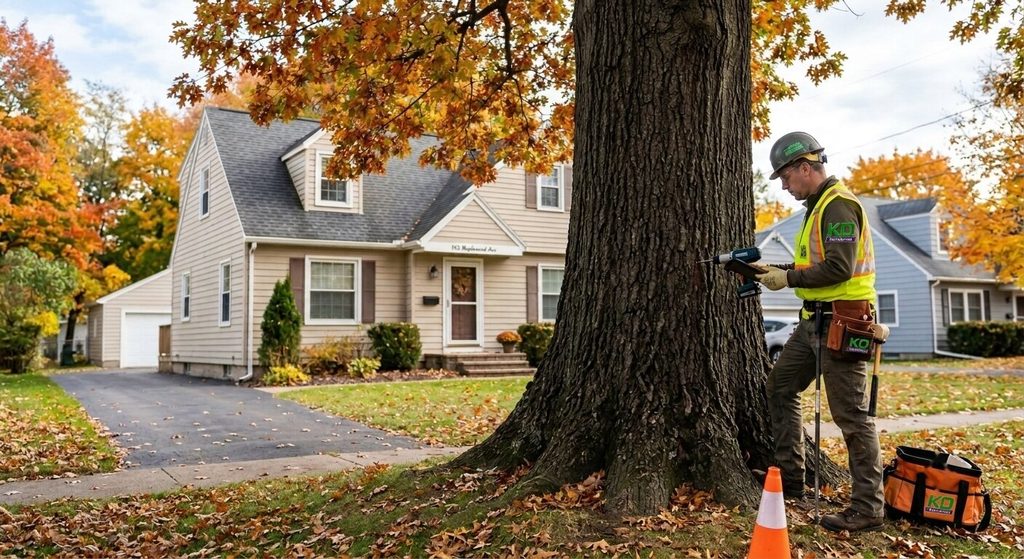
Tree Risk Assessment in Syracuse, NY: What Does It Involve?
A tree risk assessment in Syracuse, NY, should consider more than whether the tree looks healthy. The evaluation should connect observable tree conditions with the site and the consequences of possible failure.
The appropriate level of assessment depends on the question being asked. A homeowner concerned about one dead branch may need a different evaluation from a property manager responsible for multiple mature trees near buildings and pedestrian areas.
What a Professional May Evaluate
Tree species and structure: The species, size, growth form, major branch attachments, and visible structural defects.
Trunk and branches: Cracks, cavities, deadwood, broken limbs, weak unions, and other observable concerns.
Roots and surrounding soil: Visible root conditions, soil disturbance, excavation history, drainage concerns, and signs of movement.
Tree health: Foliage, branch dieback, wounds, decay indicators, and other symptoms that may warrant further investigation.
Nearby targets: Houses, garages, vehicles, walkways, parking areas, utility infrastructure, and occupied spaces.
Possible management options: Monitoring, pruning, restricting access, additional investigation, or removal where justified.
A visual assessment has limits. Some defects may be hidden inside the trunk or underground, and even a qualified assessment cannot guarantee that a tree will never fail. If a detailed report is needed for legal, insurance, or property-management purposes, clarify the scope and documentation required before booking.
KD Tree Syracuse NY lists arborist consultation Syracuse NY as a service for tree health, safety, and maintenance concerns.
When Should You Schedule an Assessment?
Consider requesting professional guidance when:
- A mature tree stands close to your home or garage.
- A tree has developed a new lean or a significant crack.
- Large dead branches extend above a roof, driveway, or sidewalk.
- You notice cavities, fungal growth, or extensive branch dieback.
- Construction or excavation has occurred near the root zone.
- A tree has sustained visible storm damage.
- You are managing a commercial property with trees near parking or pedestrian areas.
- You want advice before deciding whether pruning or removal is necessary.
Do not wait for a routine appointment if a tree appears unstable or a large limb is suspended above an occupied area. Keep people away and seek urgent assistance.
Emergency Tree Service in Syracuse, NY: What to Do After a Storm
Severe weather can leave branches broken, trees partially uprooted, and trunks split. Heavy snow, ice accumulation, strong winds, and saturated soil can all contribute to tree damage.
After a storm, safety comes before cleanup.
Step 1: Keep People Away From the Hazard
If a tree has shifted, a trunk has split, or a large branch remains suspended, stay clear of the potential fall area.
Do not walk beneath damaged limbs or approach a tree that has lifted the soil around its roots. Keep children and pets away until the hazard has been assessed.
Step 2: Treat Power Lines as Dangerous
Never touch a tree or branch that may be contacting a power line. Stay away from nearby wires and any objects that could be energized.
Do not attempt to cut, move, or pull the tree away from the line. Contact the utility provider and follow its instructions.
For an immediate threat to life, call 911.
Step 3: Contact the Correct Service
For a private-property tree emergency, contact a qualified tree service that handles hazardous removals and storm damage.
KD Tree Syracuse NY advertises 24/7 emergency tree service Syracuse and lists an average emergency arrival time of 2–4 hours across its service area. This is an advertised average, not a guarantee for every incident. Weather, demand, road access, and the severity of the hazard can affect response times.
Call (315) 902-1222 to discuss the situation and the appropriate next steps.
For a damaged or fallen tree in the City of Syracuse’s public right-of-way, contact City Dispatch at 315-448-8360. The City directs residents to National Grid at 1-800-465-1212 for downed trees around or near power lines.
Official reference: City of Syracuse, Tree Services.
Step 4: Document Property Damage Safely
If a tree has damaged a roof, fence, vehicle, or other property, take photographs from a safe location if it is possible to do so without approaching the hazard.
Contact your insurer to understand its documentation requirements. Do not climb onto a damaged roof or enter an unstable structure to take pictures.
Step 5: Leave Dangerous Cutting and Lifting to Professionals
A fallen tree can remain under tension, and a damaged limb may move suddenly when cut. A tree resting against a building or another tree can shift unpredictably.
Do not use a chainsaw on a suspended, unstable, or tensioned tree if you are not trained and equipped to manage the hazard. Large trees may require rigging, crane-assisted removal, or other controlled methods.
For local emergency response details, visit KD Tree Services Emergency Tree Services in Syracuse.
Syracuse Tree Service Rules: Private Property vs. Public Right-of-Way
Before arranging tree work, establish whether the tree is on private property or within the public right-of-way.
The City of Syracuse’s Forestry Division manages public street and park trees and states that the City does not perform work on trees located on private property. Work on or near a street tree may require City approval or a permit.
If the tree is on a city street or sidewalk, or you are unsure who is responsible, contact the City before authorizing work.
Useful official contacts:
- Damaged or fallen tree in the public right-of-way: City Dispatch, 315-448-8360.
- Downed tree around or near power lines: National Grid, 1-800-465-1212.
- Questions about public-tree work or permissions: Check the official City of Syracuse Tree Services page for current Forestry Division contact details and requirements.
- Immediate threat to life: Call 911.
Do not assume that a tree can be removed because it is close to your property line or because its branches extend over a sidewalk. Ownership, location, and local rules can affect who may authorize the work.
Seasonal Tree Risk Management in Central New York
Tree concerns can arise at any time of year. Seasonal conditions influence what property owners should watch for, but the appropriate response depends on the tree and the specific problem.
Winter: Snow and Ice Loading
Snow and ice can accumulate on branches and increase their load. After a winter storm, look from a safe location for broken limbs, new cracks, and significant changes in tree structure.
Avoid hitting ice-covered branches or climbing on slippery surfaces to clear them. If a damaged branch is hanging over a house, driveway, or walkway, arrange professional advice.
Spring: Check for Winter Damage
As growth resumes, inspect trees for broken branches, deadwood, and changes in foliage. Trees affected by winter conditions may show symptoms that were not obvious during the dormant season.
Spring can also be a useful time to plan routine maintenance, provided the work is appropriate for the species and the tree’s condition.
Summer: Watch for Changes in Tree Health
During the growing season, look for unusual leaf loss, branch dieback, fungal growth, and changes around the root zone.
Drought, excessive moisture, disease, soil compaction, and other stresses can affect tree health. A single symptom should not be treated as a confirmed diagnosis.
Fall: Prepare for Winter Weather
Before winter arrives, consider having identified concerns assessed and discuss whether pruning or other maintenance is appropriate.
Pruning timing varies by species, objective, and tree condition. A suspected immediate hazard should not be ignored merely because it is outside the preferred season for routine maintenance.
Tree Pruning vs. Tree Removal: How Do You Decide?
Tree pruning and tree removal solve different problems. The right choice depends on the type of defect, the tree’s condition, the location, and whether risk can reasonably be reduced without removing the tree.
When Pruning May Be Appropriate
Professional pruning may help when the objective is to:
- Remove selected dead or broken branches.
- Address certain structural concerns.
- Improve clearance around buildings and access routes.
- Reduce conflicts with nearby property features.
- Maintain a tree’s structure where practical.
Pruning should have a clear purpose. Excessive cutting or indiscriminate topping can damage a tree and create additional problems.
When Removal May Be Appropriate
Removal may be considered when the tree has extensive structural damage, severe decline, a risk that cannot reasonably be managed through other measures, or a location conflict that cannot be resolved adequately.
Removal should not be recommended solely because a tree is tall, old, or growing at an angle. The actual condition and surrounding circumstances matter.
Why Access and Surroundings Matter
A tree growing in an open area may be managed differently from one standing beside a house, fence, garage, or utility corridor.
In a restricted space, a crew may need to remove the tree in controlled sections rather than felling it in one piece. Rigging or crane-assisted removal may be appropriate depending on the tree and site conditions.
KD Tree Syracuse NY offers tree removal in Syracuse NY as well as trimming and pruning. Request an assessment that explains the proposed work and why it is appropriate for your particular tree.
How Much Does Tree Risk Management Cost in Syracuse, NY?
The cost depends on the service required. A consultation, a written assessment report, branch pruning, emergency cleanup, and complete tree removal are different types of work and should not be treated as interchangeable services.
For removal, factors that can influence the estimate include:
- Tree height, trunk diameter, and overall condition.
- Access for workers and equipment.
- Proximity to homes, garages, fences, and utility infrastructure.
- The complexity of rigging or crane-assisted work.
- The number and size of damaged branches.
- Debris handling, stump grinding, and cleanup requirements.
KD Tree Syracuse NY publishes pricing guidance on its Syracuse tree removal page. For current pricing, consult that page and request a written estimate for the actual property. Do not assume that a guide price for routine removal applies to a hazardous or restricted access job.
Before approving the work, ask:
- Is the estimate for an assessment, pruning, removal, or emergency cleanup?
- Does the quote include debris removal and site cleanup?
- Is stump grinding included, or is it a separate service?
- Is special equipment required?
- Are there access, permit, or property-protection considerations?
- What work is excluded from the quoted price?
KD Tree Syracuse NY advertises free estimates and flat-rate written quotes. Confirm the current terms and the exact scope of work when requesting an estimate.
How to Choose a Tree Service in Syracuse, NY
Tree work can involve heavy equipment, elevated work, falling limbs, and significant property exposure. Compare providers based on qualifications, planning, communication, and written terms not just the lowest initial price.
Before hiring a tree service, ask:
Who will evaluate the tree? Ask about the qualifications and experience of the person assessing the concern.
Is the company insured? Request current documentation and confirm that the coverage is appropriate for the proposed work.
Why is this work recommended? Ask whether pruning, monitoring, further investigation, or removal is appropriate and why.
How will the crew protect the property? Discuss equipment access, the route through the yard, nearby structures, fences, and landscaping.
What does cleanup include? Confirm whether branches, logs, woodchips, and stump grindings will be removed or left on site.
Is written pricing provided? Make sure the scope, price, cleanup, and exclusions are clear before authorizing non-emergency work.
Are permits or approvals required? Verify requirements with the appropriate local authority, particularly for trees near public streets or sidewalks.
KD Tree Syracuse NY describes its Syracuse services, advertised credentials, and estimate process on its Syracuse service page. Property owners should confirm current credentials and insurance documentation when requesting a quote.
A Practical Tree Risk Checklist for Property Owners
Use this checklist to identify when a tree may need attention. It is a screening tool, not a certification that a tree is safe.
- Check for new cracks in the trunk or major branches from a safe location.
- Look for sudden changes in lean or movement around the roots.
- Note dead, broken, or suspended limbs above buildings and access routes.
- Watch for cavities, fungal growth, and substantial branch dieback.
- Consider whether construction or excavation may have affected the root zone.
- Recheck trees after significant wind, snow, or ice events.
- Keep people away from unstable trees and damaged branches.
- Treat trees or branches near power lines as utility hazards.
- Confirm whether the tree is privately owned or in the public right-of-way.
- Request professional advice when the condition or level of risk is unclear.
- Obtain a written scope and estimate before authorizing non-emergency work.
The goal is to recognize concerns early and make informed decisions not to diagnose structural defects without appropriate expertise.
Frequently Asked Questions About Tree Risk Management in Syracuse, NY
What is tree risk management?
Tree risk management involves identifying potential hazards, evaluating tree condition and the consequences of possible failure, and deciding whether monitoring, pruning, further assessment, access restrictions, or removal is appropriate.
How do I know if a tree near my house is dangerous?
Warning signs can include a sudden lean, trunk cracks, large dead branches, visible root disturbance, or substantial storm damage. These symptoms do not prove that a tree will fail. A qualified assessment can help determine the appropriate next step.
Does every leaning tree need to be removed?
No. Some trees naturally grow at an angle. A new or increasing lean, especially with soil movement or exposed roots, is more concerning and warrants prompt assessment.
Do mushrooms at the base of a tree mean it is dangerous?
Not necessarily. Fungal growth can indicate a reason for further investigation, but it does not independently establish the extent of internal decay or mean that removal is required.
How much does tree removal cost in Syracuse, NY?
The cost depends on tree size, condition, access, nearby structures, equipment, and the work required. Check KD Tree Syracuse NY current Syracuse tree removal pricing guide and request a written estimate for your property.
Does KD Tree Syracuse NY offer emergency tree service in Syracuse?
KD Tree Syracuse NY advertises 24/7 emergency tree services for Syracuse and nearby Central New York communities. Its published average arrival time is 2–4 hours, although actual response times vary with weather, demand, access, and the severity of the incident. Call (315) 902-1222 to discuss the situation.
Can I remove a tree near a Syracuse sidewalk?
Do not assume you can. The City of Syracuse manages public street trees and may require authorization or a permit for work on or near a street tree. Check the official City tree-services guidance before arranging work.
What should I do if a tree falls near a power line?
Stay away from the tree, wires, and nearby objects that may be energized. Do not attempt to cut or move anything. Contact National Grid at 1-800-465-1212 for downed trees around or near power lines. Call 911 for an immediate threat to life.
When should I schedule a tree risk assessment?
Arrange an assessment whenever you notice a significant concern, including a new lean, structural cracks, extensive deadwood, root disturbance, or storm damage. A suspected immediate hazard should be addressed promptly rather than waiting for routine maintenance.
Protect Your Property With Tree Risk Management in Syracuse, NY
Effective tree risk management starts with recognizing potential warning signs, keeping people away from immediate hazards, and obtaining appropriate advice before choosing a solution.
Not every tree needs to be removed, and pruning cannot resolve every structural concern. The right approach depends on the tree’s condition, the surrounding property, the nature of the defect, and whether risk can reasonably be reduced.
KD Tree Syracuse NY provides arborist consultations, emergency tree services, tree removal, trimming and pruning, stump grinding, and crane assisted removal. The company advertises 24/7 emergency response, with service details and estimates available through its Syracuse pages.
If you are concerned about a tree near your home, a damaged limb over a driveway, or a tree affected by severe weather, request an assessment and ask which options are appropriate for your property.
Contact KD Tree Syracuse NY
- Phone: (315) 902-1222
- Syracuse service page: https://kdtreeservices.com/service-location/syracuse-ny/
- Arborist consultation: https://kdtreeservices.com/syracuse-ny/arborist-consultation/
- Emergency tree service: https://kdtreeservices.com/syracuse-ny/emergency-tree-services/
- Tree removal: https://kdtreeservices.com/syracuse-ny/tree-removal/
Get a clear explanation of the concern, a written scope of work, and an estimate based on the actual tree and site conditions.