[email protected] ⚡ Same-day emergency available

Category: Fall Tree Care Guide

  • Tree Root Sidewalk Damage Liability & Fines in Cohoes, NY: Who Pays for Repairs?

    As a homeowner or business owner in Cohoes, NY, walking out to find your concrete sidewalk buckling, cracking, or lifting is an immediate, high-stress financial headache. In historic parts of the Capital Region from the historic brick brownstones near Remsen Street to the sprawling residential properties on Van Schaick Island and the newer developments up around Manor Avenue mature oak, maple, and sweetgum trees provide incredible shade and curb appeal. However, as these trees age, their aggressive underground networks frequently clash with aging municipal concrete infrastructure.

    When a massive tree root shoves a heavy sidewalk slab upward, creating a dangerous trip hazard that gets progressively worse with every Upstate New York winter freeze-thaw cycle, a critical legal and financial question arises: Who is legally responsible for the sidewalk cracking, who pays for tree root sidewalk removal in Cohoes NY, and can the city issue code enforcement fines?

    This extensive guide breaks down local Cohoes municipal codes, New York State property laws, advanced arborist techniques, and actionable concrete remediation strategies to help you resolve root-damaged concrete before it triggers expensive liability, personal injury claims, or structural citations.

    🛑 Facing a Cohoes Code Violation Notice?

    Don’t wait for the city to execute the work at extortionate rates or attach a costly lien to your property taxes. Our certified Capital Region team specializes in code compliant root extraction, structural pruning, and emergency clearance.

    📞 CALL NOW FOR A FREE COMPLIANCE ASSESSMENT: (518) 625-8733

    Cohoes Sidewalk Repair Responsibility: Who Owns the Fix?

    Many local property owners operating across Albany County assume that because a sidewalk sits on a public right-of-way, or because a city-planted curbside tree inside a municipal easement caused the heave, the local municipality covers the bill.

    Unfortunately, under New York State common law and local city ordinances, the primary financial and physical obligation to maintain a safe, level walkway falls directly on the shoulders of the abutting property owner.

    The General Rule under Cohoes City Ordinances

    If you dive deep into the local legislative books, specifically Chapter 244 of the Cohoes City Code (Streets and Sidewalks), the law explicitly dictates that the owner of the premises fronting or abutting any public street, highway, or public place must maintain the sidewalk in a state of good, safe, and passable repair.

    If a majestic century-old maple tree on your front lawn or even a mature tree growing within the narrow planting strip between the curb and the sidewalk spreads its root system beneath the concrete and forces the slab upward, you are generally the primary party required by law to correct the structural hazard. The presence of cohoes sidewalk repair responsibility shifting to the property owner is standard across the Capital District, but Cohoes enforces it strictly to preserve pedestrian access near public transit lines and historic shopping corridors.

    Cohoes NY Sidewalk Code Enforcement & Fines

    Leaving a buckled sidewalk unaddressed will eventually catch the eye of Cohoes Code Enforcement officers or field inspectors from the Department of Public Works (DPW).

    [Inspector Identifies Lip >= 0.5"] ---> [Official Notice Sent (30 Days)]
                                                   |
       ____________________________________________|____________________________________________
      |                                                                                         |
    [Option A: Owner Hires Certified Pro]                                     [Option B: Owner Ignores Notice]
      • Safe root pruning & remediation                                         • City hires private contractor
      • Clean concrete repouring                                                • High processing fees added
      • Safe, code-compliant fix                                               • Total bill added as TAX LIEN
    

    – The Inspection & Official Notice: Code enforcement routinely monitors residential and commercial zones around Columbia Street, Walnut Street, and Downtown Cohoes for pedestrian hazards. If an inspector identifies an uneven concrete slab with a vertical displacement or “lip” (typically $\frac{1}{2}$ inch or greater), they will issue an official notice to repair.

    – Sidewalk Repair Fines & Tax Liens: If a property owner ignores a repair citation within the specified window (usually 30 calendar days), the City of Cohoes has the legal authority under municipal law to correct the hazard itself. The city will hire a third-party private masonry contractor to either grind down the concrete lip or completely tear out and pour fresh concrete. Once finished, the city doesn’t just hand you a standard invoice; the total cost of the work plus heavy administrative penalties, inspection fees, and processing surcharges will be attached directly to your municipal property tax bill as an assessment lien. Failing to clear this lien can jeopardize your mortgage standing or halt the sale of your home.

    Tree Root Sidewalk Damage Law: New York State Frameworks

    To fully evaluate your long-term risk profile as a property owner, you have to look at how tree root sidewalk liability applies to NY homeowners during civil personal injury claims.

    The “Prior Written Notice” Framework

    Under standard New York State common law, a municipality is heavily protected from slip-and-trip lawsuits unless it can be proven that the city received “prior written notice” of the exact structural defect before the accident occurred. However, because Cohoes city ordinances explicitly place the burden of ongoing maintenance and sidewalk safety on the property owner, your legal defense weakens drastically if a pedestrian is injured on a sidewalk slice that you have actively neglected.

    Understanding Premises Negligence & Tort Claims

    If a passerby, mail carrier, or local jogger trips over a concrete slab raised by your tree’s root system, you can be named as a primary defendant in a personal injury lawsuit for premises negligence. To win a tort claim against you, the plaintiff’s legal counsel must establish that:

    1. A dangerous, defective condition existed (the raised sidewalk slab).
    2. The property owner either created the condition, knew about it (actual notice), or should have known about it through reasonable property maintenance (constructive notice).
    3. The owner failed to execute proper repairs within a reasonable timeframe.

    Because a buckled sidewalk is highly visible, a defense attorney cannot simply claim you didn’t see it. Tree root sidewalk liability ny homeowners face is a major source of costly home insurance claims and out-of-pocket legal settlements across New York State.

    The Core Conflict: Why Tree Roots Destroy Concrete

    To understand how to safely perform tree root sidewalk removal in Cohoes NY, you must first understand why roots behave the way they do. Tree roots do not intentionally seek out and destroy concrete; they are simply searching for three critical survival elements: moisture, oxygen, and nutrients.

    [ Sidewalk Concrete Slab ] <--- Retains condensation underneath
    --------------------------
    [ Gravel Sub-Base Layer ]  <--- Loose, oxygen-rich environment
    ==========================
       ^          ^
       |          |--- [ Opportunistic Fine Roots ] Expand upward into gravel
       |
    [ Structural Anchor Roots ] Thicken over time, acting like hydraulic jacks
    

    When a sidewalk is poured, a localized microclimate forms beneath the slab. Rainwater seeps through the joints of the concrete and condenses on the underside of the stone. This creates a highly attractive, high-moisture, oxygen-rich environment directly inside the gravel or sand sub-base.

    Opportunistic fine roots grow upward into this gravel layer to drink the trapped condensation. Over several growing seasons, these fine feeder roots transition into thick, woody structural anchor roots. As these roots grow in diameter, they act like slow-motion hydraulic jacks, exerting thousands of pounds of upward pressure against the bottom of the concrete until the massive tensile forces crack and displace the heavy masonry above.

    The Root Problem: Root Pruning vs. Tree Removal

    Once you receive a city code citation or notice a shifting slab outside your storefront, you face a major mechanical and environmental dilemma: How do you fix the walking path without destabilizing or completely killing a mature, high value shade tree? Local property owners must make an informed decision between targeted structural root management or complete tree extraction.

    Comprehensive Comparison: Managing Root Infestations

    Strategic ApproachCore AdvantagesCritical ConstraintsCost Profile
    Root Pruning (with Air-Spade)• Preserves the mature tree canopy
    • Less expensive than total removal
    • Keeps historic neighborhood aesthetics intact
    • Roots can slowly regrow if unmanaged
    • Risk of structural tree failure if executed by amateurs
    Moderate
    Complete Tree Removal• Eliminates the root issue permanently
    • Allows for flawless flatwork replacement
    • Eradicates future storm/falling branch hazards
    • Higher upfront financial layout
    • Requires municipal tree permits
    • Complete loss of local shade & curb appeal
    High

    Deep Dive: Root Pruning vs. Tree Removal for Cohoes Sidewalks

    If you opt for root pruning, you cannot simply send an uncertified laborer out with a chainsaw, axe, or sledgehammer to chop away at the wood blocking the concrete frame. Shaving off massive, structural anchor roots can permanently destabilize the entire weight of the tree. This makes it a severe hazard during high-wind summer storms or heavy winter blizzards blowing violently off the Mohawk and Hudson rivers.

    Professional tree services strictly utilize the 25% Rule: a certified arborist should never prune away more than 20% to 25% of a mature tree’s total root system in a single calendar season.

    Furthermore, local tree care experts utilize Air Spade pneumatic soil excavation. This advanced tool blasts supersonic streams of compressed air to safely blow away heavy clay and dirt, completely exposing the delicate root network without scraping the protective bark or damaging the cambium layer. This allows the arborist to make precise, clean, surgical cuts that don’t invite fungal decay or root-rot pathogens into the tree.

    However, if the prominent root mass lifting the concrete is too integral to the tree’s structural equilibrium and wind resistance, full crane assisted tree removal becomes the only safe, compliant, and logical path forward to clear the path for a long lasting concrete replacement.

    ⚡ Fast Emergency Response for Capital Region Property Owners

    Has a severe storm or high wind velocity compromised a root damaged tree near your public sidewalk? Do not wait for a catastrophic structural failure. We provide rapid emergency tree cutting, hazard limb pruning, and clearance services throughout Cohoes and greater Albany County.

    📞 TAP TO CALL FOR EMERGENCY ARBORIST ASSISTANCE: (518) 625-8733

    Engineering Longevity: The Arborist Root Barrier

    If your arborist evaluation reveals that the tree can safely survive structural pruning and you proceed to pour a fresh, level concrete slab, you cannot simply lay down new stone directly over the old soil. If you do, the remaining root tips will naturally callus over, regenerate, and begin lifting the new concrete again within 3 to 5 years.

    To break this cycle, professional local tree care teams install a specialized, subsurface arborist root barrier.

    How Subsurface Barriers Shield Your Concrete

    These barriers are heavy-duty, interlocking vertical sheets manufactured from high-density polyethylene (HDPE) or coated geotextile fabrics. They are buried vertically to a depth of 12 to 24 inches directly alongside the inner edge of the new sidewalk frame.

              [ Tree Trunk ]
                    |
              (Soil Level)
         ___________|___________
        |                       |
        |===> [Root Growth] ===>|  | [ HDPE ROOT BARRIER PANEL ] 
                                |  | (Forces root to turn 90° downward)
                                v  | 
                        (Deep Sub-Soil)
                        =============================== [ New Concrete Slab ]
                        =============================== [ Gravel Sub-Base ]
    

    The face of the barrier panel features molded, vertical 90-degree ribs. When an expanding root grows horizontally toward the sidewalk, it collides with the smooth HDPE panel. The vertical ribs guide the root tip cleanly downward, forcing it to grow deep into the lower sub-soil strata, far beneath the sidewalk’s structural gravel sub-base. This keeps the critical upper soil profile clear of thick wood, ensuring your fresh concrete flatwork remains completely flat, safe, and code-compliant for several decades.

    Step-by-Step Guide to Code Compliant Sidewalk Remediation in Cohoes

    If you have a concrete sidewalk that is actively buckling from tree roots, navigating the resolution process without making costly legal mistakes requires a methodical plan:

    Step 1: Identify Property Boundaries & Trees

    Determine if the offending tree is located strictly on your private property or inside the municipal planting easement. Even if it is a city planting strip, remember that under cohoes sidewalk repair responsibility, you are still liable for maintaining the concrete walkway surface.

    Step 2: Schedule a Certified Arborist Consultation

    Never cut roots blindly. Hire a professional tree care provider to perform a structural assessment. They will use diagnostic tools or localized hand excavation to determine if the tree can safely withstand the root pruning required to lay a level slab.

    Step 3: Secure the Necessary Municipal Permits

    If the tree needs to be fully extracted and sits near a public right-of-way, or if you are altering public concrete infrastructure, you must file a permit application with the Cohoes Department of Public Works (DPW) or the building department. Working without a permit can trigger immediate stop-work orders and steep municipal code fines.

    Step 4: Execute Excavation & Root Management

    Your chosen tree service team will utilize tools like an Air-Spade to clear out the dirt around the affected area, perform clean structural root pruning, and install a continuous run of heavy-duty arborist root barrier to block future root intrusion.

    Step 5: Pour New Concrete to Specification

    With the root system managed and protected, a professional mason or concrete contractor can lay down a proper gravel base, install steel reinforcement mesh to resist future cracking, and pour high-PSI concrete that matches the exact thickness and slope requirements mandated by Cohoes city engineering codes.

    Frequently Asked Questions (FAQ)

    Is a homeowner responsible for sidewalk damage from tree roots in Cohoes, NY?

    Yes. Under Chapter 244 of the Cohoes City Code, local property owners are explicitly held legally and financially responsible for maintaining the safety, cleanliness, and structural integrity of all public walkways directly bordering their property parcels. Failing to address deep cracks, lifting, or hazardous heaves caused by private or city tree roots property damage responsibility can result in direct civil lawsuits, insurance claims, or municipal citations.

    Who pays for sidewalk repairs damaged by tree roots in Cohoes, NY?

    In almost all residential and commercial cases, the adjacent property owner pays for both the structural concrete masonry repair and any required arborist root management or tree removal work. Even if the tree is technically located within the city’s public right-of-way planting strip, local municipal code shifts the ongoing sidewalk maintenance and repair costs directly to the abutting property owner.

    Can the city fine you for sidewalk damage in Cohoes, NY?

    Yes. The Cohoes Code Enforcement division can issue official structural violation orders to property owners with hazardous walkways. If you fail to complete the required repairs within the specified timeframe outlined in the citation, the city can execute the repair work using a city-appointed contractor and place the total cost of sidewalk repair fines cohoes ny directly onto your property tax bill as an unresolvable assessment lien.

    What is the safest way to execute tree root sidewalk removal in Cohoes, NY?

    The safest way requires a dual-phase approach involving both professional tree care and code-compliant concrete replacement. You must coordinate an assessment with a certified tree professional who can safely prune non-structural roots using specialized pneumatic tools, install a subsurface physical root barrier, and prepare a stabilized sub-base for clean, long-lasting concrete flatwork.

    Save Your Sidewalk & Avoid Costly Penalties

    Don’t sit back and wait for an official municipal code enforcement citation to hit your mailbox, or worse, for an expensive personal injury lawsuit to land on your doorstep. If you have a lifting, cracked, or hazardous sidewalk caused by runaway tree roots anywhere in the Cohoes or greater Capital Region area, you need a precise evaluation that completely protects both your property’s structural safety and your financial liability.

    We provide completely transparent, code-compliant, and fully insured arborist and clearing solutions designed to handle the toughest root extractions and complex tree removals safely and effectively.

    🟢 Get Your 100% Free Cohoes Sidewalk & Root Evaluation Today!

    Eliminate the stressful guesswork and protect your property from city fines and tax liens. Talk directly to a local, experienced tree specialist right now.

    👉 CLICK TO CALL NOW: (518) 625-8733
  • Fall Tree Care Checklist & Storm Prep Guide for Bethlehem, NY: Protect Your Trees Before Winter Arrives

    Fall Tree Care Checklist & Storm Prep Guide for Bethlehem, NY: Protect Your Trees Before Winter Arrives

    Introduction

    As autumn settles across Bethlehem, NY, homeowners begin preparing their properties for the colder months ahead. Leaves are raked, gutters are cleaned, and outdoor spaces are winterized. Yet one of the most important aspects of seasonal property maintenance is often overlooked professional tree service in Bethlehem NY. Throughout Delmar, Glenmont, Slingerlands, Elsmere, and North Bethlehem, mature shade trees are a defining feature of many residential landscapes. These trees provide beauty, energy savings, privacy, and property value. However, they can also become significant hazards when winter storms arrive.

    Heavy wet snow, freezing rain, ice accumulation, and strong winds common throughout Albany County place tremendous stress on trees. Branches that appeared healthy during summer may fail unexpectedly under winter conditions. Structural defects hidden within the canopy can quickly turn into safety risks for homes, vehicles, driveways, and utility lines.

    The good news is that most winter tree emergencies are preventable.

    By following a proactive fall tree care checklist, homeowners can identify potential hazards, improve tree health, and significantly reduce the risk of storm-related damage.

    Whether you own a single ornamental tree or a property filled with mature maples and oaks, this guide explains everything you need to know about preparing your trees for winter in Bethlehem, NY.

    Quick Answer: How Do I Prepare My Property’s Trees for Winter in Bethlehem, NY?

    To prepare trees for winter in Bethlehem, NY:

    1. Inspect trees for dead, damaged, or diseased branches.
    2. Remove hazardous limbs before snow and ice arrive.
    3. Schedule a professional tree risk assessment.
    4. Prune weak branch attachments and crowded canopies.
    5. Apply mulch around root zones.
    6. Water young trees before the ground freezes.
    7. Install cabling or bracing where structural weaknesses exist.
    8. Monitor trees growing near homes, driveways, and power lines.

    Taking these steps during fall can significantly reduce storm-related damage and help maintain healthier trees throughout the winter season.

    Why Fall Tree Care Matters in Bethlehem, NY

    Bethlehem experiences a wide range of weather conditions throughout the year, but winter often presents the greatest challenges for trees.

    Unlike regions with milder climates, the Capital Region frequently experiences:

    1. Heavy wet snow
    2. Ice storms
    3. Nor’easters
    4. Freeze-thaw cycles
    5. Strong wind events
    6. Sudden temperature fluctuations

    These conditions create stress that exposes hidden weaknesses in trees.

    For example, arborists throughout Bethlehem commonly observe branch failures during early season snowstorms when trees still retain part of their leaf canopy. Wet snow accumulates on branches, dramatically increasing weight loads and causing weak limbs to break unexpectedly.

    Homeowners in Delmar and Slingerlands often have mature sugar maples planted decades ago. While these trees remain valuable landscape assets, aging branch unions and structural defects can increase susceptibility to winter storm damage.

    The purpose of fall maintenance is simple: identify problems before severe weather turns them into emergencies.

    Fall Tree Inspection Checklist for Bethlehem Homeowners

    A thorough tree inspection is the foundation of effective winter preparation.

    Many hazardous conditions develop gradually and remain unnoticed until a major weather event occurs.

    1. Inspect for Dead Branches

    Dead branches are among the most common causes of winter storm damage.

    Signs of deadwood include:

    1. Missing bark
    2. Brittle wood
    3. Lack of leaf production
    4. Visible decay
    5. Fungal growth

    Because dead limbs lose flexibility, they are far more likely to snap under the weight of snow and ice.

    2. Look for Cracks and Splits

    Structural cracks can indicate serious weaknesses.

    Pay close attention to:

    1. Large scaffold branches
    2. Branch junctions
    3. Main trunks
    4. Areas previously damaged by storms

    Even small cracks can expand significantly during freeze-thaw cycles.

    3. Evaluate Tree Lean

    Not all leaning trees are dangerous. However, a sudden lean may indicate:

    1. Root failure
    2. Soil instability
    3. Internal decay
    4. Previous storm damage

    Any tree leaning toward a structure should be evaluated promptly.

    4. Check Root Zones

    Tree health begins below ground.

    Warning signs include:

    1. Exposed roots
    2. Soil lifting around the base
    3. Mushrooms or fungal growth
    4. Root damage from construction

    Root problems are often difficult for homeowners to identify but can significantly affect stability.

    5. Examine the Trunk

    Inspect the trunk for:

    1. Cavities
    2. Hollow areas
    3. Large wounds
    4. Decay
    5. Insect damage

    A hollow trunk does not automatically mean a tree must be removed, but it should be professionally assessed.

    What Trees Are Most Vulnerable to Winter Storm Damage in Bethlehem, NY?

    Quick Answer

    The trees most vulnerable to winter storm damage in Bethlehem include mature sugar maples, red maples, white pines, ornamental pear trees, and trees with multiple trunks or weak branch attachments.

    Common Risk Factors

    Codominant Stems

    Trees with two competing trunks often develop weak unions that are susceptible to splitting.

    Dense Canopies

    Heavy canopies accumulate snow more easily and experience greater wind resistance.

    Previous Storm Damage

    Trees weakened by past weather events may contain hidden structural defects.

    Mature Trees

    Older trees often require more frequent inspections to identify developing issues before they become hazards.

    Complete Fall Tree Pruning Checklist

    Pruning is one of the most effective methods for reducing winter storm risks.

    Remove Dead and Diseased Branches

    Removing compromised limbs helps:

    1. Improve safety
    2. Reduce branch failures
    3. Limit disease spread
    4. Improve overall tree health

    Eliminate Weak Branch Attachments

    Branches attached at narrow angles are more likely to split during snow and ice events.

    Corrective pruning helps strengthen tree structure.

    Thin Dense Canopies

    Selective thinning can:

    1. Improve airflow
    2. Reduce snow accumulation
    3. Lower wind resistance
    4. Improve branch distribution

    Clear Branches Near Structures

    Evaluate branches growing over:

    1. Homes
    2. Garages
    3. Sheds
    4. Decks
    5. Driveways
    6. Walkways

    These areas deserve priority attention before winter arrives.

    Improve Structural Balance

    An uneven canopy can create stress during storms.

    Professional structural pruning helps distribute weight more evenly and improve stability.

    Winter Storm Tree Preparation Strategies

    Preparing trees for winter involves more than pruning alone.

    Prioritize High Risk Trees

    Focus first on trees located near:

    1. Houses
    2. Detached garages
    3. Vehicles
    4. Utility lines
    5. Outdoor living spaces

    These trees pose the greatest potential liability during storms.

    Address Weak Branch Unions

    Weak branch unions are one of the leading causes of winter tree failures.

    Warning signs include:

    1. Included bark
    2. Visible cracks
    3. Heavy lateral limbs
    4. Excessive canopy weight

    Monitor Large Shade Trees

    Large mature trees often provide the greatest benefits but also carry the highest consequences if structural failure occurs.

    Annual inspections become increasingly important as trees age.

    Should You Consider Tree Cabling and Bracing?

    Not every tree problem requires removal.

    For valuable trees with structural concerns, cabling and bracing can often provide additional support.

    What Is Tree Cabling?

    Tree cabling involves installing high-strength steel cables within the canopy.

    Benefits include:

    1. Reduced branch movement
    2. Improved load distribution
    3. Enhanced storm resistance
    4. Preservation of mature trees

    What Is Tree Bracing?

    Bracing uses steel rods to reinforce weak branch unions or cracked trunks.

    This technique is often recommended for trees with multiple stems or structural defects.

    Trees That Commonly Benefit

    1. Mature shade trees
    2. Historic landscape trees
    3. Multi-trunk trees
    4. Trees near homes
    5. Trees with previous storm damage

    When installed properly, these systems can significantly reduce the likelihood of structural failure.

    🛡️ Licensed & Insured ⚡ 24/7 Response 📋 Insurance Support

    Protecting Young Trees Before Winter

    Young trees require special attention during the fall because their root systems are still establishing themselves. While mature trees have extensive root networks that help them withstand seasonal stress, newly planted trees are often more vulnerable to winter injury.

    Apply Mulch Correctly

    Mulching is one of the simplest yet most effective ways to protect young trees during winter.

    Benefits of proper mulching include:

    1. Improved soil moisture retention
    2. Reduced temperature fluctuations
    3. Root insulation
    4. Reduced competition from weeds

    Apply a 2- to 4-inch layer of mulch around the root zone while keeping the mulch several inches away from the trunk. Avoid creating “mulch volcanoes,” which can trap moisture against the bark and contribute to decay.

    Water Before the Ground Freezes

    Many homeowners stop watering trees in the fall, but adequate moisture remains critical before winter dormancy.

    Trees continue to use water throughout winter, particularly during dry periods. Deep watering before the ground freezes helps reduce winter desiccation and supports root health.

    Install Trunk Guards

    Young trees may be susceptible to:

    1. Deer rubbing
    2. Rodent damage
    3. Winter sunscald
    4. Mechanical injuries from snow removal equipment

    Protective trunk guards provide a simple and effective solution.

    Inspect Tree Stakes

    If your tree is staked, check ties and supports before winter arrives. Loose supports may fail during storms, while overly tight ties can damage developing bark.

    Common Fall Tree Care Mistakes Homeowners Make

    Many winter tree emergencies can be traced back to avoidable mistakes made during the fall.

    Waiting Until After the First Snowstorm

    One of the most common mistakes is postponing tree maintenance until winter weather has already arrived.

    Once snow and ice accumulate:

    1. Pruning becomes more difficult
    2. Inspections become less effective
    3. Safety risks increase
    4. Emergency service costs often rise

    Fall provides the safest and most efficient opportunity to address potential hazards.

    Ignoring Small Warning Signs

    Minor defects rarely stay minor forever.

    Common examples include:

    1. Small trunk cracks
    2. Dead limbs
    3. Mushrooms at the base
    4. Bark separation
    5. Weak branch attachments

    Many significant failures begin as small, manageable issues.

    Over Pruning Trees

    While pruning is beneficial, excessive pruning can stress trees and reduce stored energy reserves needed for winter survival.

    Professional pruning focuses on improving structure rather than removing excessive foliage.

    Attempting Dangerous DIY Tree Work

    Large trees require specialized equipment, training, and safety procedures.

    Homeowners should avoid climbing trees, using chainsaws overhead, or attempting to remove large limbs without proper experience.

    Bethlehem Neighborhood Tree Care Considerations

    Every neighborhood within Bethlehem presents unique tree care challenges.

    Delmar

    Delmar is known for its mature residential landscapes featuring large shade trees.

    Common concerns include:

    1. Aging sugar maples
    2. Overextended canopy growth
    3. Branches overhanging homes
    4. Structural pruning needs

    Glenmont

    Rapid development in portions of Glenmont has increased concerns about construction-related root damage.

    Property owners should monitor:

    1. Soil compaction
    2. Root disturbance
    3. Drainage changes
    4. Tree stress following landscaping projects

    Slingerlands

    Slingerlands properties often contain mature oaks, pines, and wooded areas.

    Homeowners frequently benefit from:

    1. Tree risk assessments
    2. Storm preparation pruning
    3. Forest edge management
    4. Hazard tree identification

    Elsmere

    Established neighborhoods in Elsmere often feature mature ornamental and shade trees requiring routine structural inspections.

    North Bethlehem

    Open landscapes and increased wind exposure can place additional stress on trees during winter storms.

    Regular maintenance helps reduce wind related branch failures.

    DIY Tree Inspection vs Professional Arborist Inspection

    Many homeowners perform basic tree inspections, which is an excellent first step. However, professional evaluations provide a deeper understanding of tree health and structural integrity.

    DIY InspectionProfessional Arborist Inspection
    Visual review from ground levelComprehensive structural assessment
    Identifies obvious defectsDetects hidden structural issues
    Limited canopy visibilityFull canopy evaluation
    Basic observationsRisk-based recommendations
    No specialized toolsAdvanced diagnostic techniques
    General maintenance awarenessLong-term tree management planning

    Professional inspections often uncover problems that remain invisible from the ground.

    When Should You Call an Arborist Immediately?

    Quick Answer

    Contact a qualified arborist immediately if a tree poses an immediate safety risk or shows signs of significant structural failure.

    Warning Signs That Require Prompt Attention

    Sudden Leaning

    A tree that suddenly begins leaning may indicate root failure or soil instability.

    Large Trunk Cracks

    Significant cracks often signal structural weakness that can worsen rapidly during winter weather.

    Hanging or Broken Limbs

    Partially detached branches can fall unexpectedly and should be addressed promptly.

    Root Plate Movement

    If soil around the base of a tree appears lifted or cracked, the root system may be failing.

    Trees Contacting Utility Lines

    Trees growing into utility lines should always be evaluated by trained professionals.

    Recent Storm Damage

    Any tree damaged by wind, lightning, snow, or ice should be inspected before the next weather event occurs.

    Why Preventive Tree Maintenance Saves Money

    Some homeowners delay tree care because they view maintenance as an unnecessary expense.

    In reality, preventive maintenance is often far less costly than emergency response.

    Potential Costs of Neglected Trees

    Tree ProblemPossible Consequence
    Dead limb failureRoof damage
    Storm-related branch breakageVehicle damage
    Root failureStructural damage
    Tree collapseEmergency removal costs
    Property damageInsurance claims
    Utility interferenceService disruptions

    A small investment in preventive care can help avoid substantial repair expenses later.

    People Also Ask

    Why Do Tree Branches Break During Snowstorms?

    Branches often break when snow and ice accumulate faster than the tree can support the additional weight. Weak branch attachments, deadwood, and structural defects increase the likelihood of failure.

    Can Ice Damage Healthy Trees?

    Yes. Even healthy trees can experience damage during severe ice storms. Ice accumulation adds significant weight to branches and increases wind resistance.

    Should Trees Be Pruned Before Winter?

    Yes. Fall pruning can remove hazardous limbs, improve structural integrity, and reduce storm-related risks when performed correctly.

    Is Tree Cabling Worth It?

    For valuable mature trees with structural weaknesses, cabling can provide additional support and help reduce the risk of failure during severe weather.

    How Often Should Trees Be Inspected?

    Most residential trees benefit from annual inspections, particularly before winter storm season. Older trees and trees near structures may require more frequent evaluations.

    Expert Arborist Insight

    One of the most common misconceptions among homeowners is that a healthy looking tree is automatically a safe tree.

    In reality, many significant structural defects develop internally and remain invisible until a major weather event exposes them.

    Experienced arborists throughout the Capital Region frequently encounter mature trees that appear healthy from the ground but contain hidden decay, weak branch unions, or root problems that increase the likelihood of failure during winter storms.

    Annual inspections help identify these issues before they become emergencies.

    Final Thoughts: Prepare Now, Prevent Problems Later

    Winter weather in Bethlehem, NY can be unpredictable. Heavy snow, freezing rain, ice accumulation, and powerful winds all have the potential to expose weaknesses that developed over many years.

    The best time to address those weaknesses is before winter arrives.

    By following a comprehensive fall tree care checklist that includes inspections, pruning, structural assessments, storm preparation, and proactive maintenance, homeowners can significantly reduce the risk of property damage while improving the long-term health and safety of their landscape.

    Whether you live in Delmar, Glenmont, Slingerlands, Elsmere, North Bethlehem, or elsewhere in Albany County, investing in fall tree care today can help protect your property throughout the winter and support healthier, stronger trees for years to come.

    Frequently Asked Questions

    How do I prepare my property’s trees for winter in Bethlehem NY?

    Inspect trees for dead or damaged branches, prune hazardous limbs, apply mulch around root zones, water young trees before the ground freezes, and schedule a professional tree risk assessment if structural concerns are present.

    When is the best time to prune trees in Bethlehem NY?

    Late fall, after leaves have dropped and before severe winter weather arrives, is generally the ideal time for most tree pruning projects.

    What trees are most likely to suffer winter storm damage?

    Mature maples, white pines, ornamental pears, and trees with weak branch attachments or multiple trunks often face a greater risk of winter storm damage.

    Can healthy trees still lose branches during snowstorms?

    Yes. Heavy wet snow and ice can overload even healthy branches, particularly if the tree has a dense canopy or hidden structural weaknesses.

    Is tree cabling better than tree removal?

    In some situations, cabling and bracing can help preserve valuable mature trees that have manageable structural defects. An arborist can determine the safest option.

    How much does a professional tree inspection cost?

    Costs vary depending on property size, tree quantity, and inspection requirements. However, inspections are typically far less expensive than emergency tree removal or storm-related property repairs.

    Should I worry about trees near my house?

    Trees near homes should be inspected regularly because falling limbs and storm-related failures can cause significant property damage if structural issues go undetected.

    Why is fall the best time for tree maintenance?

    Fall allows homeowners to identify hazards, complete pruning, improve tree health, and prepare for winter weather before snow and ice create additional risks.

    Seasonal Tree Care Calendar for Bethlehem, NY

    Many homeowners wait until a problem appears before thinking about tree maintenance. However, the healthiest and safest trees are typically managed through year-round care.

    Use this seasonal guide to keep your trees in peak condition.

    SeasonRecommended Tree Care Activities
    SpringTree inspections, disease monitoring, fertilization if needed, storm damage assessment
    SummerMonitor drought stress, inspect for pests, light pruning, deep watering during dry periods
    FallStructural pruning, hazard assessments, mulching, winter preparation, cabling and bracing installation
    WinterDormant pruning, storm damage inspections, emergency tree services if required

    Consistent maintenance helps identify small issues before they become major safety concerns.

    Tree Species Commonly Found in Bethlehem, NY

    Understanding the species growing on your property can help you anticipate maintenance needs and storm-related vulnerabilities.

    Sugar Maple

    Sugar maples are among the most valuable shade trees in Bethlehem.

    Benefits:

    1. Excellent fall color
    2. Long lifespan
    3. Strong canopy coverage

    Potential Concerns:

    1. Codominant stems
    2. Heavy branch weight
    3. Storm-related limb failures in mature specimens

    Red Maple

    Red maples adapt well to local conditions but often require periodic structural pruning.

    Potential Concerns:

    1. Weak branch attachments
    2. Rapid growth patterns

    White Pine

    White pines are common throughout Albany County.

    Potential Concerns:

    1. Snow accumulation
    2. Wind damage
    3. Large limb failures during severe storms

    Northern Red Oak

    Oak trees provide exceptional longevity and environmental benefits.

    Potential Concerns:

    1. Large limb weight
    2. Hidden decay in older trees

    Ornamental Pear Trees

    Many ornamental pear varieties are attractive but often develop structural weaknesses as they mature.

    Potential Concerns:

    1. Splitting trunks
    2. Weak branch unions
    3. Ice damage

    Environmental Benefits of Healthy Trees

    Fall tree care isn’t just about preventing damage. Proper maintenance also helps preserve the many benefits trees provide.

    Healthy trees contribute to:

    1. Improved air quality
    2. Reduced stormwater runoff
    3. Increased property value
    4. Wildlife habitat
    5. Summer energy savings
    6. Improved curb appeal

    According to numerous urban forestry studies, mature trees can significantly enhance neighborhood aesthetics while contributing to healthier communities.

    Protecting existing trees is often one of the best long-term investments a homeowner can make.

    Why Homeowners Trust Professional Tree Care

    Tree care is a specialized field that combines biology, risk management, safety practices, and technical expertise.

    Professional arborists understand:

    1. Tree species characteristics
    2. Structural defects
    3. Disease identification
    4. Root system health
    5. Storm damage prevention
    6. Proper pruning techniques

    Rather than reacting to emergencies, professional tree care focuses on preventing problems before they occur.

    This proactive approach helps homeowners:

    1. Reduce liability risks
    2. Protect valuable landscape assets
    3. Avoid costly emergency work
    4. Improve tree longevity
    5. Maintain safer properties year-round

    Ready for Winter? Schedule Your Fall Tree Assessment

    The best time to prepare your trees for winter is before the first major storm arrives.

    If you notice dead branches, cracks, leaning trunks, root problems, or trees growing close to structures, fall is the ideal time to take action.

    A professional tree assessment can identify hidden hazards, recommend preventive solutions, and help ensure your trees remain healthy and resilient throughout the winter season.

    By investing in fall tree care today, Bethlehem homeowners can enjoy greater peace of mind knowing their property is prepared for whatever winter weather brings.

    Related Tree Care Services

    Homeowners interested in comprehensive property maintenance may also benefit from:

    1. Tree Removal Services
    2. Emergency Tree Service
    3. Tree Trimming and Pruning
    4. Stump Grinding
    5. Cabling and Bracing
    6. Arborist Consultations
    7. Storm Damage Cleanup
    8. Tree Risk Assessments
    9. Land and Lot Clearing
    10. Tree Health Evaluations

    FAQ

    What is the best fall tree care checklist for Bethlehem NY?

    Inspect trees, remove dead branches, prune hazardous limbs, mulch root zones, water young trees, and address structural weaknesses before winter storms arrive.

    When should trees be inspected before winter?

    Trees should ideally be inspected during early to mid-fall before snow, ice, and freezing temperatures become common.

    What are the most common causes of winter tree damage?

    Heavy snow, ice accumulation, strong winds, weak branch attachments, hidden decay, and poor tree structure are among the most common causes.

    Can pruning reduce storm damage?

    Yes. Proper pruning removes hazardous limbs, improves tree structure, and reduces the likelihood of branch failure during severe weather.

    Are mature trees more likely to fail during storms?

    Not necessarily. Healthy mature trees can withstand storms well, but aging trees with structural defects should be inspected regularly.

    How often should a tree risk assessment be performed?

    Most residential properties benefit from annual assessments, especially when mature trees are located near homes, driveways, or utility lines.

  • What to Do When a Tree Falls in Your Yard? Guilderland, NY Guide

    What to Do When a Tree Falls in Your Yard? Guilderland, NY Guide

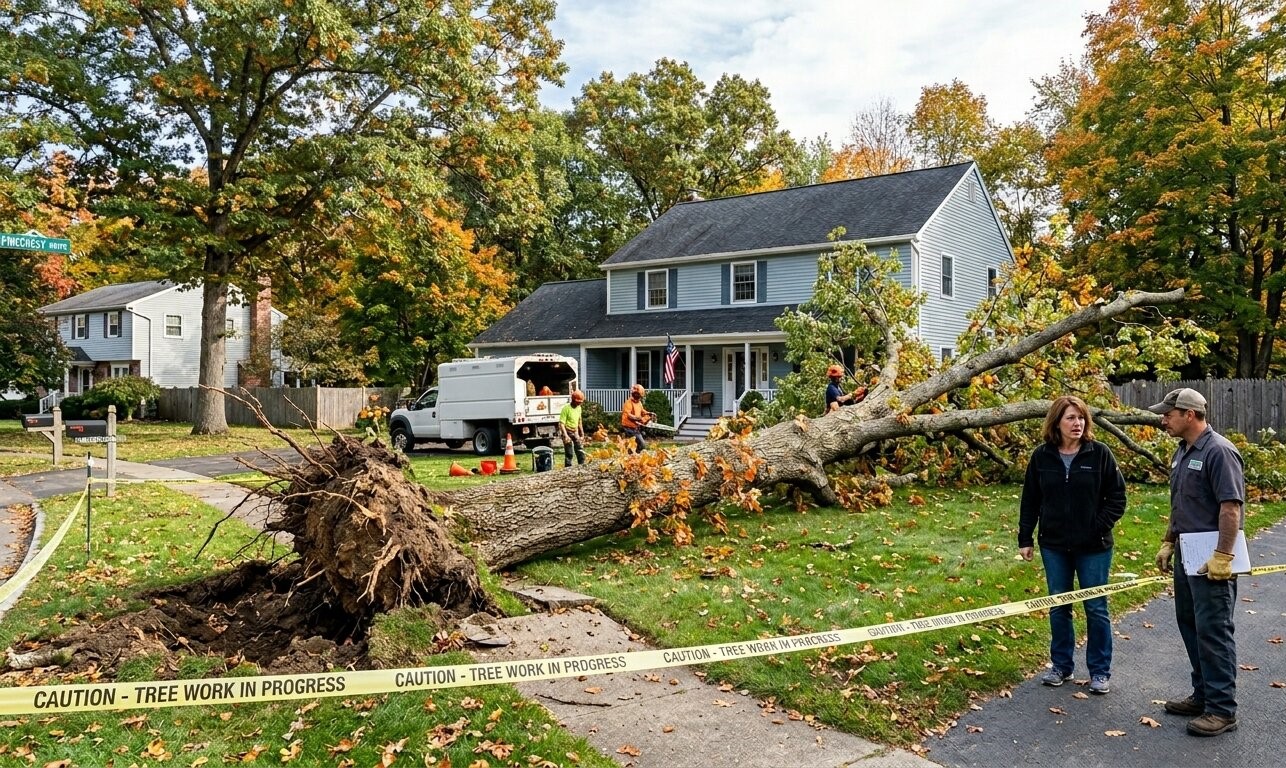
    It’s 2:00 AM. A severe Capital District storm is howling outside, throwing heavy rain against your windows. Suddenly, a deafening, structural CRACK echoes through your house, followed by a violent thud that shakes your foundation. You grab a flashlight, look out into your yard, and see a massive, 70-foot mature Oak or White Pine sprawled across your driveway, blocking your cars, tearing down utility lines, and resting precariously on your roofline near Western Avenue.

    In that exact moment, panic sets in. Your immediate instinct might be to put on boots, grab a consumer grade chainsaw from the garage, or start aggressively calling your insurance agent. Stop. Handling a multi ton fallen tree removal in Guilderland NY requires a calculated, safety first blueprint. Making the wrong move in the first 60 minutes can result in severe personal injury, thousands of dollars in uncovered property damage, or a flatly denied insurance claim. As seasoned tree care professionals who handle storm damage across Albany County week in and week out, here is your real world, step-by-step survival guide.

    1. The Immediate 60 Minute Emergency Protocol

    When thousands of pounds of unstable timber collapse onto a residential property, the environment changes instantly. Follow this operational triage sequence to secure your family and property.

    Step 1: Establish a Safety Perimeter & Evacuate if Necessary

    Before you look at the damage, account for every human and pet in the household. If the tree has physically breached your living space, punctured the roof, or cracked the structural framing of your home, evacuate the house immediately.

    Secondary structural collapses can happen hours after the initial impact as the house settles under dynamic, deadweight loads. Move your family to a safe area or a neighbor’s home down the road.

    Step 2: Survey for “Invisible” Utility Hazards

    Look up before you look down. Capital District storms frequently tear down high-voltage distribution lines along major local arteries like Carman Road or Route 146. If the fallen tree or its outer canopy is touching, leaning on, or even within a few feet of overhead utility wires, do not touch anything in your yard.

    The Ground Conduction Threat: Wet soil and foliage can conduct electricity across an entire wet lawn.

    Action: Do not approach your vehicle or the tree. Immediately call National Grid at 1-800-867-5222 or dial 911 if you notice sparking, smoke, or active fire.

    Step 3: Document for the Adjuster (Before Moving Anything)

    Once the scene is stable and you are 100% safe, pull out your smartphone. You need high-resolution photographic evidence to satisfy local insurance adjusters who look for any reason to lower payouts.

    Wide-Angle Context Shots: Capture the entire tree, showing exactly where it stood and where it landed.

    Point of Failure: Take close-ups of the root ball or the trunk snap. This proves whether the tree failed due to sudden wind shear or pre-existing rot.

    Property Damage Specifics: Photograph structural impact points on your roof, gutters, fencing, or vehicles from multiple angles.

    Step 4: Secure Emergency Mitigation (The 24/7 Dispatch)

    Do not wait for an insurance adjuster to visit your property before calling a professional crew. Homeowners insurance policies contain a mandatory “Duties After Loss” clause, which legally obligates you to take immediate action to prevent further damage to your property (such as rainwater pouring through a punctured roof).

    Call an emergency crew that offers 24/7 Emergency Tree Service in Guilderland NY. Call (518) 625-8733 for immediate emergency crane dispatch and structural tarping to protect your home from subsequent rain damage.

    2. Why Trees Topple in Guilderland: The Ground Reality

    To understand why a tree suddenly fails, you have to look below the surface. Guilderland’s unique geography makes it highly susceptible to specific types of tree failures, especially during seasonal Capital District weather shifts.

    The Sandy Pine Bush vs. Heavy Clay Dynamic

    Guilderland’s geology is diverse. Areas closer to the Albany Pine Bush Preserve feature highly sandy, loose soils, whereas other pockets of the town sit on dense, poorly draining clay layers.

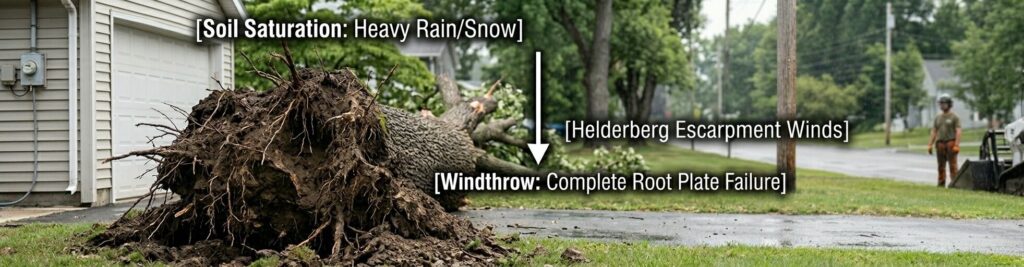
    When we experience heavy, consecutive days of rain or rapid spring snowmelts, the ground becomes completely oversaturated. The clay traps the water, turning the subsurface soil into a loose, liquid slurry.

    The Helderberg Wind Factor

    When high-velocity winds sweep down from the nearby Helderberg Escarpment, mature trees with large, full leaf canopies act like giant sails. If the roots are anchored in saturated, muddy soil, the lateral force causes a phenomenon known as windthrow. Instead of the trunk snapping, the entire root plate completely lifts out of the ground, shifting sidewalks, driveways, and lawns along with it.

    3. Insurance Myths vs. Real World Liability

    When a tree falls across a property line, neighborly relationships can fracture quickly. Let’s separate legal facts from common neighborhood myths regarding who pays for the cleanup.

    The “Act of God” Principle

    If a healthy tree on your neighbor’s property falls into your yard during a high-wind storm or an ice accumulation event, who is responsible? Your insurance policy covers your yard, and their insurance covers theirs. In the insurance world, sudden severe weather is classified as an “Act of God.” It does not matter that the trunk was rooted on your neighbor’s side of the property line; your homeowners insurance company will handle the structural removal and debris cleanup on your side, minus your deductible.

    The Negligence Exception

    The only time your neighbor is financially liable for a tree falling into your yard is if you can prove prior negligence.

    The Legal Baseline: If the neighbor’s tree was visibly dead, completely rotted, hollowed out by wood-boring insects, or leaning dangerously for months, and they ignored the hazard, they are liable. If you previously sent them a polite, certified letter with photos from an ISA Certified Arborist warning them of the hazard, their insurance carrier will likely have to pay for your property damage due to failure to maintain the property.

    4. The Extreme Danger of DIY Chainsaw Tree Removal

    Every year, hospital emergency rooms across Albany County treat homeowners who attempted to clean up storm debris themselves. Cutting a fallen tree is fundamentally different from slicing firewood on a flat chopping block.

    Emergency Tree Removal Guilderland NY

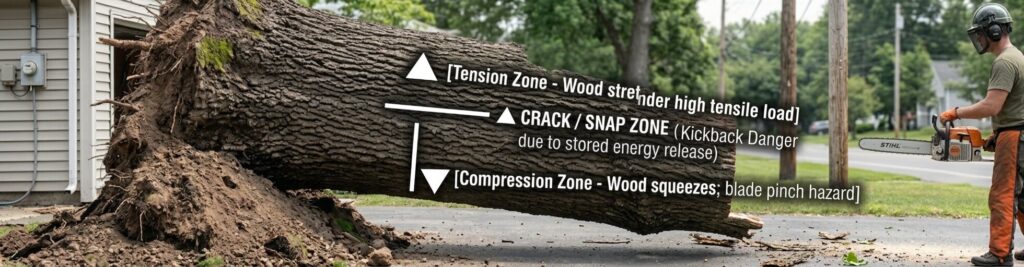
    Compression, Tension, and Springpoles

    When a tree falls, it traps immense kinetic energy within its branches.

    Tension: Branches on the outer curve of a bend are stretched tightly like a recurve bow. Cutting into a tensioned branch causes it to snap violently outward (kickback), which can instantly shatter bones or throw a heavy chainsaw back into the operator’s face.

    Compression: Branches underneath the tree are compressed by the weight of the trunk. Cutting them causes the guide bar of your chainsaw to become instantly pinched and trapped, leaving you vulnerable next to an unstable log.

    The Root Ball Trap

    When a fully uprooted tree is severed near its base without proper equipment securing it, the physics shift instantly. The massive root ball, balanced under heavy tension by hundreds of pounds of root-bound soil, can suddenly roll right back down into its original hole like a giant trapdoor, crushing anyone standing underneath it. Professional crews use heavy-duty Stihl MS 462 professional saws, specialized rigging, and skid steers to safely bleed off this mechanical energy step-by-step.

    5. What Real Life Tree Removal Costs in Guilderland

    Let’s talk transparent numbers. No professional can give an exact quote without seeing the specific situation, but emergency operations generally follow a strict risk-and-resource matrix.

    Cost Breakdown Matrix

    Service LevelEstimated Price RangeWhat’s Included / Key Variables
    Emergency Triage & Tarping$600 – $2,500After-hours mobilization, stabilizing a tree resting on a roof, applying heavy-duty structural tarps over holes.
    Standard Crane-Assisted Removal$1,500 – $4,500+Bringing in a heavy crane to lift multi-ton log sections cleanly off a house without scratching siding or damaging roofs.
    Basic Yard Debris Chipping$400 – $1,200Dragging limbs to a high-capacity industrial chipper, processing brush into wood chips, and hauling it away.
    Deep Stump Grinding$300 – $950Grinding the main stump and primary root flares down 6 to 12 inches below grade so you can replant grass.

    Critical Factors That Change the Bill

    – Target Involvement: A tree lying safely in an open lawn is straightforward. A tree leaning over high-voltage power lines or resting inside a second-story master bedroom requires slow, highly technical rigging, which increases labor time.

    – Equipment Accessibility: Can a 24-ton crane or a specialized spider lift drive directly into your backyard, or must the crew cut, carry, and rig every log manually out of a tight property gap?

    Licensed & Insured • 24/7 Emergency Response • Insurance Documentation Support

    6. Proactive Storm Proofing: Stop the Next Fall

    The easiest way to deal with an emergency tree removal cost is to avoid it entirely. Before the next major storm pattern moves through the Capital District, take a walk through your property and audit your tree canopy for these high-risk warning signs:

    – Co-Dominant Stems (The “V” Crotch): Trees that split into two equal-sized main trunks forming a sharp “V” shape lack a continuous wood fiber connection at the base. Under the weight of heavy ice or twisting wind, these are the number one structural points to fail, splitting right down the center.

    – Fungal Shelf Mushrooms: If you see large, woody mushrooms growing out of the base of your tree or directly from the root flares, it means internal wood-decay fungi are actively eating away the structural heartwood of your tree. It may look green on top, but it is hollow and structurally compromised inside.

    – Proactive Canopy Thinning: Having an expert perform structural pruning reduces the “sail effect.” By selectively removing weak, crossing, or dead inner limbs, wind can blow cleanly through the canopy rather than catching it and ripping the roots out of the ground.

    Guilderland Quick Reference Emergency Contacts

    When a tree failure threatens your safety, utilities, or property structure, use this localized directory for an immediate response:

    – Life Threatening Crushes / Fires / Injuries: Dial 911

    – Town of Guilderland Police (Non-Emergency Line): (518) 356-1501

    – National Grid (To Report Fallen Power Lines): 1-800-867-5222

    – Town of Guilderland Highway Dept (Trees Blocking Public Roads): (518) 861-5108

    – Expert Emergency Tree Service & Crane Support: Call (518) 625-8733 for immediate dispatch, storm damage stabilization, and insurance-compliant crane clearing throughout Guilderland, Albany County, and surrounding areas.

  • How to Prepare Your Yard for Heavy Snow and Ice in Albany, NY

    How to Prepare Your Yard for Heavy Snow and Ice in Albany, NY

    Winter is fast approaching, and with it comes the white blanket of snow that can both enhance the beauty and challenge the gardening and landscaping maintenance. In some areas, the first snowflakes have already fallen, so preparing the outdoors becomes imperative. No matter if you have tender plants, majestic trees, sculptured shrubs or a beautiful lawn that you wish to be the center of attention during the frosty months, there are some measures that will be taken to secure your landscaping.

    In this step by step, we will tell you and help you through the entire process of preparing your Albany, NY yard for winter. This will cover everything from fall yard cleanup to protecting your trees and preventing damage that is caused by heavy snow and ice.

    Understanding the Albany Winter Climate

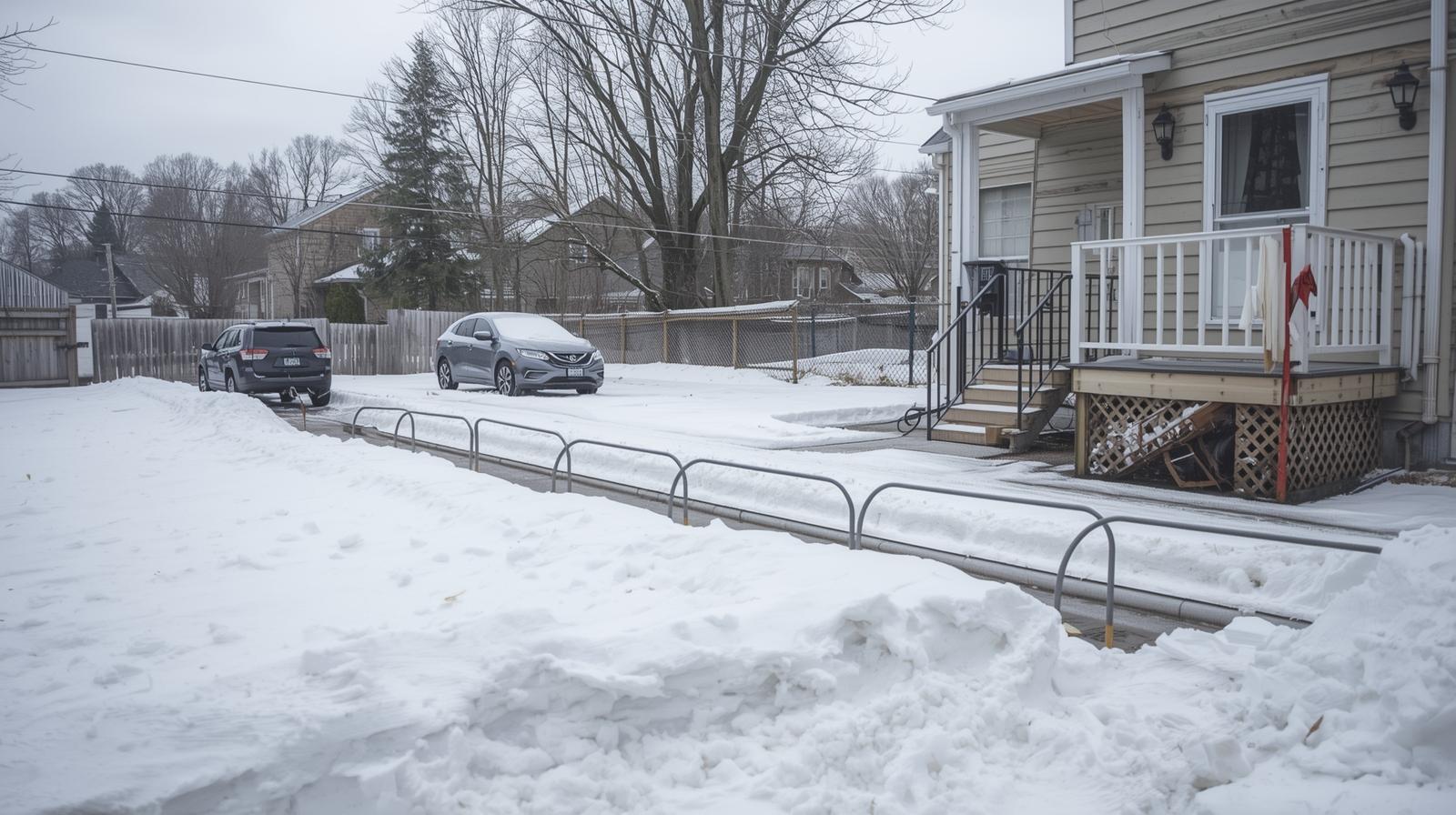
    Albany, NY, is known for its cold, snowy winters. The city often receives over 60 inches of snow each year, and temperatures can drop well below freezing. Ice accumulation on trees, driveways, and rooftops is also common. This means homeowners need to take proactive steps to protect their landscapes and outdoor areas before the snow begins to fall.

    If you don’t prepare yard for winter, the combination of snow weight, ice buildup, and freezing soil can cause significant snow and ice yard damage like broken branches, cracked pathways, and ruined plants.

    Start with a Thorough Fall Yard Cleanup

    tree service Albany NY

    A proper fall yard cleanup is the foundation for winter preparation. This step helps remove debris that can trap moisture, invite pests, and lead to mold or rot once the snow starts to melt.

    Rake up fallen leaves, remove twigs, and clear out dead plants from your garden beds. If you have trees that drop a lot of leaves, don’t let them smother your lawn. A thick layer of leaves can block sunlight and air circulation, which damages the grass beneath.

    Cut back perennials, trim overgrown bushes, and pull out weeds before they go dormant. When spring comes, you are guaranteed that the lawn area will be healthy and will sprout again.

    In addition to cleaning the yard in fall, it is also a great time to aerate and fertilize your lawn. The reason for this is that the aeration will bring oxygen and nutrients to the roots before the soil freezes, while the fertilizer will supply the soil with the necessary nutrients so it can be strong during winter rest.

    Snow and Ice Protection for Trees and Shrubs

    The weight of heavy snow and ice can crack or break branches, particularly those of young and delicate trees. To prevent snow and ice damage in your yard, check your trees and shrubs before winter comes. Cut the dead or weak branches that are likely to break under the weight off.

    You can cover small trees and delicate shrubs with burlap or tree wrap to protect them from cold winds and frost. The plants that are not accustomed to the Albany climate will benefit the most from this treatment. Also, wrapping them protects them from deer and rodents that might gnaw on the bark when food is scarce.

    In the case of taller trees, prune on a selective basis to develop strong branching patterns that are able to resist snow loading. However, do not prune too much as this can weaken the tree prior to winter.

    Preparing Your Lawn for the First Freeze

    Snow will not be the only thing that will cover your lawn; it will also be the care that your lawn will receive. A strong, well prepared lawn will emerge from its hiding place, the snow, faster in the spring. Mow your lawn for the last time, but this time make it a bit shorter than usual, around 2 to 2.5 inches high.

    If the grass is left too long, it can become matted down by snow, leading to mold and disease. If it’s cut too short, it becomes vulnerable to freezing. Finding the right balance is key when you prepare yard for winter.

    Also, clear away any debris or furniture left on the lawn. Items like garden hoses, chairs, or toys can create dead patches or dents in the grass when trapped under snow for months.

    Hardscapes and Outdoor Features protection

    Driveways, patios, and walkways should not be forgotten when you prepare yard for winter Albany NY. Snow and ice can get into tiny fissures of concrete and stone surfaces, leading to the cracking of the surface when the temperature dips.

    Outdoor furniture has to be washed and stored in a place that is dry or at least covered with waterproof coverings. Hoses should be drained and stored, the outdoor water valves should be turned off, and irrigation systems should be emptied to avoid the occurrence of freezing pipes.

    If there is a deck, it should be cleaned thoroughly and a weatherproof finish should be applied to protect it from moisture and ice.

    Protection of Garden Beds and Flowering Plants

    Winter is a hard time for perennial plants but they can still manage it with the help of autumn care. After your fall yard cleanup, spread a layer of mulch over the gardens as part of your prepare yard for winter routine. The mid-layer of soil, where the mulch is applied, helps retention of the heat from the ground, which means that it won’t freeze so fast and there won’t be harmful root damage from temperature fluctuations.

    Avoid using heavy mulch too early in the season, as it can trap moisture and encourage rot. Wait until the ground has started to freeze lightly before applying it.

    For more official guidance on tree and storm safety, visit the New York State Department of Environmental Conservation, https://dec.ny.gov/nature/forests-trees/private-forest-management.

    Planning Ahead for Next Spring

    When you take the time to prepare yard for winter, you’re also setting yourself up for a better spring. Your lawn and plants will recover faster, your hardscapes will remain in good shape, and you’ll have less cleanup to do when the snow melts.

    Winter preparation might feel like a chore, but it’s a valuable investment in your home’s curb appeal and overall property health. Albany winters can be harsh, but with a little effort in the fall, your yard will thrive year after year.

    FAQ

    1. When is the best time to start my yard preparation for winter in Albany?

    You should consider initiating your fall yard cleanup along with winter preparation in the late October to early November period as ground freeze and heavy snow is not yet in place.

    2.What are the ways to protect my plants from yard damage caused by snow and ice?

    You can protect your most fragile plants by using burlap or frost cloth, mulching, and gently removing snow from around the plants right after the storms.

    3. Would it be a good idea to fertilize my lawn prior to winter?

    Indeed, applying late-fall fertilizer not only helps in making grass roots strong but also prepares them for the cold season hence giving a healthier lawn in spring.

    4. Is it a must to clear the whole lawn of leaves?

    Yes, the presence of thick layers of leaves on your lawn can lead to mold and also the grass will be choked under the snow.

    5. In case of a time shortage, how can I prepare my yard for winter Albany NY?

    Just do the essentials: rake leaves, trim trees, drain hoses, and cover delicate plants. Even a small effort can prevent major snow and ice yard damage.
    If you want expert help getting your yard ready, give KD Tree Service Albany NY a call, (518) 625-8733.

  • The Complete Fall Tree Care Guide for New York Homeowners

    The Complete Fall Tree Care Guide for New York Homeowners

    Fall is a wonderful time of the year; the temperature starts to cool down and provides beautiful fall color for many trees. Fall is known to be the best season to plant trees due to the ideal temperatures, dormancy approaching on all trees, lessening plant stress, and the adequate soil temperatures needed for optimum tree growth.

    Fall also brings more rain and soil moisture, creating an increased amount of root growth and development. Due to transpiration being low, it allows optimal root generation. With temperatures moderate to cool, it is easier on the plants, allowing a lesser chance for transplant shock and less stress from the extreme summer heat. Planting in the earlier part of the Fall also allows for the most optimum plant growth before cooler winter temperatures arrive.  As fall approaches, be sure to take full advantage of the season. It is widely spoken that fall is the best time to plant trees and shrubs.For professional fall tree care in New York, KD Tree Services provides certified arborist support to keep your trees healthy and ready for winter.

    Why Fall Tree Care Is Important

    Fall is a crucial season for tree maintenance because it allows trees to prepare for the challenges of winter. Leaves dropping, cooler temperatures, and frost can stress trees if they aren’t properly cared for. Following a reliable fall tree care guide New York ensures that your trees are strong, healthy, and better equipped to handle the winter. Seasonal tree care in New York also reduces the risk of damage from heavy snow, ice, and cold winds.

    Caring for your trees now can prevent common problems such as weak branches, disease, and pest infestations. It’s much simpler to take care of these problems in the fall than to fix damage once winter has set in. Using fall tree care tips NY can also boost your property’s value and appearance, helping your landscape stay healthy, colorful, and well cared for.

    Assessing Your Trees Before Winter

    The first thing any homeowner should do in a fall tree care guide New York is check the overall health of their trees. Look out for signs of disease, dead branches, or structural problems that could get worse once winter arrives. Trees with damaged limbs are more likely to break under heavy snow or ice.

    Taking the time to inspect your trees also shows you where pruning or fertilizing might be needed. A careful assessment makes your autumn tree maintenance more focused and effective. Trees that receive attention in the fall are generally healthier and more resilient when spring arrives.

    For more guidance on proper tree care in New York, visit the NY State DEC’s forest management page, https://dec.ny.gov/nature/forests-trees.

    Fall Pruning & Care

    Pruning is one of the most important aspects of fall tree care New York homeowners. To help prevent branches from breaking during winter storms, remove any dead, weak, or brittle branches. Pay special attention to branches that cross over or rub together. Open cuts from branches that rub against one another can lead to damage, creating an entry point for pests or diseases. This is an important part of fall tree care tips NY.

    Yet, trees must not be over-pruned. Trees do need enough leaves to help buffer them during winter. Proper pruning and autumn tree maintenance do help in having trees and shrubs built for strength to better handle winter, and this will also help promote growth in spring. Doing this requires clean, sharp pruning tools to help minimize damage to the tree, following a reliable fall tree care guide New York.

    Winter Preparation

    Winter tree care also begins with proper pruning through autumn. Part of this pre-winter tree care is the addition of mulch around the tree’s base to help protect the roots and prevent the soil from freezing. Mulch also aids in preventing the soil from drying out and adds nutrients as it decomposes.

    Wrapping younger trees or those that are more delicate with protective materials can also minimize the risk of frost cracks and reduce damage from winter winds. Deeply watering them before the ground freezes will help provide hydration that lasts through winter. Proper tree care practices during this time are key to effective seasonal tree care in New York and will greatly help maintain tree health and extend longevity.

    Fertilizing and Soil Care

    Fertilizing in the fall provides essential nutrients that help trees survive winter and grow vigorously in spring. Be sure to use a slow-release fertilizer that suits your tree type and follow the instructions carefully to avoid overfeeding.

    Soil care is pivotal in seasonal tree care in New York as well. Manage the pH and texture of the soil to make sure it is a friend to the roots. The addition of compost and/or organic matter will enhance the soil structure and nutrient content. Healthy trees need a strong foundational soil. 

    At this time of year, check for and manage any pests and diseases that might damage your trees over the winter. Check for problematic insects, fungus, and general signs of stress.

    Treating issues early with appropriate methods is part of a smart fall tree care guide New York.

    Regular inspections and preventative care, such as removing fallen leaves and debris, reduce the chance of disease spreading. Healthy trees are more resilient and have less likelihood of being affected by pests in the upcoming seasons, making fall tree care New York practices even more effective.

    Tips by Type of Tree

    Every type of tree can have a slightly different set of fall tree care tips NY. As an example, evergreens may need more protection from wind and snow, while deciduous trees benefit more from pruning and root care. Recognizing the specific requirements of your trees ensures your efforts in pre-winter tree care are effective.

    Every New York property owner can identify the optimal approaches for each type of tree on their land by consulting a local arborist or following a comprehensive tree care guide for NY homeowners. Local knowledge helps ensure your autumn tree maintenance is appropriate for the predominant climate and soil conditions in New York.

    You can find a trusted professional in New York, https://kdtreeservices.com/hire-certified-arborist-new-york/.

    Benefits of Following a Fall Tree Care Guide

    Using a detailed fall tree care guide New York offers several clear benefits. Your trees stay stronger, healthier, and better protected against winter damage. Taking care of them properly helps them grow well, lowers the risk of disease, and keeps your yard looking its best. On top of that, well-kept trees add value to your property and make your outdoor space more enjoyable for your family.

    Spending time on fall tree care tips NY now can help you avoid bigger problems later, like costly treatments or tree replacements. The small effort in autumn pays off in the form of healthy, thriving trees year-round.

    FAQs

    What is the best time for tree pruning in New York during the fall?


    Late autumn, after leaves have fallen but before the first heavy frost, is the best time to prune most trees.

    Yes, applying a slow-release fertilizer in autumn helps trees to store nutrients for winter and encourages spring growth.

    Applying mulch around the tree’s base, covering the trunk, and giving a deep watering to the tree before the ground freezes are some of the ways.

    You can do simple tasks like mulching and light pruning by yourself, but for large trees or major pruning, hiring a certified arborist is recommended.

    Fall tree care makes the trees winter resilient, less prone to diseases and pests, and thus your yard is always beautiful and safe.

    By using this fall tree care guide New York, homeowners can keep their trees stronger and healthier while getting them ready for winter. Following these fall tree care tips NY helps your property stay attractive, safe, and well looked after all season. Proper autumn tree maintenance and pre-winter tree care safeguard your trees and make sure your landscape is ready to thrive come spring.

    For the best care for your trees this fall, reach out to KD Tree Services for expert guidance and hands-on help (518) 625-8733.

    Primary keyword fall tree care guide New York Secondary keyword fall tree care tips NY LSI autumn tree maintenance, pre-winter tree care, fall pruning & care, preparing trees for winter, seasonal tree care in New York Geotargeted keyword fall tree care New York, tree care guide NY homeowners