[email protected] ⚡ Same-day emergency available

Category: Tree Removal

  • How to Hire a Reliable Insured Tree Service in Voorheesville NY

    How to Hire a Reliable Insured Tree Service in Voorheesville NY

    When a mature oak starts leaning heavily after a severe storm along the Helderberg Escarpment, a dying ash tree begins dropping heavy limbs over your driveway, or overgrown branches stretch dangerously close to your home’s roofline, hiring a professional contractor becomes an immediate priority. For homeowners throughout Albany County, managing structural landscape hazards is an inevitable part of property maintenance.

    Many property owners begin their search by typing tree service Voorheesville NY into a search engine, expecting every company that appears in the local search results to offer identical standards of safety, legal compliance, and operational skill. In reality, local tree care operations differ dramatically in their technical experience, insurance liability coverage, and safety practices.

    Choosing the right contractor isn’t merely about finding someone with a chainsaw it’s about selecting an authoritative professional who understands hyper-local tree biology, maintains proper legal protections, and possesses the specialized rigging expertise to complete the job without creating unexpected liabilities for your property. This guide will walk you through everything you need to know to make a safe, smart, and cost-effective hiring decision.

    💡 Key Takeaways

    1. Comprehensive Financial Protection: Hiring an insured tree removal company protects your home, assets, and personal finances from catastrophic loss during high-risk removals.
    2. Non Negotiable Credentials: Always prioritize checking arborist insurance by requesting an active certificate of insurance sent directly from the issuing agency to verify policy endorsements before any equipment touches your property.
    3. Hyper Local Environmental Factors: Regional geographic realities such as the brittle nature of local ash trees or shallow limestone soils require specialized equipment and deep localized knowledge.
    4. Variable Cost Drivers: Your actual voorheesville tree cutting cost is dictated by tree diameter, architectural hazards, and structural access constraints, rather than basic height measurements.
    5. Transparent Service Execution: Highly rated local tree professionals rely on clear, straightforward communication providing fully itemized, written contracts that guarantee explicit safety protocols and lawn protection measures before work begins.

    🛡️ Why Hiring an Insured Tree Removal Company Matters

    Tree removal and high-altitude pruning consistently rank among the most hazardous utility services in New York state. Every single property layout requires a complex matrix of risk assessment, structural weight calculation, friction rigging, and heavy machinery operation. Unlike standard home remodeling projects, an operational error in tree care can cause immediate, irreversible structural damage to your home, underground lines, or neighbor’s property.

    Consider a mature sugar maple growing along tight property lines in the Village Center of Voorheesville. Removing it safely requires evaluating its natural lean, internal hollows, surrounding overhead utility lines, and structural drop zones. If yard access is restricted, the canopy must be dismantled piece-by-piece using advanced arboricultural rigging ropes, blocks, and lowering devices, or handled with a crane assist.

    [Hazardous Tree Assessment] 
           │
           ├──► Restricted Access? ──► [Compact Spider Lifts / Climbing Rigging]
           │
           └──► Open Access? ───────► [Bucket Trucks / Crane-Assisted Removal]
    

    When a contractor operates without deep training or carries inadequate insurance, homeowners are exposed to severe risks:

    1. Structural structural damage to roofs, siding, foundations, or fences.
    2. Immediate personal liability for severe ground crew or climber injuries.
    3. Catastrophic structural damage from unexpected trunk splits or rigging failures.
    4. Compromised public utility connections and city repair fines.
    5. Unfinished cleanup, leaving massive logs and dangerous debris on your lawn.

    An authoritative tree service approaches your property with a systematic safety blueprint rather than relying on guesswork. This operational protocol ensures that your property, your family, and the crew remain protected throughout the entire project.

    🗺️ Understanding the Unique Tree Care Challenges in Voorheesville

    When searching for a reliable arborist near me, it is critical to seek out a team with distinct regional geographic knowledge. Trees do not grow under identical conditions across New York, and the specific ecosystem flanking Albany County introduces distinct variables that directly impact tree structural integrity and removal strategies.

    Residential and commercial properties across Voorheesville feature an array of mature native and introduced canopy species:

    1. Hardwoods: Red Maple, Sugar Maple, White Oak, Black Walnut, Shagbark Hickory.
    2. Softwoods: Eastern White Pine, Norway Spruce, Eastern Hemlock.
    3. High Risk Target Species: White Ash, Green Ash, Aging Norway Maples.

    ⛰️ The Helderberg Escarpment & Soil Dynamics

    Properties situated near the base of the Helderberg Escarpment or spreading out toward Thacher Park navigate highly specific terrain profiles. The region is defined by shallow, rocky limestone soils. This shallow root-zone environment prevents large trees like the white oak or red maple from establishing deep, vertical taproots. Instead, they develop wide, shallow lateral root plates.

    During seasonal periods of heavy spring saturation followed by sudden autumn wind events, these shallow root systems are highly susceptible to wind-throw (complete uprooting). A localized tree expert recognizes these soil limitations and checks for subtle soil heaving or root flare decay during every routine property evaluation.

    🐛 The Emerald Ash Borer Crisis

    Across Albany County, the invasive Emerald Ash Borer (EAB) has severely impacted the local ash tree population. This is a critical structural consideration for homeowners. Once an ash tree is killed by EAB, the wood loses internal moisture and structural elasticity exceptionally fast.

    Critical Safety Hazard: Dead ash trees become notoriously brittle within months. They are prone to sudden structural failure, breaking apart at the trunk or dropping massive canopy limbs unexpectedly.

    Because of this rapid decay, standard climbing techniques are often highly unsafe. A leading tree service will not permit a climber to ascend a severely degraded ash tree; instead, they will deploy specialized compact spider lifts or crane systems to systematically dismantle the hazard tree from above without placing dynamic load on the unstable trunk.

    [EAB Infested Ash Tree] ──► Rapid Internal Moisture Loss ──► Brittle Trunk ──► Climbing Unsafe ──► Requires Crane / Aerial Lift
    

    🔍 Checking Arborist Insurance: The Complete Verification Blueprint

    Hearing a tree company say they’re “fully insured” isn’t enough. Before any work begins, ask for proof of insurance. A reputable tree service will gladly provide documentation to help protect your home, property, and peace of mind.

                      [Insurance Verification Stream]
                                     │
       ┌─────────────────────────────┴─────────────────────────────┐
       ▼                                                           ▼
    [General Liability Insurance]                       [Workers' Comp Insurance]
      • Covers structural damage to property              • Covers crew injuries on your property
      • Must specify "Tree Removal"                       • Shields homeowner from civil lawsuits
    

    🏡 1. General Liability Insurance

    This coverage protects against accidental structural damage to your property or neighboring structures during the project. If a lowering line snaps and a multi-ton trunk section crashes through your roof, a comprehensive tree service damage insurance policy handles the structural restoration costs.

    The Contractor Loophole: Many unendorsed landscape operators carry basic, low-cost commercial liability insurance meant for ground-level lawn care. These policies frequently contain explicit exclusion clauses for aerial tree operations, tree removal, or any work performed above 15 feet. If an unendorsed landscaper damages your home, their carrier will deny the claim, instantly shifting the financial burden onto your personal homeowners policy or your own pocket.

    👷 2. Workers’ Compensation Insurance

    Professional tree care is inherently high-risk work, making workers’ compensation coverage non-negotiable. This coverage ensures that if a climber, groundman, or equipment operator is injured while on your property, their medical expenses, lost wages, and rehabilitation costs are fully covered by the employer’s insurance provider.

    The Homeowner Liability Trap: New York State labor laws place an extraordinary burden of care on property owners. If you hire an uninsured crew and a worker suffers an injury on your land, you can be held personally liable for their medical expenses and long-term damages through a civil lawsuit. Your standard homeowners insurance policy may explicitly deny coverage for commercial workplace accidents occurring on your property if you hired an unlicensed, uninsured entity.

    📑 Step-by-Step Certificate of Insurance Verification Protocol

    To ensure you are fully protected by true insurance coverage, never accept a photocopied or printed paper certificate handed over by a salesman. Follow this professional verification process:

    1. Request a Direct Issue: Instruct the tree service to have their independent insurance agency email a current certificate of insurance (COI) directly to you, listing your full name and physical address as the official “Certificate Holder.”
    2. Verify the Class Codes: Look closely at the operations description box on the COI. Confirm that the policy explicitly includes specialized tree pruning, trimming, and hazardous removal classifications (such as NY Class Code 0106 or equivalent comprehensive tree care designations).
    3. Confirm Dates and Status: Verify that the policy effective dates comfortably cover the entire duration of your scheduled tree project.
    4. Perform an Agency Check: If you want absolute certainty, call the independent insurance agency listed on the document to verify that the policy number is active, in good standing, and has not been cancelled due to non-payment.

    💰 Decoding Voorheesville Tree Cutting Cost

    Understanding the cost structure of regional tree services helps you evaluate bids intelligently without sacrificing safety or quality. Tree care estimates vary because they are built around site-specific risk management and labor hours rather than a fixed menu price.

    📊 Tree Removal Cost Estimator (Regional Ranges)

    The following data reflects current local market realities for professional, fully insured tree care operations in Albany County:

    Tree ClassificationTypical Height / ScopeAverage Local Price RangePrimary Equipment & Crew Profile
    Small / OrnamentalUnder 30 feet (e.g., Birch, Dogwood)$250 – $6002-3 Man Crew, Light Chainsaws, Commercial Brush Chipper
    Medium Canopy30 to 60 feet (e.g., Declining Ash, Pine)$600 – $1,5003-4 Man Crew, Medium Aerial Lift Truck, Complex Rigging Kits
    Large Mature Hazard60 to 80+ feet (e.g., Heavy Oak over roof)$1,500 – $3,500+4-5 Man Crew, Crane Assist, Large Grapple Trucks, Ground Protection Mats
    Emergency Post-StormImmediate response for uprooted/failed trees$2,000 – $5,000+Rapid Mobilization, Hazardous Rigging under structural tension

    🛠️ Key Factors That Shape Your Written Estimate

    When an arborist provides an estimate for voorheesville tree cutting cost, they analyze several specific operational variables:

    1. Trunk Diameter at Breast Height (DBH): Total height is only one part of the equation. A short tree with a wide, massive trunk contains significantly more wood volume, weighs vastly more, and requires far more labor to cut, process, and haul away than a tall, slender pine.
    2. Structural Integrity & Decay: Counterintuitively, a completely dead tree often costs more to remove than a living one. If advanced fungal decay, hollow cavities, or EAB damage has made the wood brittle, the crew must take extensive extra safety steps, set up remote anchor points, or utilize cranes, which adds to the overall operational time.
    3. Equipment Access Realities: Can heavy machinery drive directly up to the base of the tree? If a yard has narrow gates, steep grades, delicate manicured turf, or septic lines that prevent a 30-ton bucket truck from entering, the crew must climb manually or utilize lightweight compact lifts. This extra handling increases the total labor hours required.
    4. Proximity to Urban Targets: Trees hanging directly over residential structures, public roads, delicate pools, or primary power lines require highly technical lowering procedures. Each section must be tied off, cut, and lowered slowly to prevent impact damage, which extends the job duration.

    🔍 What Separates a Reliable Tree Service from an Average Contractor?

    True reliability is measured by a contractor’s systematic approach to risk management, client communication, and site preservation. When evaluating local tree services, look for these key operational standards that indicate professional execution.

    1. Comprehensive On Site Appraisals

    A professional tree care company will rarely, if ever, issue a firm financial quote over the telephone or from a single text-message photograph. An arborist must physically walk the property to assess structural lean, locate overhead hazards, evaluate soil stability, and identify access routes for heavy machinery.

    2. Evidence-Based Recommendations

    Unreliable operations often push for immediate, costly removals on every tree they inspect. In contrast, an expert arborist evaluates whether a tree can be safely preserved through targeted structural pruning, crown reduction, or dynamic cabling systems. If a removal is deemed necessary, they will walk you through the diagnostic evidence—such as deep trunk fissures, structural root rot, or severe canopy dieback—so you can make an informed decision.

    3. Deployment of Specialized, Task Specific Machinery

    Using the correct tool for the specific architectural challenge reduces property risk and cuts down on labor hours. Top-tier crews do not rely on standard rigging systems for every situation; they utilize advanced tools ranging from low-impact articulated dumpers to massive cranes designed to lift multi-ton log sections cleanly over a residential roof structure without touching the lawn.

    🛠️ The Professional Estimate: What to Look For

    When evaluating written estimates from competing local contractors, remember that the lowest price is often missing critical operational phases. A professional, itemized proposal should explicitly detail the following components to prevent sudden cost increases:

        [Anatomy of a Professional Estimate]
        ├── Detailed scope of work per individual tree
        ├── Explicit rigging & heavy equipment disclosures
        ├── Comprehensive cleanup parameters (chipping, raking)
        └── Transparent stump processing & haul-away fees
    

    Scope of Work Breakdown

    The written proposal should clearly isolate each tree chosen for service and define the exact action to be taken. If a tree is marked for pruning, the contract should clarify the specific methodology (e.g., canopy thinning, deadwood removal down to 2 inches in diameter, or clearance pruning away from structural walls).

    Equipment and Surface Protection Clauses

    Heavy equipment can easily ruin a manicured lawn or crack a thin residential driveway. A high-quality estimate will state exactly what machinery will be brought onto the property and define the specific precautions the crew will take to safeguard your turf, such as laying down high-density polyethylene ground protection mats.

    Explicit Cleanup Disclosures

    One of the most frequent causes of homeowner frustration is an unexpected cleanup fee. Ensure your contract explicitly states whether the contractor is responsible for chipping all brush, raking the surrounding lawn for twigs and sawdust, cutting trunk wood into manageable firewood logs, or hauling away the heavy timber entirely.

    Licensed & Insured • 24/7 Emergency Response • Insurance Documentation Support

    ❓ Frequently Asked Questions

    What insurance should a tree removal company have in Voorheesville?

    A professional tree removal company operating in Voorheesville must carry a minimum of $1,000,000 in Commercial General Liability Insurance to cover accidental property damage, along with an active Workers’ Compensation Insurance policy to protect all crew members on your land. They should also maintain comprehensive commercial auto insurance for all heavy trucks and equipment on site. Always request a current certificate of insurance issued directly by their carrier to confirm these policies do not contain exclusions for professional aerial tree work.

    Does homeowners insurance cover emergency tree removal in New York?

    If a structurally sound tree falls due to a sudden, covered environmental event such as a severe windstorm or ice accumulation your homeowners insurance policy will typically help cover the costs of removing the tree from covered structures like your roof or garage. However, if a tree falls because it was left dead, decayed, or neglected for years, the insurance company may deny the claim due to owner negligence. Preventive removal of a hazardous standing tree is almost never covered by insurance.

    What is the difference between stump grinding and complete stump removal?

    Stump grinding uses a high-speed hydraulic machine to shred the wood down 6 to 12 inches below ground level, leaving the deep root structural system to decay naturally. Complete stump removal requires large excavators to physically dig the entire root ball out of the earth. Grinding is significantly more cost-effective and much less disruptive to your surrounding lawn and landscaping.

    Why are verbal agreements risky in professional tree care?

    Verbal agreements offer no legal protection if a project goes wrong. Without an itemized, written contract, a homeowner has no way to hold a company accountable for unexpected property damage, incomplete debris cleanup, or sudden price increases once the tree is down. Professional contractors always provide detailed digital or physical proposals outlining the complete scope of work before setting foot on your property.

    How does the condition of a tree affect its removal cost?

    Counterintuitively, a completely dead tree often costs more to remove than a living one. When a tree stays dead for an extended period, the wood fibers dry out and become unstable. This structural degradation makes the tree unpredictable during cutting and dangerous for a climber to ascend, frequently requiring specialized aerial lifts or crane systems that increase the overall operational cost.

    📝 Your Tree Service Hiring Checklist

    Before signing a proposal or authorizing a crew to begin work on your property, ensure you have completed every step of this professional vetting protocol:

    1. [ ] On-Site Assessment Completed: The arborist inspected the tree’s health, structure, and surrounding hazards in person.
    2. [ ] Direct Certificate of Insurance (COI): You received an active COI directly from the contractor’s independent insurance agent.
    3. [ ] Workers’ Comp Verified: You confirmed active coverage for every crew member coming to your home.
    4. [ ] Explicit Cleanup Terms: The estimate clearly states whether brush chipping, log hauling, and lawn raking are included.
    5. [ ] Stump Disposal Defined: The proposal clarifies whether stump grinding and debris haul-away are included or require an extra fee.
    6. [ ] Property Protection Plan: The contractor explained exactly how they will prevent lawn damage from heavy trucks (e.g., using specialized protective ground mats).
    7. [ ] Authentic Customer Reviews Check: You checked recent, detailed local reviews highlighting consistent safety, punctuality, and professionalism.
    8. [ ] Fully Itemized Proposal: You hold a signed, written contract detailing every step of the project and the final price.

    🌲 Final Thoughts: Choosing Long Term Value Over Low Cost

    Finding a premier tree service Voorheesville NY is ultimately about prioritizing safety, precision, and comprehensive asset protection over a cheap price. Tree removal is an intricate structural engineering task performed high above your home, where there is zero margin for error.

    By partnering with an experienced, fully insured tree removal company that provides verified proof of insurance, understands hyper-local environmental conditions, and uses specialized equipment, you gain complete peace of mind. Taking the time to execute proper due diligence protects your home, balances your financial risks, and ensures your landscape stays safe, functional, and beautiful for decades to come.

  • Norway Maple Removal Albany: The Complete Capital Region Property Guide

    Norway Maple Removal Albany: The Complete Capital Region Property Guide

    Property owners walking down New Scotland Avenue in Albany, New York past the bustling medical corridors of Albany Medical Center, the quiet residential side streets of the Pine Hills and Whitehall neighborhoods, or down toward St. Peter’s Hospital often admire the thick, mature tree canopy arching over our historic streets. The deep summer shade and old-growth feel are central to the historic charm of the Capital District.

    However, many of those massive, dense shade trees aren’t native to upstate New York. A massive portion of Albany’s urban forest consists of Norway Maples (Acer platanoides), a species introduced from Europe centuries ago. Today, this specific hardwood presents severe, hidden challenges for local urban infrastructure, native biodiversity, and long-term property safety.

    If you suspect you have one of these trees encroaching on your property lines, understanding your options for a professional norway maple removal albany strategy is essential for protecting your property value, avoiding catastrophic storm damage, and managing lawn health. This hyper-local guide breaks down how to accurately identify this tree, why it presents unique financial and physical risks to Albany homeowners, and how to execute a safe extraction aligned with New York State environmental frameworks.

    📞 Got a Hazardous Tree Overhanging Your Property on New Scotland Ave? Don’t wait for the next heavy Capital District storm or winter ice load to cause a structural failure. Call or text Albany’s local service team directly at (518) 625-8733 for an immediate, upfront safety evaluation and expert land clearing solutions.

    Identification: Is That a Sugar Maple or an Invasive Norway Maple?

    One of the greatest challenges in local hardwood tree care across Albany is that the Norway Maple looks strikingly similar to our beloved, native Sugar Maple (Acer saccharum). Because their leaves share the classic, iconic five-lobed maple shape, hundreds of property owners mistake an invasive hazard for a prized native tree.

    Before committing to remove norway maple canopies from your landscape, you must accurately verify the species. Their ecological footprints, wood strength, and root structures are completely opposite. To confirm if the tree on your property requires specialized management or extraction, use this standard botanical checklist before scheduling your structural evaluation:

    The Botanical Identification Matrix

    Botanical FeatureInvasive Norway Maple (Acer platanoides)Native Sugar Maple (Acer saccharum)
    Leaf Petiole SapOozes a distinct, milky white sap from the stem within seconds of being plucked.Oozes a clear, watery sap (the historical source of pure maple syrup).
    Bark TextureFeatures tight, interlocking, neat furrowed ridges forming a precise, geometric diamond pattern.Features loose, large gray plates that tend to curl outward or flake vertically as the tree matures.
    Seed Pods (Samaras)Broad, wide-angled wings spreading almost 180 degrees horizontally (resembling a bicycle handlebar).Cleanly U-shaped, narrow-angled wings resembling a pair of small wings hanging downward.
    Fall Foliage TimingTurns a dull, uniform pale yellow very late in the autumn, often stubbornly holding its leaves deep into November.Turns vibrant, brilliant shades of fiery orange, deep red, and gold early in October.
    Bud CharacteristicsFeatures large, blunt, plump purplish green buds at the tips of twigs during winter dormancy.Features sharp, pointed, narrow brown buds that resemble tiny cones.

    🚫 Why the Norway Maple is Ranked as an Invasive Tree Species in NY

    Modern search algorithms analyze the deep context of local ecosystem management when scanning digital guides. When examining the broader invasive tree species ny framework, the Norway Maple holds a prominent, heavily regulated spot.

    In 2015, the New York State Department of Environmental Conservation (NYSDEC) enacted 6 NYCRR Part 575, officially classifying the Norway Maple as a regulated invasive species within New York. This statutory designation means the species cannot be legally introduced, sold, distributed, or transported in a free-living state across the state because of the measurable, irreversible damage it inflicts on local ecosystems.

           ┌─────────────────────────────────────────────────────────┐
           │     THE DOMINO EFFECT OF NORWAY MAPLE INVASION          │
           └────────────────────────────┬────────────────────────────┘
                                        │
           ▼ Deep Canopy blocks 95%+ of sunlight from reaching ground
                                        │
           ▼ Shallow Root System aggressively siphons local soil moisture
                                        │
           ▼ Complete Understory Die-Off of native shrubs and ephemerals
                                        │
           ▼ Local Soil Erosion & structural destabilization around lawns
    

    1. Extreme Shade Monocultures

    Norway Maples leaf out significantly earlier in the spring than native hardwoods and hold their dense, dark canopies weeks later into the autumn. This extended canopy block isolates the ground below, cutting off up to 95% of ambient sunlight from reaching the forest floor or your residential lawn. This deep shade eliminates native spring ephemerals, natural wildflowers, and common turfgrasses, resulting in bare, unsightly patches of eroded soil underneath the tree’s drip line.

    2. Shallow, Aggressive Root Systems

    Unlike native oaks or deep-rooted maples that tap into deeper sub-surface water tables, Acer platanoides develops an incredibly dense, mat-like shallow root system right at the surface layer. These roots aggressively consume surface moisture and vital topsoil nutrients, outcompeting any surrounding landscaping plants, flower beds, or shrubs. Over time, this alters the local ecology tree removal balance, starving out native saplings and preventing natural forest regeneration.

    ⚠️ Infrastructure Risks Along the New Scotland Ave Corridor

    Beyond the clear environmental impact, mature Norway Maples pose tangible, high dollar structural risks to residential homes, historical sidewalks, and public utility lines along highly compressed urban avenues like New Scotland, Whitehall Road, Manning Boulevard, and Allen Street.

    Sidewalk Heaving and Foundation Damage

    Because the root systems are shallow, expansive, and grow exponentially in diameter, they naturally push upward as they thicken. Along old Albany avenues, this translates directly to buckling concrete blocks, cracked historic bluestone sidewalks, and compromised retaining walls.

    If a mature Norway Maple is situated within 10 to 15 feet of an older home’s stone or brick foundation common in the historic properties around the Pine Hills district those thick surface roots can exert immense lateral pressure against basement structures, causing water intrusion, structural bowing, and costly masonry repairs.

    Brittle Hardwood Structural Failures & Storm Vulnerability

    While Norway Maples grow rapidly, their wood fibers are notoriously weak, brittle, and prone to internal rot compared to other native northern hardwoods. As these trees age past 50–60 years, they enter a rapid decline stage, becoming highly susceptible to internal heartwood rot, severe fungal infections like Verticillium wilt, and rapid crown dieback.

    During severe upstate New York weather events whether it’s heavy winter snow loads, sudden ice storms off the Helderberg Escarpment, or intense summer thunderstorms rolling across the Hudson River Valley mature Norway Maples are frequently the first trees to drop massive, multi-ton limbs. If the tree is situated near active power lines, residential driveways, or busy commuter routes right near Albany Med, a sudden structural failure can quickly turn into an emergency property liability or cause a major localized power outage. This is why investing in professional hardwood tree care and preventative removals is so critical for urban safety.

    ┌───────────────────────────────────────────────────────────────────────────┐
    │                      NORWAY MAPLE RISK PROFILE SUMMARY                    │
    ├─────────────────────────────────────┬─────────────────────────────────────┤
    │ Risk Factor                         │ Structural & Ecological Impact       │
    ├─────────────────────────────────────┼─────────────────────────────────────┤
    │ Wood Integrity                      │ Low; highly brittle, rapid internal │
    │                                     │ decay after 50 years of growth      │
    ├─────────────────────────────────────┼─────────────────────────────────────┤
    │ Root Behavior                       │ Destructive surface flares; heaves  │
    │                                     │ sidewalks and cracks foundations    │
    ├─────────────────────────────────────┼─────────────────────────────────────┤
    │ Storm Resilience                    │ Very poor; high failure rate during │
    │                                     │ Capital District ice/wind events    │
    └─────────────────────────────────────┴─────────────────────────────────────┘
    

    🛠️ The Execution: When and How to Remove a Norway Maple

    If you have a compromised, hazardous, or ecologically damaging specimen on your urban lot, attempting a DIY extraction with a basic consumer chainsaw is highly dangerous. Large scale norway maple removal albany operations require heavy specialized equipment, advanced rigging physics, and tight compliance with local municipal codes.

    When you decide to remove norway maple populations from your yard, our experienced local field crews follow a precise, highly managed sequence designed to fully protect your home, overhead utility lines, and neighboring structures while ensuring the invasive species is eradicated permanently:

    1.Comprehensive Site Safety Assessment & Permitting Phase:Prerequisite Phase.

    The field crew maps all nearby overhead electrical drops, secondary service wires, property boundaries, and structural targets along the driveway or lawn. If the tree sits within the tight, narrow setbacks typical of residential alleys near New Scotland Ave, a specialized rigging plan is locked in before a single cut is made.

    2.Sectional Canopy Dismantling with Impact Mitigation & Cutting:Rigging & Cutting.

    Climbers or high-reach bucket truck operators ascend into the crown, dismantling limbs section-by-section. Utilizing advanced synthetic lowering lines, heavy-duty friction blocks, and specialized port-a-wraps, every limb is mechanically lowered to the ground. This prevents heavy impacts on your lawn or nearby structures.

    3.Main Trunk Felling or Vertical Chunking Lowering:Controlled Lowering.

    The main trunk is cut down in controlled vertical segments a process known as chunking if working in a zero-clearance urban backyard. If an open drop zone is available on a wider yard, a precise directional notch is cut to lay the trunk down safely along a predetermined path.

    4.Heavy-Duty Stump Grinding & Sub-Surface Flare Severing Eradication:Final Eradication.

    Norway Maples are notorious for aggressively resprouting from left-behind stump tissue. To ensure total eradication, our high-horsepower stump grinders pulverize the remaining wood down 6 to 12 inches below the surface grade. This process completely severs the immediate lateral root flares to eliminate the risk of future suckering.

    📅 Planning Your Albany Tree Arborist Consultation

    Property management is all about timing. If you are noticing structural cracks under the canopy, dying upper branches, or pavement heaving along your property line on New Scotland Ave, you should immediately schedule your structural evaluation.

    During a professional albany tree arborist consultation, a certified expert evaluates the tree’s overall lean, internal decay levels using specialized tools, and proximity to active utility grids. This process takes the guesswork out of tree management, providing you with a clear, legally compliant roadmap for protecting your property.

    🌳 Rebuilding the Canopy: Top Native Alternatives for Albany Lawns

    Once you decide to replace norway maple tree specimens from your landscape, the next critical phase is planning a long-term replanting strategy. To restore balance to our local ecology tree removal frameworks and enhance your home’s curb appeal, prioritize planting strong, native northern hardwoods.

    These species provide unmatched seasonal beauty, long structural lifespans, and essential support for local bird, pollinator, and wildlife populations. Consider these top native choices perfectly adapted to the Capital Region’s distinct soils and climate:

    1. Sugar Maple (Acer saccharum)

    The Gold Standard: The ultimate replacement option if you love the traditional maple look. It offers unmatched orange-and-red autumn color, supports local wildlife, and features a much deeper, structurally sound root system that won’t ruin nearby concrete.

    2. White Oak (Quercus alba)

    The Legacy Tree: An absolute powerhouse for the local ecosystem. White oaks live for centuries, feature remarkably strong wood fibers that easily resist heavy storm damage, and provide crucial habitat for hundreds of native insect and bird species.

    3. Red Maple (Acer rubrum)

    The Adaptable Performer: Exceptionally tolerant of wet, compacted clay soils or urban street setups, making it an excellent option for urban lawns near Washington Park or lower-lying zones along the Hudson basin. It displays a brilliant scarlet red color early every autumn.

    4. Princeton American Elm (Ulmus americana ‘Princeton’)

    1. The Historic Choice: A disease-resistant, proven cultivar that allows homeowners to bring back the iconic, high-arching, vase-shaped elm canopy that historically lined Albany’s streets before Dutch Elm disease. It is highly tolerant of urban roadside salt and stress.

    Using these specific native species to replace norway maple tree liabilities ensures that Albany’s neighborhood blocks retain their beautiful green canopies without any of the destructive infrastructure and ecosystem side effects.

    🛠️ Operational Logistics: Navigating the Removal Process in Urban Albany

    Managing a tree extraction in older, highly condensed urban clusters like the Capital District demands deep preparation. Unlike rural or suburban logging, an urban tree service must operate inside thin corridors where error thresholds are virtually zero.

    Overhead Utility Coordination & Electrical Hazards

    Older grid lines run directly through tree canopies across the Whitehall and Pine Hills neighborhoods. When branches grow around standard high voltage lines or secondary service drops running directly to your house, specialized safety measures are required:

    Line Clearance Qualification: Field crews must maintain specific OSHA certifications to operate within the Minimum Approach Distance (MAD) of energized hardware.

    Utility Drop Dropping: In high-risk scenarios, coordination with local utility companies (such as National Grid) may be necessary to temporarily disconnect and drop a residential service line while the structural trunk work occurs over a roofline.

    Navigating Zero Clearance Backyards

    Many historic homes on New Scotland Ave feature narrow alleys, detached garages, and tightly restricted backyards that completely prohibit driving heavy cranes or standard bucket trucks directly to the base of the tree. To solve this restriction, crews deploy advanced low impact rigging setups:

    [Tree Canopy Canopy] ──► [Speedline High-Wire Rigging] ──► [Controlled Drop Zone]
                                                                │
       Helps transport heavy limb sections over rooflines ──────┘
       without touching manicured turf or fencing.
    

    Friction Devices (Port-A-Wraps): Placed at the base of the tree anchor, these steel tubes allow a ground operator to absorb thousands of foot-pounds of kinetic force from a falling branch with just one hand on the lowering line.

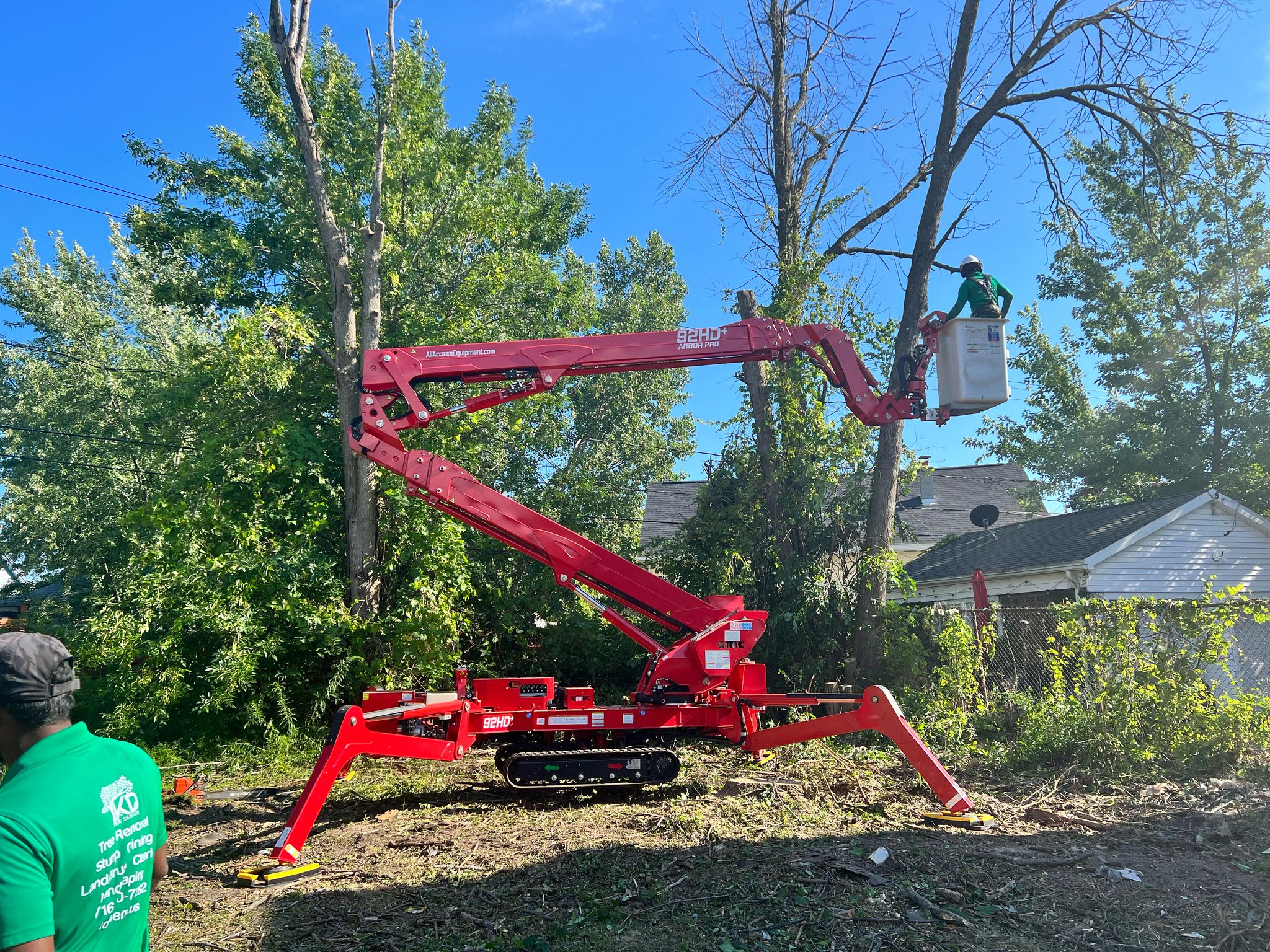
    Compact Articulated Lifts: Tracked spider lifts that fold down to widths of less than 36 inches can roll smoothly through standard pedestrian gates, expanding to provide high-access platforms without destroying sensitive underlying turf.

    ⚖️ Legal & Financial Responsibilities for Albany Property Owners

    When dealing with a massive invasive hardwood on your boundary line, clear financial and legal frameworks come into play under New York State property law and city municipal ordinances.

    The Boundary Tree Conundrum

    What happens if the trunk of a dying Norway Maple straddles the exact line dividing your lot from your neighbor’s property?

    Under New York state legal precedents, any tree whose trunk intersects a property boundary is classified as a co owned asset (boundary tree).

    Neither property owner has the legal right to completely cut down, destroy, or significantly alter the tree without obtaining explicit, written consent from the other party.

    However, if a specific branch or root system crosses over onto your property line, you maintain the legal “right to self-help,” allowing you to trim back encroaching elements precisely to the property line, provided the pruning actions do not kill or structurally destabilize the entire organism.

    “Act of God” vs. Negligence Claims

    A common question asked before heavy storm cycles is: “If my neighbor’s tree crashes through my roof during a storm, who pays for the damage?”

    The Baseline Rule: Generally, if a structurally sound, healthy tree falls due to an unexpected weather anomaly (high wind shear, ice accumulations), New York law classifies the event as an Act of God. Your individual homeowner’s insurance policy handles your structural repairs.

    The Negligence Exception: If the tree was explicitly dead, rotting, leaning dangerously, or infected, and you can prove the owner had clear knowledge of the structural hazard (such as a certified certified arborist report or a sent certified letter warning them of the danger), the scenario flips to actionable negligence. In these cases, the owner can be held personally and financially liable for all property destruction and associated removal costs.

    ❓ Frequently Asked Questions

    Are Norway Maple trees considered invasive in Albany NY?

    Yes, Norway Maple trees are officially classified as a regulated invasive species in Albany, NY, and across New York State under the 6 NYCRR Part 575 environmental conservation regulations. Because they produce dense shade that kills off lawns, develop aggressive shallow root systems that lift sidewalks, and outcompete native trees like the Sugar Maple, state and local ecological guidelines advise against planting them and strongly support their controlled removal.

    Do I need a permit for a norway maple removal albany project?

    If the tree is located entirely within your private property boundaries, a city permit is generally not required for removal. However, if the Norway Maple is located within the public right-of-way the grassy utility strip located between the sidewalk and the street curbs along New Scotland Ave it is owned and managed by the City of Albany Department of General Services. Always consult a certified professional to verify property lines before scheduling any cutting.

    Can I just girdle a Norway Maple to kill it?

    While girdling (cutting a deep ring around the bark and cambium layer) can kill the tree over time, it is highly dangerous in dense residential neighborhoods like the Pine Hills or Whitehall. A dead, standing tree quickly rots, loses structural integrity, and becomes a major hazard for falling limbs during high winds or winter freezes. Controlled cutting and immediate stump grinding are the safest management options for urban lots.

    Will heavy tree removal equipment ruin my lawn or driveway?

    Professional crews mitigate property damage by utilizing specialized ground protection mats. These heavy-duty composite mats are laid down across lawns and driveways to distribute the weight of the machinery evenly, preventing turf rutting, soil compaction, and concrete or brick cracking during the removal process.

    How much does it cost to remove a mature Norway Maple in Albany?

    The overall financial investment for extraction varies significantly based on factors like total height, structural stability, proximity to utility lines, and backyard accessibility. A tight, zero-clearance backyard extraction on New Scotland Ave requiring advanced rigging can run higher than an open-yard removal due to the extended labor time and specialized technical gear involved. Request a comprehensive on-site estimate to lock in exact costs for your layout.

    🏢 Local Property Management Note: Proactive canopy management protects your property’s value. Replacing brittle, invasive trees with structurally sound native hardwoods reduces future storm liabilities, protects historic foundations, and ensures the long-term health of Albany’s beautiful urban ecosystem.

    📞 Secure Your Property Before the Next Big Storm! Don’t risk expensive roof damage, ruptured water lines, or city fines from a failing, invasive hardwood. Protect your home and family today. Call or text our Albany field crews directly at (518) 625-8733 to lock in your expert norway maple removal albany strategy and schedule your comprehensive, on site albany tree arborist consultation right now!

  • Tree Branches Over Neighbor’s Fence in Colonie, NY: Who Is Liable?

    Tree Branches Over Neighbor’s Fence in Colonie, NY: Who Is Liable?

    If your tree branches extend over your neighbor’s property in Colonie, NY, you are not automatically liable simply because the branches cross the property line. Under New York law, neighboring property owners generally have the right to trim branches back to the property line at their own expense. However, if a tree is dead, diseased, structurally unsound, or poses a known hazard, the tree owner may be held responsible for resulting property damage or injuries.

    For homeowners dealing with overhanging limbs, property line disputes, or hazardous trees, consulting a professional tree service in Colonie NY can help prevent costly legal and insurance issues.

    Understanding Tree Ownership and Property Lines in Colonie, NY

    Trees are one of the most valuable features of residential properties throughout Colonie, Loudonville, Latham, Menands, and the greater Albany County area. Mature trees provide shade, privacy, energy savings, and curb appeal.

    Problems arise when branches begin extending over fences, driveways, roofs, or neighboring yards.

    Many homeowners ask:

    1. Who owns the branches?
    2. Can my neighbor cut them?
    3. Who pays if they fall?
    4. Can I be sued for tree damage?

    The answer depends on tree condition, property boundaries, and whether negligence is involved.

    New York Property Line Tree Rules Explained

    Under established New York property law, a homeowner generally has the right to trim portions of a neighbor’s tree that extend onto their property.

    This means a neighbor may legally:

    1. Cut overhanging branches back to the property line.
    2. Remove roots that encroach onto their property.
    3. Protect structures from tree-related damage.

    However, they cannot:

    1. Enter your property without permission.
    2. Remove the entire tree.
    3. Cause unnecessary harm that kills the tree.

    Property owners should always use proper pruning methods because excessive cutting can create safety hazards and trigger legal disputes.

    What Happens When Tree Branches Hang Over a Fence?

    When tree branches over a fence line become a problem, liability depends on whether actual damage occurs and whether the tree owner acted responsibly.

    Common complaints include:

    Falling Branches

    Large limbs can break during storms and damage:

    1. Fences
    2. Sheds
    3. Vehicles
    4. Roofs
    5. Decks

    Excessive Debris

    Overhanging trees may create:

    1. Leaf accumulation
    2. Seed pods
    3. Pine needles
    4. Sap deposits

    Blocked Sunlight

    Branches can reduce sunlight for:

    1. Gardens
    2. Lawns
    3. Solar panels
    4. Outdoor living spaces

    While these situations can be frustrating, they do not automatically create legal liability.

    Am I Liable If My Tree Branches Overhang Into My Neighbor’s Yard in NY?

    Usually, No

    Simply having branches extend over a property line does not automatically make a homeowner liable under New York law.

    The neighboring owner typically has the right to trim those branches at their own expense.

    When Liability Can Occur

    Liability becomes more likely when the tree owner knew or reasonably should have known that the tree posed a danger.

    Examples include:

    1. Dead trees
    2. Diseased trees
    3. Decaying trunks
    4. Cracked limbs
    5. Leaning trees
    6. Previous storm damage

    If a homeowner ignores obvious warning signs and damage occurs, courts may view that as negligence.

    Neighbor Tree Damage Liability: Real World Examples

    Scenario 1: Healthy Tree Falls During a Storm

    A healthy maple tree loses a limb during a severe windstorm and damages a neighboring fence.

    In many cases:

    1. Insurance handles the claim.
    2. The tree owner is not considered negligent.
    3. Liability may not exist.

    Scenario 2: Dead Tree Damages a Home

    A homeowner ignores a dead oak tree for several years despite visible decay.

    A large limb falls onto a neighbor’s garage.

    Potential outcome:

    1. Tree owner may be liable.
    2. Insurance companies may pursue reimbursement.
    3. The neighbor may seek damages.

    This is why regular tree inspections are critical.

    Boundary Tree Law in NY

    A boundary tree is a tree whose trunk grows directly on the property line.

    In these situations:

    1. Both property owners may share ownership.
    2. Both parties may have maintenance rights.
    3. Significant removal typically requires mutual agreement.

    Removing or damaging a boundary tree without consent can result in legal complications and potential financial liability.

    Tree Cutting Laws in Colonie, NY

    Before removing large trees, homeowners should understand applicable regulations.

    Factors that may affect removal include:

    Local Ordinances

    Municipal requirements can vary.

    Utility Easements

    Trees near utility lines may require specialized clearance procedures.

    Protected Trees

    Certain properties or developments may have restrictions regarding tree removal.

    HOA Rules

    Neighborhood associations may impose additional requirements.

    A licensed tree service company can help determine what permits or approvals may be necessary.

    How Tree Inspections Protect Homeowners

    One of the strongest defenses against liability claims is documentation.

    Professional arborists can perform:

    Tree Risk Assessments

    Evaluating structural stability and health.

    Disease Detection

    Identifying decay, fungus, pest infestations, and structural weakness.

    Hazard Reports

    Documenting conditions that may require corrective action.

    Preventive Maintenance

    Reducing the risk of storm-related failures.

    These reports can be valuable if insurance or legal questions arise later.

    How to Prevent Tree Disputes With Neighbors

    Most tree conflicts can be avoided through proactive communication.

    Recommended steps include:

    Inspect Trees Annually

    Routine inspections help identify problems before they become hazards.

    Prune Trees Regularly

    Proper pruning prevents excessive encroachment.

    Address Safety Concerns Quickly

    Dead limbs should be removed immediately.

    Document Maintenance

    Keep records of inspections, trimming, and arborist recommendations.

    Communicate Early

    Friendly conversations often prevent legal disputes.

    When to Call a Tree Service in Colonie, NY

    Contact a professional tree service if:

    1. Branches are touching your roof.
    2. Limbs extend over neighboring structures.
    3. Storm damage has occurred.
    4. Trees show signs of disease.
    5. Property line disputes are developing.
    6. You need a professional arborist opinion.

    Early intervention is almost always less expensive than repairing property damage.

    Why Local Homeowners Trust Professional Tree Services

    Experienced tree professionals understand:

    1. New York tree regulations
    2. Property line concerns
    3. Arboricultural best practices
    4. Risk assessment procedures
    5. Safe pruning techniques

    Working with a qualified local expert helps homeowners protect their trees, property, insurance interests, and neighbor relationships.

    Final Thoughts

    If you’re wondering whether you’re liable for tree branches hanging over your neighbor’s fence in Colonie, NY, the answer is usually no unless negligence is involved. New York property owners generally have the right to trim branches that cross property lines, but responsibility can change when hazardous conditions are ignored.

    Regular inspections, professional pruning, and proactive communication remain the best ways to prevent disputes and reduce liability. If you have concerns about a tree near a property line, consulting a professional tree service in Colonie NY can provide clarity, protect your property, and help keep your neighborhood relationships intact.

    Frequently Asked Questions

    Can my neighbor cut branches that hang over their property in New York?

    Yes. Property owners can generally trim branches back to the property line as long as they do not unnecessarily damage the tree.

    Who is responsible for trimming overhanging branches?

    Typically, the property owner affected by the overhanging branches pays for trimming on their side of the property line.

    What if my neighbor’s tree damages my fence?

    Responsibility depends on whether the tree owner was negligent. If the tree was healthy and damage occurred during a storm, insurance often handles the claim.

    Can I force my neighbor to remove a hazardous tree?

    If a tree presents a documented safety risk, legal remedies may be available. Consulting an attorney or certified arborist is recommended.

    Should I hire an arborist before trimming large branches?

    Yes. Professional arborists can ensure pruning is performed safely and in a way that protects the long-term health of the tree.

    How often should trees be inspected?

    Most mature trees should be professionally inspected every 1-3 years, with additional inspections after major storms.

  • Tree Removal in Watervliet NY: Tight Yard & Small Space Property Protection

    Tree Removal in Watervliet NY: Tight Yard & Small Space Property Protection

    Quick Answer: How do you remove a large tree from a small backyard safely?
    Professional arborists remove a large tree from a small backyard using a combination of sectional dismantling, tight space tree rigging, advanced climbing, and crane assisted tree cutting. Instead of felling the tree in one piece, the canopy and trunk are systematically cut and lowered in controlled sections. This prevents costly property damage to nearby homes, fences, and utility lines.

    Why Tight Yard Tree Removal is One of the Most Challenging Tree Services

    Many homeowners assume tree removal is simply a matter of cutting a trunk and letting it fall. In reality, handling a mature tree on a confined residential property requires meticulous engineering, specialized rigging equipment, and years of hands on experience.

    Throughout Watervliet, NY, many residential neighborhoods feature beautiful, mature trees planted decades ago. Over the years, properties evolved garages were built, decks were added, fences were installed, and utility lines were strung. Today, it is incredibly common to find giant silver maples, aging ash trees, or massive oaks looming just inches from structural foundations.

    In these high-stakes scenarios, traditional tree felling is impossible. Every single branch must be micro-managed from the top down. A single miscalculation can mean a crushed roof, a destroyed fence, or a major safety hazard for neighboring Capital Region properties.

    Why Watervliet Properties Often Require Specialized Tree Removal Methods

    The historic layout and compact residential lots in Watervliet leave zero room for error. When our crews evaluate local job sites, we frequently navigate a complex matrix of obstacles:

    1. Narrow side-yard and alleyway access
    2. Shared property boundaries and tight setbacks
    3. Detached garages and backyard sheds sitting directly under the canopy
    4. Overhead utility lines and power infrastructure
    5. Premium landscaping, decorative fencing, and concrete patios

    When a tree’s canopy extends over three different properties simultaneously, you cannot rely on guesswork. The entire removal blueprint must be mapped out before a chainsaw ever starts.

    Common Reasons Homeowners Need Tree Removal in Watervliet, NY

    Tree HazardPotential Risk in Tight YardsBest Action Plan
    Dead & Decaying WoodWeakened limbs drop without warning onto roofs or fences.Immediate sectional dismantling.
    Storm DamageCracked structural trunks from high winds or heavy ice.Emergency emergency stabilization & removal.
    Severe LeanRoot heave indicating potential structural failure toward a home.Controlled rigging and hazard mitigation.
    Diseased Species (Ash/Maple)Internal hollows that compromise the tree’s lifting integrity.Crane-assisted extraction to avoid climbing weak structures.

    The Capital Region Weather Factor

    Living in the Capital Region means our trees endure extreme seasonal shifts. From heavy, wet spring snows and violent summer thunderstorms to severe Nor’easters and freezing winter ice, local trees are constantly under stress. Saturated soils combined with high winds turn structurally compromised trees in tight yards into ticking time bombs. Waiting for the next big storm to hit is a high risk gamble.

    What is Tight Space Tree Rigging?

    When branches cannot fall freely, we utilize tight space tree rigging. This is a highly technical discipline that uses physics and specialized gear to defy gravity and steer heavy wood away from obstacles.

    An advanced rigging setup includes:

    1. High tensile arborist ropes and friction brakes (lowering devices)
    2. Arborist blocks, pulleys, and impact-rated slings
    3. Redirect anchors to steer limbs away from structures

    Why Rigging Matters

    Without heavy-duty rigging systems, even a medium-sized branch falling from 40 feet can puncture a roof, crush vinyl fencing, or rip down local power lines. Proper rigging ensures that even a 1,000-pound limb transitions smoothly from the sky to a designated drop zone on the ground without leaving a scratch on your property.

    How Professionals Safely Remove a Tree From a Small Backyard

    [1. Site Assessment] ➔ [2. Site Protection] ➔ [3. Sectional Rigging] ➔ [4. Controlled Lowering] ➔ [5. Stump Grinding]
    
    1. Comprehensive Site Assessment: We inspect the tree’s structural integrity, identify structural hazards, map out drop zones, and clear nearby utility risks.
    2. Property & Site Protection: Ground protection mats are laid down to protect your lawn, and shields are placed over delicate landscaping or structural windows.
    3. Canopy Reduction via Sectional Dismantling: A skilled climber or lift operator begins at the lowest limbs, securing each branch to a rigging line before making precision cuts.
    4. Controlled Lowering & Trunk Dismantling: The ground crew manages the friction device, lowering the cut sections smoothly. The main trunk is then systematically cut into small “logs” and lowered piece by piece.
    5. Debris Processing & Optional Stump Grinding: All brush is fed into a chipper, logs are hauled away, and the remaining stump can be ground down well below grade to reclaim your yard space.

    When Crane Assisted Tree Cutting is Necessary

    Traditional climbing and rigging are highly effective, but certain scenarios demand crane assisted tree cutting. This approach is used when a tree is too unstable to climb safely or when access is completely cut off by structures.

    1. Maximum Safety: The crane holds the weight of the tree section before it is cut, completely eliminating dynamic drops or swinging loads.
    2. Zero Footprint: Massive sections are lifted vertically straight up into the air and flown over roofs directly to the street, completely bypassing your lawn, fences, and garden beds.
    3. Incredible Efficiency: What might take two days of traditional rigging can often be executed safely via crane in just a fraction of the time.

    Does Tight Yard Tree Removal Cost More?

    Yes, tight space tree removal typically requires a higher investment than clearing a tree in an open field. The cost is a direct reflection of the meticulous safety measures required:

    1. Labor & Time: Navigating tight spaces and lowering wood piece-by-piece takes longer to execute safely.
    2. Specialized Equipment: The use of heavy-duty rigging gear, aerial lifts, or commercial cranes impacts operational costs.
    3. Risk Mitigation: The additional setup required to guarantee the protection of your home, garage, and neighboring properties.

    While the upfront cost may be higher, investing in a highly specialized crew saves you from the massive financial headache of property damage caused by inexperienced cutting.

    Frequently Asked Questions

    How do you remove a large tree from a small backyard safely?

    We use a specialized method called sectional dismantling alongside tight space tree rigging. The tree is cut down into highly manageable pieces from the top down and lowered using ropes and pulleys to protect nearby structures.

    Will the heavy equipment damage my lawn or fence?

    No. Professional crews utilize ground protection mats to distribute weight and prevent lawn ruts. For tight clearances, we rely on precision rigging and cranes to lift heavy tree limbs cleanly over fences without making contact.

    How do I know if my tree requires a crane for removal?

    If a tree is severely decayed, structurally compromised by a storm, or completely inaccessible by foot or lift, a crane is often the safest and most practical option. A certified arborist will determine this during your initial site consultation.

    What are the dangers of hiring an un-insured or inexperienced tree cutter?

    Hiring an amateur significantly exposes you to severe liability. If a tree section drops onto your roof or a neighbor’s property, or if an un-insured worker is injured on your job site, you could be held financially responsible for damages and medical bills. Always verify specialized experience, liability insurance, and worker’s compensation.

    Final Thoughts: Work With Watervliet’s Conned Space Experts

    Managing large trees on compact properties is a highly technical craft. Successfully protecting your home, family, and neighboring property requires deep local knowledge, cutting-edge rigging systems, and an absolute refusal to cut corners.

    Whether you are dealing with an unstable silver maple hanging over your garage, an ash tree suffering from dieback, or an overgrown oak encroaching on your foundation, proactive removal is always the safest, most cost-effective solution. Don’t wait for a Capital Region storm to make the decision for you.

    Request Your Free Tight Space Tree Consultation Today

    As Watervliet’s trusted local arborists, KD Tree Service Albany NY specializes in zero impact, high risk confined space tree removals. Our team is fully licensed, heavily insured, and equipped with compact spider lifts and precision rigging gear to handle the tightest backyards safely.

    📞 Call Us Today: (518) 625-8733

    💻 Get a Free Estimate Online: https://kdtreeservices.com/service-location/albany-ny/

    📍 View Our Location on Google Maps: https://maps.app.goo.gl/F2aDHZXmK5mYt2qo9

    Serving Watervliet, Troy, Latham, Albany and the surrounding Capital Region with 24/7 emergency tree support.

  • Do You Need a Permit to Remove a Tree in Albany NY? Everything Homeowners Need to Know

    Do You Need a Permit to Remove a Tree in Albany NY? Everything Homeowners Need to Know

    Quick Answer

    If you’re wondering whether you need an Albany NY tree removal permit, the answer depends on where the tree is located and whether it falls under city regulations.

    Trees located on public property, within street rights-of-way, or affected by development projects may require approval from local authorities. For trees located entirely on private property, requirements can vary depending on zoning regulations, development activity, historic district considerations, and other local requirements.

    Pro Tip: Before removing any tree, verify ownership and permit requirements with the City of Albany. A quick phone call can help prevent delays, fines, and costly mistakes.

    Why Tree Removal Permits Matter in Albany

    Trees are a valuable part of Albany’s urban landscape. They provide shade, improve air quality, reduce stormwater runoff, increase curb appeal, and contribute to property values throughout neighborhoods such as Pine Hills, Center Square, Arbor Hill, Buckingham Lake, Helderberg, Delaware Avenue, and the Mansion District.

    To preserve these benefits, Albany regulates certain tre related activities through its urban forestry program.

    Removing a tree without understanding local requirements can lead to:

    1. Project delays
    2. Enforcement actions
    3. Potential fines
    4. Replacement obligations
    5. Additional costs

    Understanding the rules before work begins can save homeowners significant time and frustration.

    Do You Need a Permit to Cut Down a Tree on Your Property in Albany?

    One of the most common questions homeowners ask is:

    “Do I need a permit to cut down a tree on my property in Albany?”

    In many situations, homeowners have greater flexibility when removing trees located entirely on private property. However, permit requirements or additional review may apply when:

    1. The tree is located within a public right-of-way.
    2. The removal is associated with a development project.
    3. Local zoning regulations apply.
    4. Historic district requirements are involved.
    5. Site plan review is required.
    6. The tree impacts public infrastructure.

    Because every property is unique, homeowners should confirm current requirements before scheduling removal work.

    In Our Experience: The Most Common Tree Permit Mistake

    One of the most common misunderstandings among Albany homeowners involves trees located between the sidewalk and the street.

    Many residents assume these trees belong to them because they sit directly in front of their property. However, in many cases these trees are located within a public right-of-way and may fall under city oversight.

    We’ve found that verifying ownership before hiring a tree service company can prevent unnecessary delays and avoid potential compliance issues.

    Albany Tree Removal Permit: Public Trees vs. Private Trees

    Understanding ownership is one of the most important parts of determining whether approval may be required.

    Public Trees

    Public trees are commonly located:

    1. Along streets
    2. Near sidewalks
    3. Between sidewalks and curbs
    4. Within public parks
    5. On municipal property
    6. Inside public rights-of-way

    These trees are generally managed through the city’s forestry program.

    Private Trees

    Private trees are generally located entirely within property boundaries and outside public easements or city managed areas.

    However, privately owned trees may still be subject to review in certain situations involving development, zoning, or historic districts.

    Albany DGS Forestry Rules Homeowners Should Know

    Albany’s Forestry Division helps manage and maintain public trees throughout the city.

    Its responsibilities include:

    1. Tree planting
    2. Tree pruning
    3. Hazard tree assessments
    4. Urban forest management
    5. Public tree removal
    6. Tree maintenance
    7. Stump management

    The goal is to balance public safety, environmental benefits, and long term tree preservation.

    Permit vs. No Permit: Common Albany Tree Removal Scenarios

    SituationPermit or Approval May Be Required?
    Tree located in public right-of-wayOften Yes
    Tree located in a city parkYes
    Development-related tree removalOften Yes
    Tree entirely on private propertyDepends on circumstances
    Tree within a historic districtMay require review
    Storm-damaged emergency treeCase-by-case
    Tree affecting public infrastructureOften Yes

    This table provides general guidance. Property owners should verify requirements before proceeding.

    How to Apply for a Tree Work Permit in Albany

    If a tree falls under city jurisdiction, follow these general steps:

    Step 1: Verify Tree Ownership

    Determine whether the tree is located:

    1. On private property
    2. Within a public right-of-way
    3. On municipal land
    4. Near public infrastructure

    Step 2: Contact the Appropriate Department

    Reach out to the City’s Forestry Division to discuss the proposed work.

    Step 3: Provide Property Information

    Be prepared to provide:

    1. Property address
    2. Tree location
    3. Description of proposed work
    4. Relevant project details

    Step 4: Schedule an Inspection

    Certain situations may require an inspection before work can proceed.

    Step 5: Obtain Approval Before Starting Work

    Do not begin removal, pruning, or other regulated work until any required approvals have been obtained.

    Why Tree Ownership Verification Matters

    Tree ownership often determines whether approval is required.

    Homeowners in Pine Hills, Center Square, Arbor Hill, Buckingham Lake, and Helderberg frequently encounter mature trees located near sidewalks, curbs, and roadways.

    While these trees may appear to belong to the adjacent property owner, they may actually be located within a city right-of-way.

    Verifying ownership first can help avoid permit issues and unexpected project delays.

    Common Situations That Trigger Permit Questions

    Dead Trees

    Dead trees can create safety hazards, but ownership and location still matter.

    Hazardous Trees

    Trees showing signs of decay, instability, or structural failure may require professional evaluation.

    Storm Damaged Trees

    Severe weather can create emergency situations that require prompt action.

    Construction Projects

    Land clearing, additions, utility work, and redevelopment projects often trigger additional review requirements.

    Utility Conflicts

    Trees located near power lines or public utilities may require coordination with additional parties before work begins.

    Local Considerations for Albany Neighborhoods

    Tree removal concerns often arise in neighborhoods with mature tree canopies, including:

    1. Pine Hills
    2. Center Square
    3. Arbor Hill
    4. Buckingham Lake
    5. Helderberg
    6. Delaware Avenue
    7. Mansion District
    8. West Hill
    9. New Scotland Area

    These neighborhoods contain many established trees that contribute significantly to community character and property values.

    What Happens If You Remove a Regulated Tree Without Approval?

    Removing a regulated tree without authorization may result in:

    1. Municipal violations
    2. Enforcement actions
    3. Financial penalties
    4. Restoration requirements
    5. Replacement obligations

    The outcome depends on the circumstances and applicable regulations.

    Tree Removal Guidelines in New York State

    In addition to Albany regulations, New York property owners should remember:

    Property Rights Matter

    You generally cannot remove a tree located on someone else’s property without permission.

    Boundary Trees Can Be Complicated

    Trees located on property lines may involve shared ownership considerations.

    Local Rules Often Take Priority

    Municipal ordinances frequently establish additional requirements beyond general property rights.

    Key Takeaways

    1. Albany regulates certain tree removals to protect its urban forest.
    2. Trees located within public rights-of-way often require city approval.
    3. Development-related projects may trigger additional review requirements.
    4. Tree ownership should always be verified before removal.
    5. Historic districts may have additional considerations.
    6. Consulting local authorities can help avoid costly mistakes.

    People Also Ask

    Can I Remove a Dead Tree Without a Permit in Albany?

    Possibly, but ownership and location should always be verified first.

    Is There a Fee for a Tree Work Permit?

    Permit requirements and fees can change. Always verify current requirements with the city.

    How Long Does Permit Approval Take?

    Approval timelines vary depending on workload, project complexity, and inspection requirements.

    Can I Trim a Tree Located in the City Right-of-Way?

    Work on trees located within public rights-of-way may require authorization.

    Can a Tree Service Company Handle the Permit Process?

    Many professional tree service companies help homeowners navigate local requirements.

    Frequently Asked Questions

    Do I need a permit to cut down a tree on my property in Albany?

    Requirements depend on ownership, location, zoning considerations, development activity, and other factors.

    Who owns the tree between the sidewalk and street?

    Many trees in this area are located within a public right-of-way and may fall under city jurisdiction.

    How do I know if a tree belongs to the city?

    Trees located near sidewalks, curbs, streets, or public easements may be regulated by the city.

    What happens if I remove a city-owned tree?

    Unauthorized removal may result in penalties or enforcement actions.

    Can I remove a tree near power lines?

    Trees near utility lines should be evaluated carefully and may require coordination with utility providers.

    Are emergency tree removals handled differently?

    Emergency situations may involve different procedures depending on public safety concerns.

    Do construction projects require tree review?

    Many development and construction projects require additional review related to existing trees.

    Can I prune a public tree myself?

    Public trees may be subject to city regulations. Verify requirements before performing work.

    Who should I contact before removing a tree?

    If ownership or permit requirements are unclear, contact the City before proceeding.

    Are historic districts subject to additional review?

    Certain locations and projects may involve additional review requirements.

    Related Resources

    Homeowners researching tree care may also find these topics helpful:

    1. Tree Removal Cost in Albany, NY
    2. Emergency Tree Removal Services
    3. Stump Grinding vs. Stump Removal
    4. Tree Trimming vs. Tree Removal
    5. Signs a Tree Needs Professional Evaluation

    Final Homeowner Checklist

    Before removing any tree in Albany:

    ✔ Verify tree ownership.

    ✔ Determine whether the tree is located within a public right-of-way.

    ✔ Confirm whether development or zoning approvals apply.

    ✔ Check for historic district considerations.

    ✔ Consult local authorities if ownership is unclear.

    ✔ Hire a qualified arborist when necessary.

    ✔ Obtain required approvals before beginning work.

    Final Thoughts

    If you’re researching Albany, NY tree removal permit requirements, the most important step is determining whether the tree is privately owned or falls under city jurisdiction.

    While many private-property tree removals may involve fewer restrictions, trees located within public rights-of-way, development projects, or historically sensitive areas may require additional review.

    Taking a few minutes to verify ownership and requirements before starting work can help prevent delays, avoid costly mistakes, and ensure compliance with local regulations.

    When in doubt, consult local authorities and qualified tree professionals before removing any tree.

  • Roadside Tree Removal Permits & Traffic Safety in Latham, NY: The Complete Property Owner’s Guide

    Roadside trees add immense aesthetic value, shade, and environmental benefits to neighborhoods throughout Latham, NY. However, when a roadside tree becomes dead, structurally compromised, or heavily decayed, it transforms into an immediate liability. A failing tree risks striking motorists, blocking pedestrian walkways, knocking out three-phase utility lines, and damaging nearby commercial or residential structures.

    Unlike standard backyard tree care, executing a tree removal adjacent to an active thoroughfare requires complex permit navigation, strict traffic safety setups, multi-agency coordination, and absolute regulatory compliance. Whether you are a local homeowner, a commercial property manager, an HOA representative, or a business owner along a major corridor, this guide breaks down exactly how to manage roadside tree care safely, legally, and efficiently while understanding when professional tree removal services may be necessary to protect public safety and remain compliant with local regulations.

    Quick Answer: Do You Need a Permit for Roadside Tree Removal in Latham, NY?

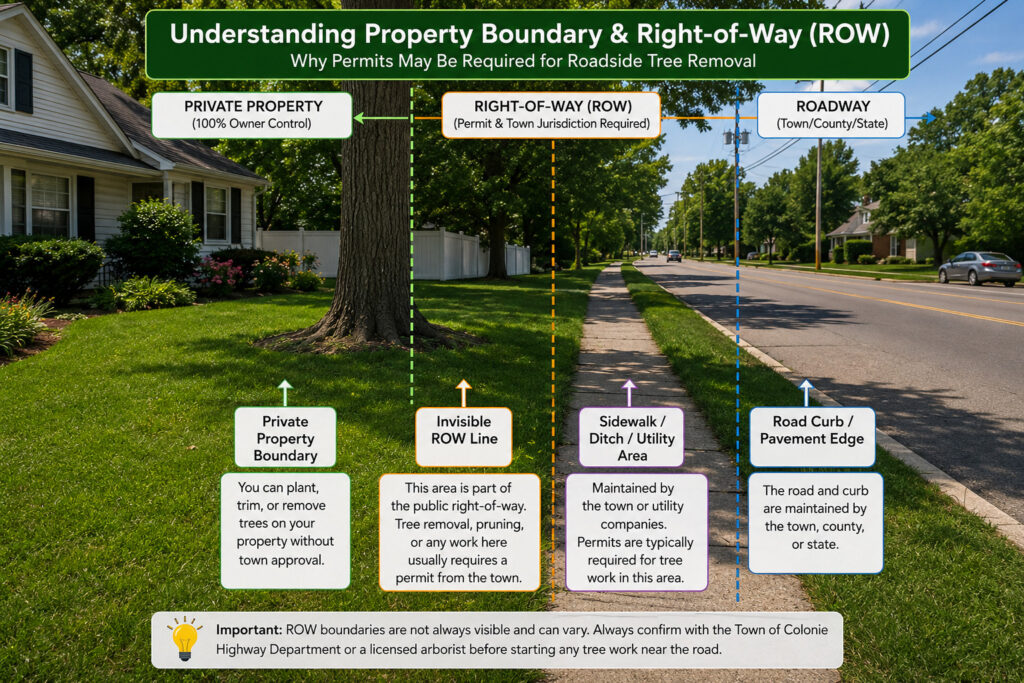
    Yes, in the vast majority of cases. Because Latham is an unincorporated hamlet within the Town of Colonie, regulatory oversight depends entirely on the tree’s proximity to the public right-of-way (ROW).

    A formal permit, municipal approval, or utility clearance is strictly required if:

    1. The tree’s trunk sits partially or fully within a public right-of-way or municipal easement.
    2. The physical removal operations require partial lane closures, shoulder obstructions, or sidewalk blocks.
    3. The canopy or root system interfaces directly with overhead primary power distribution lines.
    4. The tree borders municipal, Albany County, or New York State-controlled roadways.
    Tree Removal latham Albany NY

    Why Roadside Tree Care Requires Advanced 20 Year Industry Expertise

    Dropping a tree in an open backyard is straightforward. Cutting down a massive canopy tree next to an active, moving roadway leaves zero margin for error. Professional tree crews must proactively mitigate dynamic variables that do not exist in standard residential jobs:

    1. Dynamic Vehicle Traffic & Driver Distraction: Managing real time traffic speeds while maintaining safe operating footprints.
    2. Pedestrian Interception: Securing busy walkways, bus stops, and school zones from overhead debris.
    3. High Voltage Utility Coexistence: Safely rigging massive limbs down around active National Grid primary lines.
    4. Restricted Critical Drop Zones: Working in narrow corridors sandwiched between asphalt highways, structural storefronts, and underground infrastructure.
    5. Emergency Routing: Maintaining absolute clarity for fire, EMS, and police vehicles passing through active work areas.

    Common Indicators Demanding Roadside Tree Removal in Latham

    Property managers and local authorities regularly monitor roadside lines for specific structural failure signs. If your roadside trees exhibit any of the following, prompt action is necessary:

    1. Structural Deadwood & Brittle Limbs

    Dead trees shed moisture and cell elasticity rapidly. Deprived of living sapwood, major leaders become highly brittle, making them prone to snapping under minimal wind loads and dropping directly onto travel lanes.

    2. Capital Region Storm Damage

    Severe weather across Albany County places immense stress on roadside canopies. Trees frequently suffer catastrophic structural breakdown from:

    1. Heavy Ice Accumulation: Weighting down lateral limbs until they shear off.
    2. Wet, Dense Snow Loading: Snapping central leader trunks.
    3. High Summer Wind Shear & Microbursts: Twisting asymmetric canopies and loosening root stability.

    3. Progressive Truncal Lean

    A tree that develops a sudden or progressive lean toward a road, commercial parking area, or sidewalk demands immediate, proactive extraction before a complete root-plate failure occurs.

    4. Sight Triangle Obstructions (Visibility Hazards)

    Overgrown roadside trees can block critical lines of sight. Municipalities require clear lines of vision, meaning trees must be removed or heavily pruned if they obscure:

    1. Regulatory traffic signs, signals, and flashing lights.
    2. Approaching vehicles at intersections and blind corners.
    3. Commercial curb cuts, driveways, and pedestrian crosswalks.

    5. Advanced Heartwood Rot & Internal Fungal Decay

    Fungal brackets (conks) at the base or deep cavities along the trunk signify advanced internal decay. When the structural integrity of the heartwood compromises, the tree risks completely shearing at the base during a storm.

    Deciphering Roadway Right-of-Way (ROW) Jurisdictions in Latham

    Determining who owns a roadside tree depends entirely on the specific road classification. In Latham, public roadways are segmented into three distinct management tiers:

    Roadway Type / HierarchyPrimary Managing AgencyKey Local Examples in Latham, NY
    Local Hamlet RoadsTown of Colonie Highway DepartmentResidential subdivisions, secondary connector streets
    County RoadsAlbany County Department of Public WorksMajor routes feeding into neighboring towns
    State HighwaysNew York State Department of Transportation (NYSDOT)Route 9 (Loudon Rd), Route 7 (Troy-Schenectady Rd), Albany Shaker Rd

    If a hazardous tree is rooted entirely inside the official ROW of any of these entities, unauthorized cutting by a private property owner is highly illegal. However, if the trunk sits on your private property but its dead canopy hangs over a state or town road, you retain full liability for any damage or injury caused by falling limbs.

    Who Holds Legal & Financial Responsibility for Roadside Trees?

    Is the tree trunk inside the public property/ROW line?
     ├── YES ──► Municipal, County, or State DOT responsibility.
     └── NO  ──► 100% Private Property Owner responsibility (Even if limbs overhang the road).
    
    1. Private Property Owners: Responsible for trees rooted on their deeded land. If a known dead tree on your property falls onto a road, insurance companies can classify it as owner negligence rather than an “Act of God.”
    2. Town of Colonie Highway Division: Manages proactive trimming and emergency clearing within the ROW of over 330 miles of dedicated Town roads.
    3. Albany County Highway Authorities: Maintains clearance profiles along designated county highway properties.
    4. NYSDOT (New York State DOT): Maintains absolute authority over tree removal and canopy clearances on state infrastructure like Route 9.
    5. National Grid (Utility Provider): If a tree or limb poses an imminent threat to high-voltage lines, National Grid’s utility contractors may execute drastic line-clearance pruning to safeguard regional grid stability.

    Advanced Traffic Safety Protocols During Roadside Removals

    To insulate the public from danger, professional crews implement rigid Maintenance and Protection of Traffic (MPT) guidelines that conform strictly to state standards.

    1. Advanced Reflective Signage: High-visibility orange warning arrays (e.g., “Tree Work Ahead”) placed at calculated distances to alert oncoming drivers.
    2. Channelizing Safety Devices: Heavy-duty traffic cones, reflective drums, and physical barricades to clearly map a smooth vehicular transition zone around operations.
    3. Certified Traffic Flaggers: Stationed strategically at opposite ends of two-lane setups to coordinate safe, alternating single-lane traffic flow in real-time.
    4. Engineered Temporary Lane Closures: Coordinated ahead of time with local law enforcement to safely position high-reach bucket trucks and heavy cranes.
    5. Pedestrian Intercept Containment: Physically barricading walkways to prevent foot traffic from walking beneath active overhead rigging systems.
    6. Machinery Exclusion Footprints: Keeping an absolute safety buffer around commercial log loaders, heavy-duty wood chippers, and crane outriggers to protect bystanders from mechanical swing zones.

    Executing Complex Removals Near Route 9, Loudon Road & Commercial Arteries

    Operating along Latham’s high-traffic business sectors—such as Route 9 (Loudon Road), Route 7 (Troy-Schenectady Road), and surrounding school zones—presents distinct logistical hurdles. High daily traffic volumes, dense commercial entryways, and compressed utility lines eliminate the possibility of traditional felling methods.

    To execute tree care seamlessly here, experienced commercial crews utilize heavy-duty, crane-assisted rigging. By securing the tree sections to a crane hook before making the cut, operators can lift massive timber pieces vertically into the air and swing them safely away from traffic into a controlled processing zone. These high-stress operations are frequently scheduled during off-peak windows to eliminate local traffic bottlenecks and protect commercial access points.

    Dedicated Commercial Roadside Tree Services

    For corporate stakeholders, retail center managers, real estate developers, and local HOAs, roadside tree hazards pose massive financial, operational, and liability challenges. Commercial roadside projects routinely support:

    1. Major retail strip centers and sprawling corporate office parks.
    2. Multi-family residential complexes and multi-acre townhome developments.
    3. Medical office campuses and institutional facilities.

    Commercial properties demand meticulous risk mitigation. A professional tree service provides comprehensive structural asset management by delivering formal traffic control blueprints, absolute utility verification records, multi-million dollar commercial general liability policies, and synchronized scheduling designed to protect your day-to-day business operations.

    How Much Does Roadside Tree Removal Cost in Latham, NY?

    Because roadside tree removals incorporate significant safety logistics and specialized heavy machinery, costs are calculated across several operational variables:

    1. Tree Dimensions & Condition: Tall, heavy-canopy structures or unstable, hollow trees require more meticulous rigging steps and increased crew hours.
    2. Proximity to Live Travel Lanes: Jobs directly touching active curbs necessitate more extensive MPT setups, signs, and flagging personnel, which influences base operational overhead.
    3. Heavy Equipment Deployment: Incorporating specialized high-reach bucket trucks or large-tonnage cranes introduces mechanical operational costs but significantly accelerates project timelines and safety.
    4. Utility Line Complexity: Coordinating with utility line-clearance professionals to insulate lines adds specialized safety protocols.
    5. Administrative Permit Processing: Managing site plans, engineering traffic approvals, and coordinating with Town of Colonie or state offices involves administrative hours.

    Emergency Roadside Tree Removal After Capital Region Storms

    When unpredictable weather strikes Latham, compromised trees can fail instantly. Emergency roadside tree response is prioritized immediately when:

    1. Uprooted trunks or massive broken sections completely block active roadway lanes.
    2. Fractured, high-altitude limbs hang loosely over sidewalks or parking lots (“widowmakers”).
    3. Heavy structural timber collapses directly into primary power configurations, creating a live hazard.
    4. Essential paths for emergency vehicles are entirely cutoff.

    Highly responsive emergency tree crews work in tandem with regional emergency services to efficiently cut, clear, and restore safe, normal traffic flow across Latham’s road network.

    The Roadmap of a Professional Roadside Tree Removal Project

    [1. Certified Arborist Site Assessment] 
                       │
                       ▼
    [2. Permitting & Jurisdictional Verification] 
                       │
                       ▼
    [3. MPT Traffic Control Deployment] 
                       │
                       ▼
    [4. Heavy Machinery & Crane Stabilization] 
                       │
                       ▼
    [5. Precision Sectional Rigging & Removal] 
                       │
                       ▼
    [6. Complete Debris Processing & Chipping] 
                       │
                       ▼
    [7. Final Roadway Sweeps & Reopening]
    
    1. Certified Arborist Site Assessment: The tree’s structural health, lean, internal hollows, and proximity to infrastructure are systematically analyzed to map out the safest extraction method.
    2. Permitting & Jurisdictional Verification: Crews identify whether the asset falls under private, Town, County, or State DOT jurisdiction, securing all necessary work-within-right-of-way permits before a single machine rolls out.
    3. MPT Traffic Control Deployment: Before starting any equipment, warning signage, safety cones, and flagging teams are deployed to insulate the workspace legally and physically.
    4. Heavy Machinery & Crane Stabilization: Bucket trucks, chip vans, and cranes enter the secured zone, setting down heavy-duty outrigger pads to distribute weight safely across the road shoulder or asphalt.
    5. Precision Sectional Rigging & Removal: Highly trained climbers or bucket operators piece out the canopy section-by-section, using heavy-duty rigging ropes or cranes to lower massive limbs with absolute spatial control.
    6. Complete Debris Processing & Chipping: Small branches are routed through high-horsepower wood chippers, massive trunk sections are loaded via grapple loaders onto log trucks, and sawdust is completely cleared.
    7. Final Roadway Sweeps & Reopening: The entire roadway, sidewalk, and curb footprint undergo meticulous manual sweeping to eliminate any organic hazards. Traffic control devices are packed, and full public transit safely resumes.

    Frequently Asked Questions

    Do you need a permit to remove a roadside tree in Latham, NY?

    Voice Search Answer: Yes, if the tree stands inside the public right-of-way or if its removal process alters traffic flow, cuts off sidewalks, or requires specialized lane closures. For trees standing 100% on private property outside the right-of-way, a municipal permit is generally not required unless specified by Town of Colonie site-plan covenants.

    How do I accurately confirm who owns a roadside tree near my property?

    An experienced local tree care company can verify your exact property pins and cross-reference them with Town of Colonie or Albany County tax maps and right-of-way blueprints to pinpoint the exact managing authority.

    Can a private property owner remove limbs near overhead utility lines?

    No. Working within 10 feet of primary, high-voltage lines requires specialized OSHA line-clearance certifications. Untrained individuals attempting this face extreme risks of electrical arc-flashes or fatal electrocution. Always utilize an insured crew trained in utility safety protocols.

    What should I do if a storm damaged tree completely blocks a road?

    If a fallen tree introduces an immediate safety crisis or blocks public roads, contact local emergency services or the Town of Colonie Highway Department right away. For dangerous trees impacting your private driveway or commercial parking footprint, contact an emergency tree service for immediate mitigation.

    Secure Your Professional Roadside Tree Consultation in Latham, NY

    Safely managing a complex roadside tree project requires deep regulatory insight, advanced heavy machinery, and an absolute commitment to local traffic safety standards. Whether you are dealing with an unstable tree threatening a local sidewalk, managing an expansive commercial plaza on Route 9, or requiring urgent, fast storm cleanup, hiring an experienced team ensures the project is executed safely, legally, and cleanly.

    From managing complex Town of Colonie right-of-way protocols to deploying advanced crane-assisted rigging and compliant traffic boundaries, professional crews keep Latham’s properties safe, valuable, and accessible throughout the entire year.

    Are you dealing with an unstable or hazardous roadside tree along your property line? What specific roadways or overhead utilities border your trees?

  • How Much Does Tree Removal Cost in Delmar, NY? 2026 Cost Guide for Homeowners

    How Much Does Tree Removal Cost in Delmar, NY? 2026 Cost Guide for Homeowners

    Quick Answer: Tree Removal Cost in Delmar, NY

    Tree removal in Delmar NY typically costs between $450 and $5,500+, with most homeowners paying $1,200 – $1,800 for a standard removal. Small trees may cost less than $850, while large oak, maple, and pine trees near homes can exceed $5,000 due to additional labor, equipment, and safety requirements.

    The final price depends on:

    1. Tree height
    2. Tree species
    3. Tree condition
    4. Accessibility
    5. Distance from structures
    6. Stump removal needs
    7. Emergency service requirements

    Why Tree Removal Costs Vary So Much in Delmar

    One homeowner on Delaware Avenue may pay $700 to remove a small ornamental tree, while another homeowner in Elsmere may pay over $4,000 to safely remove a mature oak hanging over a roof.

    The difference comes down to risk, labor, and equipment.

    Throughout Delmar and neighboring Bethlehem communities, many residential properties contain mature trees planted decades ago. Large maples, oaks, ash trees, white pines, and spruces commonly reach heights of 60–100 feet, requiring specialized removal techniques.

    Average Tree Removal Costs in Delmar, NY (2026)

    Tree HeightTypical Cost
    Under 30 Feet$450–$850
    30–50 Feet$850–$1,500
    50–70 Feet$1,500–$2,500
    70–90 Feet$2,500–$4,500
    90+ Feet$4,500–$8,000+

    Average Delmar Homeowner Cost

    Most homeowners spend:

    $1,200–$1,800

    for a medium-sized tree removal project.

    Real Tree Removal Price Examples in Delmar

    Example #1: Small Front Yard Tree

    Location: Near Kenwood Avenue

    Tree: 25-foot ornamental tree

    Difficulty: Easy access

    Cost:

    $500–$900

    Example #2: Medium Maple Tree

    Location: Elsmere residential neighborhood

    Tree: 50-foot Norway Maple

    Difficulty: Moderate

    Cost:

    $1,200–$2,000

    Example #3: Large Oak Near House

    Location: Delaware Avenue

    Tree: 80-foot Oak

    Difficulty: High risk removal

    Cost:

    $2,500–$5,500+

    Example #4: Emergency Storm Damaged Tree

    Location: Bethlehem area

    Tree: Split White Pine

    Difficulty: Emergency Tree response

    Cost:

    $1,500–$6,000+

    Tree Removal Cost by Species

    Tree species significantly affect removal pricing because some trees grow taller, wider, and heavier than others.

    Tree SpeciesTypical Cost Range
    Maple Tree$1,000–$2,500
    Oak Tree$2,000–$5,500+
    White Pine$1,500–$4,500
    Ash Tree$900–$3,000
    Spruce Tree$1,200–$3,500
    Ornamental Tree$450–$1,200

    Throughout Delmar, mature oak and maple trees tend to be among the most expensive removals because of their size and proximity to homes.

    What Factors Affect Tree Removal Costs?

    Tree Height

    Height is usually the biggest pricing factor.

    Taller trees require:

    1. More labor
    2. More rigging
    3. More equipment
    4. Longer cleanup times

    Location on Your Property

    Trees located near:

    1. Homes
    2. Garages
    3. Fences
    4. Pools
    5. Decks
    6. Utility lines

    require more careful removal techniques.

    A tree in an open yard will almost always cost less to remove than a tree suspended above a roof.

    Accessibility

    Easy access saves money.

    Difficult access may include:

    1. Narrow side yards
    2. Backyard-only access
    3. Landscaping obstacles
    4. Steep grades

    Limited access often increases labor costs.

    Tree Health

    Dead trees are often more dangerous than healthy trees.

    Professionals frequently encounter:

    1. Hollow trunks
    2. Internal decay
    3. Root failure
    4. Dead limbs

    These conditions increase risk and may require additional safety measures.

    Delmar Weather and Tree Risks

    Homeowners throughout Delmar and Albany County regularly experience:

    1. Heavy snow
    2. Ice storms
    3. High winds
    4. Thunderstorms
    5. Saturated spring soil

    These weather conditions can weaken root systems and increase the likelihood of tree failure.

    Trees that appear healthy can become dangerous after years of storm exposure.

    This is especially common among aging maples and ash trees throughout older Delmar neighborhoods.

    Signs You May Need Tree Removal

    You should schedule an arborist inspection if you notice:

    1. Dead branches
    2. Large trunk cracks
    3. Leaning trees
    4. Root upheaval
    5. Hollow cavities
    6. Mushroom growth
    7. Pest infestations
    8. Significant canopy decline

    Early intervention often prevents costly property damage.

    Tree Removal vs Tree Trimming

    Not every tree requires removal.

    Tree trimming may be a better solution when:

    1. The tree is healthy
    2. Hazardous branches can be removed
    3. Growth needs management
    4. Structural correction is possible

    Removal is typically recommended when a tree presents a significant safety risk or cannot be saved.

    Additional Tree Service Costs

    Stump Grinding

    Most tree removals do not automatically include stump grinding.

    Stump SizeCost Range
    Small$100–$250
    Medium$250–$450
    Large$450–$800+

    Tree Trimming

    Average trimming costs:

    $250–$1,500+

    depending on tree size and complexity.

    Emergency Tree Removal

    Emergency service usually costs more because of:

    1. Immediate response
    2. Hazard mitigation
    3. Storm conditions
    4. After-hours labor

    When Is the Best Time of Year to Remove a Tree in Delmar?

    Many arborists recommend scheduling non emergency tree removals during late fall, winter, or early spring.

    Benefits often include:

    1. Easier access
    2. Reduced foliage
    3. Better visibility
    4. Less impact on landscaping

    However, hazardous trees should be removed as soon as they are identified, regardless of season.

    How to Choose a Tree Removal Company in Delmar

    Before hiring a tree service, homeowners should verify:

    ✔ Proper licensing

    ✔ Liability insurance

    ✔ Workers’ compensation coverage

    ✔ Experience with large tree removals

    ✔ Emergency service availability

    ✔ Local references

    ✔ Written estimates

    Choosing a qualified professional helps protect your property and reduces liability risks.

    Frequently Asked Questions

    How much does it cost to remove a 50 foot tree in Delmar, NY?

    Most 50-foot tree removals cost between $1,100 and $2,000.

    What is the average tree removal cost in Delmar?

    Most homeowners pay $1,200–$1,800.

    Are oak trees more expensive to remove?

    Yes. Large oak trees typically require more labor and equipment due to their size and weight.

    Is stump grinding included?

    Usually not. Stump grinding is often priced separately.

    Does homeowners insurance cover tree removal?

    Coverage depends on the cause of the tree failure and your policy terms.

    Can I remove a tree myself?

    Small trees may be manageable, but large trees near structures or utility lines should generally be handled by professionals.

    Do I need a permit to remove a tree in Delmar?

    Permit requirements can vary depending on local regulations and property circumstances. Homeowners should verify current requirements before proceeding.

    Get a Professional Tree Removal Estimate in Delmar, NY

    Every property is different, and every tree presents unique challenges.

    The most accurate way to determine tree removal costs is through a professional on-site evaluation that considers:

    1. Tree species
    2. Height
    3. Condition
    4. Accessibility
    5. Nearby structures
    6. Equipment requirements
    7. Cleanup needs

    A detailed inspection helps identify risks, prevent unexpected expenses, and ensure the safest removal method for your property.

    Final Takeaway

    Tree removal in Delmar NY generally costs between $450 and $5,500+, with most homeowners paying $1,200–$1,800. Large oak, maple, pine, and ash trees commonly found throughout Delmar neighborhoods can cost significantly more when located near homes, power lines, or other structures. Understanding the factors that influence pricing and obtaining a professional assessment will help you make the safest and most cost-effective decision for your property.

  • What to Do When a Tree Falls in Your Yard? Guilderland, NY Guide

    What to Do When a Tree Falls in Your Yard? Guilderland, NY Guide

    It’s 2:00 AM. A severe Capital District storm is howling outside, throwing heavy rain against your windows. Suddenly, a deafening, structural CRACK echoes through your house, followed by a violent thud that shakes your foundation. You grab a flashlight, look out into your yard, and see a massive, 70-foot mature Oak or White Pine sprawled across your driveway, blocking your cars, tearing down utility lines, and resting precariously on your roofline near Western Avenue.

    In that exact moment, panic sets in. Your immediate instinct might be to put on boots, grab a consumer grade chainsaw from the garage, or start aggressively calling your insurance agent. Stop. Handling a multi ton fallen tree removal in Guilderland NY requires a calculated, safety first blueprint. Making the wrong move in the first 60 minutes can result in severe personal injury, thousands of dollars in uncovered property damage, or a flatly denied insurance claim. As seasoned tree care professionals who handle storm damage across Albany County week in and week out, here is your real world, step-by-step survival guide.

    1. The Immediate 60 Minute Emergency Protocol

    When thousands of pounds of unstable timber collapse onto a residential property, the environment changes instantly. Follow this operational triage sequence to secure your family and property.

    Step 1: Establish a Safety Perimeter & Evacuate if Necessary

    Before you look at the damage, account for every human and pet in the household. If the tree has physically breached your living space, punctured the roof, or cracked the structural framing of your home, evacuate the house immediately.

    Secondary structural collapses can happen hours after the initial impact as the house settles under dynamic, deadweight loads. Move your family to a safe area or a neighbor’s home down the road.

    Step 2: Survey for “Invisible” Utility Hazards

    Look up before you look down. Capital District storms frequently tear down high-voltage distribution lines along major local arteries like Carman Road or Route 146. If the fallen tree or its outer canopy is touching, leaning on, or even within a few feet of overhead utility wires, do not touch anything in your yard.

    The Ground Conduction Threat: Wet soil and foliage can conduct electricity across an entire wet lawn.

    Action: Do not approach your vehicle or the tree. Immediately call National Grid at 1-800-867-5222 or dial 911 if you notice sparking, smoke, or active fire.

    Step 3: Document for the Adjuster (Before Moving Anything)

    Once the scene is stable and you are 100% safe, pull out your smartphone. You need high-resolution photographic evidence to satisfy local insurance adjusters who look for any reason to lower payouts.

    Wide-Angle Context Shots: Capture the entire tree, showing exactly where it stood and where it landed.

    Point of Failure: Take close-ups of the root ball or the trunk snap. This proves whether the tree failed due to sudden wind shear or pre-existing rot.

    Property Damage Specifics: Photograph structural impact points on your roof, gutters, fencing, or vehicles from multiple angles.

    Step 4: Secure Emergency Mitigation (The 24/7 Dispatch)

    Do not wait for an insurance adjuster to visit your property before calling a professional crew. Homeowners insurance policies contain a mandatory “Duties After Loss” clause, which legally obligates you to take immediate action to prevent further damage to your property (such as rainwater pouring through a punctured roof).

    Call an emergency crew that offers 24/7 Emergency Tree Service in Guilderland NY. Call (518) 625-8733 for immediate emergency crane dispatch and structural tarping to protect your home from subsequent rain damage.

    2. Why Trees Topple in Guilderland: The Ground Reality

    To understand why a tree suddenly fails, you have to look below the surface. Guilderland’s unique geography makes it highly susceptible to specific types of tree failures, especially during seasonal Capital District weather shifts.

    The Sandy Pine Bush vs. Heavy Clay Dynamic

    Guilderland’s geology is diverse. Areas closer to the Albany Pine Bush Preserve feature highly sandy, loose soils, whereas other pockets of the town sit on dense, poorly draining clay layers.

    When we experience heavy, consecutive days of rain or rapid spring snowmelts, the ground becomes completely oversaturated. The clay traps the water, turning the subsurface soil into a loose, liquid slurry.

    The Helderberg Wind Factor

    When high-velocity winds sweep down from the nearby Helderberg Escarpment, mature trees with large, full leaf canopies act like giant sails. If the roots are anchored in saturated, muddy soil, the lateral force causes a phenomenon known as windthrow. Instead of the trunk snapping, the entire root plate completely lifts out of the ground, shifting sidewalks, driveways, and lawns along with it.

    3. Insurance Myths vs. Real World Liability

    When a tree falls across a property line, neighborly relationships can fracture quickly. Let’s separate legal facts from common neighborhood myths regarding who pays for the cleanup.

    The “Act of God” Principle

    If a healthy tree on your neighbor’s property falls into your yard during a high-wind storm or an ice accumulation event, who is responsible? Your insurance policy covers your yard, and their insurance covers theirs. In the insurance world, sudden severe weather is classified as an “Act of God.” It does not matter that the trunk was rooted on your neighbor’s side of the property line; your homeowners insurance company will handle the structural removal and debris cleanup on your side, minus your deductible.

    The Negligence Exception

    The only time your neighbor is financially liable for a tree falling into your yard is if you can prove prior negligence.

    The Legal Baseline: If the neighbor’s tree was visibly dead, completely rotted, hollowed out by wood-boring insects, or leaning dangerously for months, and they ignored the hazard, they are liable. If you previously sent them a polite, certified letter with photos from an ISA Certified Arborist warning them of the hazard, their insurance carrier will likely have to pay for your property damage due to failure to maintain the property.

    4. The Extreme Danger of DIY Chainsaw Tree Removal

    Every year, hospital emergency rooms across Albany County treat homeowners who attempted to clean up storm debris themselves. Cutting a fallen tree is fundamentally different from slicing firewood on a flat chopping block.

    Emergency Tree Removal Guilderland NY

    Compression, Tension, and Springpoles

    When a tree falls, it traps immense kinetic energy within its branches.

    Tension: Branches on the outer curve of a bend are stretched tightly like a recurve bow. Cutting into a tensioned branch causes it to snap violently outward (kickback), which can instantly shatter bones or throw a heavy chainsaw back into the operator’s face.

    Compression: Branches underneath the tree are compressed by the weight of the trunk. Cutting them causes the guide bar of your chainsaw to become instantly pinched and trapped, leaving you vulnerable next to an unstable log.

    The Root Ball Trap

    When a fully uprooted tree is severed near its base without proper equipment securing it, the physics shift instantly. The massive root ball, balanced under heavy tension by hundreds of pounds of root-bound soil, can suddenly roll right back down into its original hole like a giant trapdoor, crushing anyone standing underneath it. Professional crews use heavy-duty Stihl MS 462 professional saws, specialized rigging, and skid steers to safely bleed off this mechanical energy step-by-step.

    5. What Real Life Tree Removal Costs in Guilderland

    Let’s talk transparent numbers. No professional can give an exact quote without seeing the specific situation, but emergency operations generally follow a strict risk-and-resource matrix.

    Cost Breakdown Matrix

    Service LevelEstimated Price RangeWhat’s Included / Key Variables
    Emergency Triage & Tarping$600 – $2,500After-hours mobilization, stabilizing a tree resting on a roof, applying heavy-duty structural tarps over holes.
    Standard Crane-Assisted Removal$1,500 – $4,500+Bringing in a heavy crane to lift multi-ton log sections cleanly off a house without scratching siding or damaging roofs.
    Basic Yard Debris Chipping$400 – $1,200Dragging limbs to a high-capacity industrial chipper, processing brush into wood chips, and hauling it away.
    Deep Stump Grinding$300 – $950Grinding the main stump and primary root flares down 6 to 12 inches below grade so you can replant grass.

    Critical Factors That Change the Bill

    Target Involvement: A tree lying safely in an open lawn is straightforward. A tree leaning over high-voltage power lines or resting inside a second-story master bedroom requires slow, highly technical rigging, which increases labor time.

    Equipment Accessibility: Can a 24-ton crane or a specialized spider lift drive directly into your backyard, or must the crew cut, carry, and rig every log manually out of a tight property gap?

    Licensed & Insured • 24/7 Emergency Response • Insurance Documentation Support

    6. Proactive Storm Proofing: Stop the Next Fall

    The easiest way to deal with an emergency tree removal cost is to avoid it entirely. Before the next major storm pattern moves through the Capital District, take a walk through your property and audit your tree canopy for these high-risk warning signs:

    Co-Dominant Stems (The “V” Crotch): Trees that split into two equal-sized main trunks forming a sharp “V” shape lack a continuous wood fiber connection at the base. Under the weight of heavy ice or twisting wind, these are the number one structural points to fail, splitting right down the center.

    Fungal Shelf Mushrooms: If you see large, woody mushrooms growing out of the base of your tree or directly from the root flares, it means internal wood-decay fungi are actively eating away the structural heartwood of your tree. It may look green on top, but it is hollow and structurally compromised inside.

    Proactive Canopy Thinning: Having an expert perform structural pruning reduces the “sail effect.” By selectively removing weak, crossing, or dead inner limbs, wind can blow cleanly through the canopy rather than catching it and ripping the roots out of the ground.

    Guilderland Quick Reference Emergency Contacts

    When a tree failure threatens your safety, utilities, or property structure, use this localized directory for an immediate response:

    Life Threatening Crushes / Fires / Injuries: Dial 911

    Town of Guilderland Police (Non-Emergency Line): (518) 356-1501

    National Grid (To Report Fallen Power Lines): 1-800-867-5222

    Town of Guilderland Highway Dept (Trees Blocking Public Roads): (518) 861-5108

    Expert Emergency Tree Service & Crane Support: Call (518) 625-8733 for immediate dispatch, storm damage stabilization, and insurance-compliant crane clearing throughout Guilderland, Albany County, and surrounding areas.

  • Bogart GA Tree Removal Permits 2026: Do You Need a Permit to Remove a Tree in Oconee County?

    If you’re planning to remove a tree in Bogart Georgia, one of the first questions you’ll probably ask is:

    “Do I need a permit to remove a tree on my property in Bogart?”

    Quick Answer:

    Not always.

    Tree removal requirements in Bogart can depend on:

    – Property location

    – Development activity

    – Zoning considerations

    – Environmental restrictions

    – Existing site approvals

    – Hazardous tree conditions

    – Commercial vs residential use

    Removing one storm damaged backyard tree may involve different considerations than clearing trees before construction or development projects.

    Because every property differs, verifying requirements before removal remains the safest approach.

    Why This Question Is More Complicated Than Many Homeowners Expect

    A common assumption:

    “The tree is on my property, so I can remove it whenever I want.”

    That assumption isn’t always accurate.

    Local planning departments often oversee issues involving:

    – Development review

    – Zoning compliance

    – Environmental protection

    – Land disturbance

    – Erosion control

    – Buffers

    – Construction permits

    Oconee County’s Planning & Code Enforcement department manages zoning, permitting, development review, and code related functions affecting land use and development.

    Licensed & Insured • 24/7 Emergency Response • Insurance Documentation Support

    Does Every Tree in Bogart Require a Permit?

    No.

    Not every tree removal automatically requires approval.

    However, additional review may become more relevant when removal involves:

    – Construction projects

    – Site development

    – Commercial property improvements

    – Land disturbance

    – Existing development approvals

    – Protected environmental areas

    Oconee County maintains permit resources and zoning compliance processes for certain development activities.

    Common Reasons Homeowners Remove Trees in Bogart

    Homeowners across Bogart, Watkinsville, Athens, and Oconee County frequently seek removal because of:

    – Dead trees

    – Hazardous trees

    – Storm damage

    – Diseased trees

    – Trees leaning toward structures

    – Large limbs threatening roofs

    – Root-related concerns

    After severe weather, mature pines and aging trees sometimes begin leaning toward homes, driveways, and utility lines situations where prompt evaluation becomes important.

    That local reality is one reason emergency tree services remain common in Northeast Georgia.

    Hazardous Trees: Warning Signs You Should Not Ignore

    Seek evaluation quickly if you notice:

    – Major trunk cracks

    – Significant leaning

    – Root lifting

    – Large dead limbs

    – Storm damage

    – Sudden instability

    – Trees threatening homes

    Hazard trees create risks involving:

    – Roof damage

    – Vehicle damage

    – Utility interruptions

    – Personal injury

    – Insurance claims

    Licensed & Insured • 24/7 Emergency Response • Insurance Documentation Support

    Emergency Tree Removal After Storms in Bogart

    Georgia storms frequently leave homeowners dealing with:

    – Fallen limbs

    – Split trunks

    – Leaning pines

    – Trees blocking driveways

    – Immediate safety concerns

    Homeowners often contact tree professionals after storms when trees shift unexpectedly toward roofs or access routes.

    Documentation may help:

    – Photos

    – Insurance records

    – Property damage evidence

    – Professional evaluations

    Oconee County Development & Permit Considerations

    Oconee County provides permitting resources, zoning compliance applications, and development-related processes through Planning & Code Enforcement.

    The county’s Unified Development Code also addresses:

    – Environmental protection

    – Landscaping & buffers

    – Erosion control

    – Procedures and permits

    These categories may become relevant depending on property conditions or development activity.

    If uncertainty exists, homeowners can verify requirements with county offices before proceeding. Oconee County Planning & Code Enforcement lists contact information and permitting support.

    Frequently Asked Questions About Tree Removal in Bogart

    Can I remove a dead tree without a permit?

    Requirements vary depending on property conditions, location, and circumstances.

    Dead trees threatening safety may involve different considerations than healthy trees.

    How long do approvals take?

    Timelines vary based on:

    – Project complexity

    – Jurisdiction

    – Development involvement

    – Documentation needs

    Does insurance cover tree removal?

    Coverage often depends on:

    – Cause of damage

    – Policy details

    – Whether structures were affected

    What if my neighbor’s tree falls onto my property?

    Responsibility depends on facts, local law, and circumstances.

    Can HOA requirements affect tree removal?

    Some neighborhoods maintain separate restrictions in addition to county requirements.

    What about utility easements?

    Trees near utility infrastructure may involve additional considerations.

    Before Removing a Tree in Bogart: Use This Checklist

    Before scheduling work:

    – Identify property jurisdiction

    – Determine whether development activity is involved

    – Review hazard signs

    – Document storm damage

    – Consider zoning or permit questions

    – Verify applicable requirements

    – Seek evaluation for hazardous trees

    Related Services Homeowners Often Need

    Tree concerns rarely stop at removal.

    Homeowners frequently also seek:

    – Emergency tree removal

    – Tree trimming & pruning

    – Storm cleanup

    – Stump grinding

    – Arborist consultation

    – Hazard assessments

    These services become common after severe weather or when aging trees threaten structures.

    Need Help Evaluating a Hazardous Tree?

    Homeowners in Bogart, Athens, Watkinsville, Oconee County, and nearby areas often seek help after storms, sudden leaning, or visible tree decline.

    KD Tree Service Bogart offers tree removal, emergency response, trimming, and related tree care services.

    For local contact information:

    Phone: (470) 465-4406

    Final Thoughts: Verify Before Cutting

    Whether dealing with:

    – Hazardous trees

    – Storm damage

    – Dead trees

    – Property maintenance

    – Development projects

    The safest approach remains:

    Verify before cutting.

    Requirements can depend on:

    – Property location

    – Zoning

    – Existing approvals

    – Development activity

    – Environmental considerations

    – Tree condition

    Checking first may help avoid delays and uncertainty.

    Educational disclaimer: Information provided here is general only and should not be interpreted as legal, zoning, or permitting advice. Verify current requirements with applicable local authorities before proceeding. Oconee County maintains Planning & Code Enforcement resources for permitting, zoning, and development questions.

    Licensed & Insured 24/7 Emergency Response Insurance Documentation Support

  • Who Pays When a City Tree Falls on Your Property on State St Albany including Removal Costs and Liability

    Who Pays When a City Tree Falls on Your Property on State St Albany including Removal Costs and Liability

    A fallen tree on State St in Albany, NY, creates immediate chaos for property owners. Whether an oak canopy crashes into a historic brownstone roof, blocks a commercial driveway near Washington Park, or crushes a vehicle curbside, the financial questions come fast.

    The answers are rarely as simple as “the City owns the tree, so the City pays.” Under New York municipal regulations, state common law, and expert arboricultural guidelines, determining who cuts the check for emergency tree removal services and property damage depends heavily on documentation, timing, and legal notice.

    The Quick Answer: Who Pays for a Fallen City Tree in Albany?

    Under New York State common law, if a structurally sound, healthy street tree falls due to a severe storm, high winds, or sudden winter ice storms, it is legally classified as an “Act of God.”

    In these scenarios, your own homeowner’s insurance policy pays for the structural property damage and tree debris removal costs, even though the tree was physically rooted on City property.

    The City of Albany is held financially responsible only if you can prove municipal negligence. This means you must demonstrate that the tree was a visibly dead, decayed, or structurally compromised hazard before it fell, and that the City failed to act despite having official “Prior Written Notice” of the danger.

    Step 1: Verify the Public Right of Way (ROW) Boundaries

    Property disputes in historic urban corridors like State St, Downtown Albany, or the Hudson Avenue area often come down to inches. Just because a tree is close to the street asphalt does not automatically make it a municipal tree.

    City-Owned Street Trees: According to the Albany City Charter, trees located within the public Right-of-Way (ROW) are the property and responsibility of the Albany Department of General Services (DGS) Forestry Bureau. However, the ROW line rarely stops neatly at the curb or sidewalk; it often extends several feet onto what appears to be your private front lawn frontage.

    Private & Boundary Trees: If a tree trunk sits entirely on your property line, it is private property. If the base spans across your private property line and the public ROW line, it is classified as a boundary tree, creating shared maintenance complexities. To verify exact lines before hiring a local tree removal company, you must reference the Albany County Tax Maps or the local GIS geographic entity database.

    Step 2: The Albany Tree Liability & Service Matrix

    To make sense of how insurance companies, municipal claims adjusters, and professional tree cutting services evaluate these incidents, use the liability and operational breakdown below:

    Tree Condition Before the FallPrimary Cause of the CollapseWho Pays for Property Damage?Who Clears the Tree Debris & Stump?
    Healthy / Visually SoundStorm, Wind, or LightningYour Homeowner’s InsuranceHomeowner (Via Private Emergency Tree Service)
    Dead, Decayed, or Rotten (No Prior Official Report Filed)Natural Decay or GravityYour Homeowner’s InsuranceHomeowner / City Shared Cleanup Crews
    Documented Hazard (Reported to City System Prior)Structural Failure or WindCity of Albany (Claims Bureau)Albany DGS Forestry Crews / Contracted Arborists

    Step 3: Did the City Receive “Prior Written Notice”?

    In New York municipal law, the Prior Written Notice rule acts as a liability shield for local governments. The City of Albany cannot be held liable for damages caused by a defective tree unless an official hazard report was filed in their tracking systems before the failure occurred.

    If a public street tree exhibits clear warning signs, it must be logged immediately. These critical structural defects include:

    – A hollow trunk cavity or open bark splitting.

    – Severe leaning over structures or roads.

    – Massive dead limbs and canopy dieback.

    – An upheaving root plate lifting the State St sidewalk concrete.

    Licensed & Insured • 24/7 Emergency Response • Insurance Documentation Support

    The Digital Reporting Process

    New York courts heavily scrutinize how municipal hazards are tracked. To protect yourself and build a proper paper trail for future insurance subrogation (where your insurer sues the City to get your deductible back), follow this exact verification process:

    1.Document the Structural Defect:Expert Field Evidence.

    Take clear, geotagged photographs of the visible defects, such as fungal growth (conks) at the base, trunk decay, or dead canopy branches.

    2.Submit via Official Channels:Digital Entry.

    Report the hazard directly to Albany DGS. Use the SeeClickFix platform or call the central dispatch line at 518-434-CITY (2489) to request a municipal arborist consultation.

    3.Lock in Your Tracking Code:Legal Evidence.

    Save the system-generated automated ticket tracking ID, confirmation email, and timestamps. This tracking code serves as your legal proof that the City had prior knowledge of the hazard.

    Step 4: What to Do Immediately After a Tree Falls

    If a city tree has just collapsed onto your home, fence, or driveway layout, take these immediate, methodical steps:

    1. Check for Downed Power Lines: If utility lines are down, stay clear of the entire area and call National Grid (800-867-5222) or emergency services immediately.
    2. Preserve the Scene Visually: Before city crews or a private crane assisted tree removal team cuts up the log, take comprehensive photos of the root system, points of fracture, structural damage, and neighboring street signs.
    3. Hire a Certified Local Professional for Documentation: Insurance claims move faster when backed by an ISA Certified Arborist evaluation. A professional tree service can provide an emergency hazard mitigation report, safely perform storm damage cleanup, and handle the subsequent stump grinding and root removal.
    4. Notify Your Insurance Provider: File a claim with your homeowner’s insurance agent immediately. Provide them with your photo evidence and any historic SeeClickFix ticket numbers you saved.

    Local Expert Note: The historic urban canopy along State St is beautiful but dense, featuring aging mature trees that require regular structural pruning and tree trimming. If you spot a decaying public tree outside your property, do not ignore it. Reporting it early and keeping a digital copy of your receipt is your only legal protection if that tree eventually compromises your home.

    Disclaimer: This article is for informational and educational purposes. It does not constitute formal legal advice or professional insurance consultation. Municipal liabilities depend on specific case facts, changing local ordinances, and insurance policy exclusions.