
For decades, the towering maple trees lining New Scotland Avenue helped define some of Albany’s most recognizable neighborhoods. Streets throughout Pine Hills, Buckingham Pond, and nearby residential corridors became known for mature tree canopies that shaded homes, cooled sidewalks during humid summers, and gave older properties timeless curb appeal.
Now many of those same trees are entering dangerous decline at the same time, leading more homeowners to search for professional tree removal in Albany NY before severe weather causes major property damage.
Across Albany, aging silver maples and Norway maples are increasingly showing signs of structural failure, internal decay, and storm-related weakness. Local arborists and urban forestry professionals throughout the Capital Region have been warning that many trees planted during Albany’s post-war expansion years are simultaneously reaching the end of their safe lifespan.
And most homeowners have no idea their tree is failing until something serious happens.
Sometimes it starts with a heavy limb crashing onto a roof during a summer thunderstorm. Other times, homeowners notice splitting branches after a wet snowstorm or discover large dead sections high in the canopy that suddenly appeared over winter.
In some cases, trees that looked “healthy” from the street were already hollow inside.
That is exactly why more Albany homeowners are beginning to ask an important question:
“Could my tree be next?”
If your property contains mature maple trees planted decades ago, the answer may be yes.
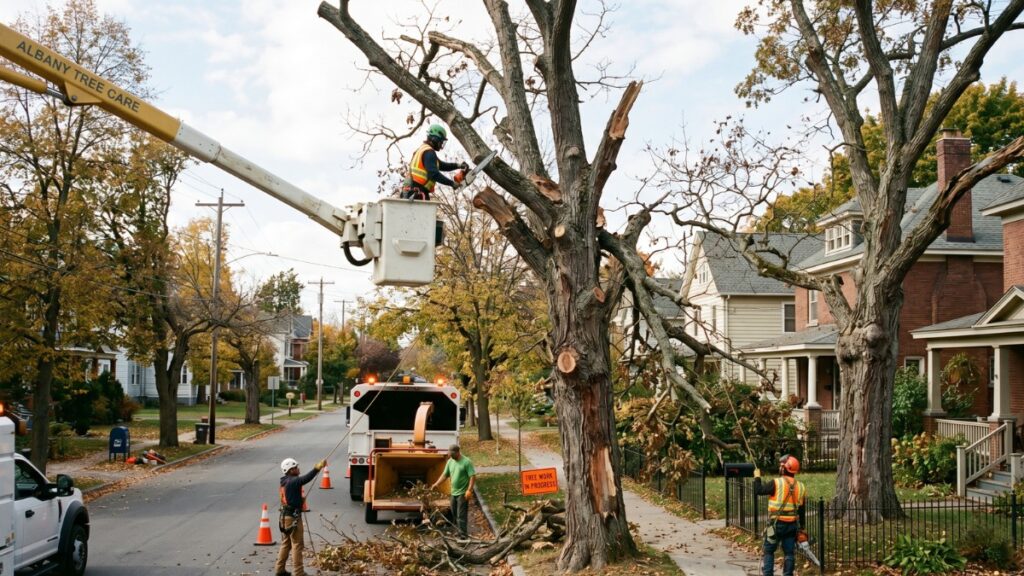
Why So Many Albany Trees Are Suddenly Failing
What’s happening across New Scotland Avenue is not random.
It’s the result of a long-developing urban forestry problem that many Northeastern cities are now facing.
During the 1940s through 1970s, fast-growing shade trees like silver maple and Norway maple became extremely popular throughout Albany neighborhoods. Developers and municipalities planted them heavily because they grew quickly, created large canopies fast, and gave new neighborhoods an established appearance.
The problem is that thousands of these trees were planted within the same general time period.
Today, many are aging out together.
Urban forestry professionals often refer to this as an “even-aged canopy issue,” where large groups of trees decline simultaneously because they share similar species, age, environmental stress, and growing conditions.
Throughout Albany, tree crews and ISA-certified arborists are increasingly seeing:
hollow trunks
severe canopy dieback
internal decay
root instability
splitting trunks
fungus growth near the base
dead upper limbs
sudden branch failures during storms
Silver maples are especially vulnerable because they grow rapidly but develop weaker wood than many slower-growing native hardwood species. As they mature, large limbs become increasingly prone to cracking under stress from wind, ice, or heavy snow.
Norway maples create different long-term problems. Their shallow root systems often struggle in compacted urban soil while mature trees become more brittle over time.
What makes the situation particularly dangerous is that many declining trees still appear alive and full from a distance even while serious internal decay is already progressing.
Why New Scotland Avenue Became a Hotspot
The New Scotland Avenue corridor contains many residential blocks where trees were planted uniformly decades ago.
That means entire streets may now contain trees of nearly identical age and species.
When one begins declining, neighboring trees often show similar structural problems within only a few years.
Several Albany-specific conditions have accelerated the issue dramatical.
1. Albany’s Harsh Freeze Thaw Cycles
Capital Region winters are especially hard on aging trees.
Water enters small cracks in trunks and limbs during warmer daytime temperatures. Overnight freezing causes that moisture to expand internally, slowly worsening structural weakness year after year.
Older maples already suffering from decay become highly vulnerable during these repeated freeze-thaw cycles.
This is one reason some trees suddenly split or collapse after winter even if they appeared stable the previous fall.
2. Road Salt Damage
Trees near roads, sidewalks, and driveways absorb salt runoff every winter.
Over time, road salt damages root systems and interferes with nutrient uptake.
Common symptoms include:
thinning leaves
premature fall color
dead branch tips
weak spring growth
bark splitting
canopy thinning
Combined with decades of urban stress, mature trees become far less resilient during severe weather.
3. Storm Damage That Builds Over Time
Many Albany residents remember storms that caused widespread limb failures and National Grid outages across the region.
But one major misconception is that surviving a storm means the tree is fine.
In reality, structural damage often remains hidden for years.
A tree weakened during one storm may not fully fail until much later. Arborists frequently discover internal cracking and decay inside trees homeowners believed were still healthy.
During recent storm seasons across Upstate New York, many emergency tree removals involved mature maples that had shown warning signs long before complete failure occurred.
4. Soil Compaction Around Older Properties
Urban trees rarely receive ideal growing conditions long term.
Driveways, sidewalks, parked vehicles, construction activity, and heavy foot traffic slowly compact soil around roots over decades.
Compacted soil reduces oxygen movement underground and weakens root health.
This creates chronic stress that slowly reduces structural stability over time, which is why many homeowners eventually require professional tree removal in Albany NY after years of unnoticed decline.
The Warning Signs Many Homeowners Miss
One of the biggest mistakes homeowners make is assuming:
“If the tree still has leaves, it must be healthy.”
Unfortunately, that is not always true.
Many structurally compromised trees continue producing leaves even while severe internal decay develops.
Here are the warning signs Albany homeowners should never ignore.
Large Dead Sections High in the Canopy
If major limbs stop producing leaves during spring or summer, internal decline may already be progressing significantly.
Dead upper canopy growth is one of the clearest indicators of stress.
Vertical Cracks Along the Trunk
Deep splits in the trunk often signal severe structural weakness.
These cracks commonly worsen during freeze-thaw cycles.
Hollow Cavities
Large openings or hollow sections inside the trunk usually indicate decay.
Although some hollow trees survive temporarily, stability becomes unpredictable.
Mushrooms or Fungus Near the Base
Fungal growth near the trunk flare or roots may indicate internal rot.
This is especially common in older silver maples throughout Albany neighborhoods.
Sudden Leaning
A tree that suddenly leans after storms or heavy rain may have root failure beginning underground.
This should always be professionally inspected immediately.
Frequent Limb Drops
If branches regularly fall during mild wind or normal weather conditions, structural integrity may already be compromised.
Many Albany emergency tree service calls begin with repeated limb-drop complaints.
How Old Is Your Tree? It May Be Older Than You Think
Many homeowners underestimate the age of trees on their property.
A maple planted by previous homeowners during Albany’s suburban expansion decades could already be approaching advanced decline stages, increasing the likelihood of needing emergency tree service in Albany NY during future storms or heavy winter weather.
A rough age estimate can be calculated using trunk diameter.
Measure the tree circumference approximately 4.5 feet above ground level and divide by 3.14 to estimate diameter.
For silver maples:
20-inch diameter → often 50–60 years old
30-inch diameter → frequently 80+ years old
However, urban conditions often shorten lifespan significantly.
Trees exposed to:
road salt
poor pruning
storm stress
root restriction
compacted soil
repeated construction damage
…may decline earlier than expected.
Who Is Responsible for Dangerous Trees in Albany?
This is one of the most misunderstood issues homeowners face.
Trees Near Streets and Sidewalks
Some trees located between sidewalks and roads may involve city oversight or permit requirements.
However, responsibility can vary depending on exact location and property boundaries.
Homeowners should never assume the city will automatically remove a hazardous tree.
Trees on Private Property
If the tree originates on private property, the homeowner is typically responsible for:
inspections
maintenance
pruning
removal
damage liability
If a neglected tree damages a neighboring home, fence, vehicle, or utility line, liability issues can become expensive very quickly.
Why Waiting Often Costs More
Many homeowners delay inspections because the tree still “looks okay.”
Unfortunately, emergency tree removal is usually far more expensive than planned preventive work.
Emergency situations may require:
crane removals
blocked-road coordination
power line safety procedures
nighttime storm response crews
hazardous climbing conditions
Meanwhile, storm damage can include:
roof destruction
broken siding
crushed vehicles
damaged fences
electrical hazards
insurance complications
A professional arborist inspection costs far less than major structural repairs after a tree failure.
What Albany Homeowners Should Do Right Now
If your neighborhood contains mature maples, proactive inspection is critical.
Step 1: Walk Your Property Carefully
Look for:
dead limbs
hanging branches
trunk cracks
hollow cavities
fungus growth
sudden leaning
canopy thinning
Photograph changes yearly to monitor decline progression.
Step 2: Schedule an ISA Certified Arborist Inspection
Professional arborists can identify structural problems long before visible collapse occurs.
This becomes especially important after:
wind storms
ice storms
wet snow accumulation
summer thunderstorm activity
Step 3: Avoid Improper Pruning
“Topping” mature maples often accelerates decline and creates weak regrowth that becomes even more hazardous later.
Improper pruning can shorten tree lifespan dramatically.
Step 4: Plan Tree Replacement Before Failure Happens
Waiting until a tree collapses creates unnecessary risk and significantly higher costs.
Planned removal allows homeowners to safely transition their property before emergency conditions develop.
Best Replacement Trees for Albany Properties
Urban forestry experts increasingly recommend greater species diversity throughout Albany neighborhoods.
Overreliance on a few fast-growing species is exactly what contributed to today’s widespread aging-tree problem.
Several replacement trees perform much better in modern urban conditions.
Red Maple
Excellent fall color with stronger adaptability than silver maple.
Swamp White Oak
Long lifespan, strong storm resistance, and excellent shade potential.
Kentucky Coffeetree
Highly tolerant of difficult urban environments and compacted soils.
Hackberry
Surprisingly resilient against city stress and harsh weather conditions.
Disease Resistant Elm Varieties
Modern elm cultivars provide classic canopy beauty with far better disease resistance than older generations.
Native and climate-adapted species generally provide the best long term stability for Capital Region properties, especially for homeowners exploring long-term tree replacement services after removing aging or hazardous maples.
Albany’s Tree Problem Is Bigger Than One Street
What is happening near New Scotland Avenue reflects a much larger challenge affecting older cities throughout the Northeast.
Entire generations of urban trees are aging simultaneously.
Communities that once depended heavily on fast-growing species are now facing:
mass removals
declining canopy coverage
rising maintenance costs
increasing storm hazards
expensive long-term replanting efforts
For homeowners, the lesson is clear:
A mature tree adds enormous beauty, shade, and property value but only when it remains structurally safe and properly maintained.
Ignoring warning signs can turn a beautiful shade tree into a major financial and safety risk surprisingly quickly.
Final Thoughts
Albany’s mature tree canopy remains one of the city’s greatest assets, especially throughout neighborhoods surrounding New Scotland Avenue.
But many silver maples and Norway maples planted generations ago are now entering serious decline at the same time.
Homeowners who act early can:
reduce storm damage risk
avoid emergency removals
protect nearby structures
prevent costly property damage
safely transition to healthier replacement trees
If your property contains mature maples, now is the time for a professional tree inspection not after the next severe storm warning moves through Albany.
Because once a large aging tree begins visibly failing, the internal damage is often already far worse than most homeowners realize.